Budget 2026’s Broadcaster Payroll Credit Needs a Firewall Ledger
If Ottawa is going to subsidize more newsroom payroll, Canadians deserve recipient-level receipts and editorial-independence safeguards.
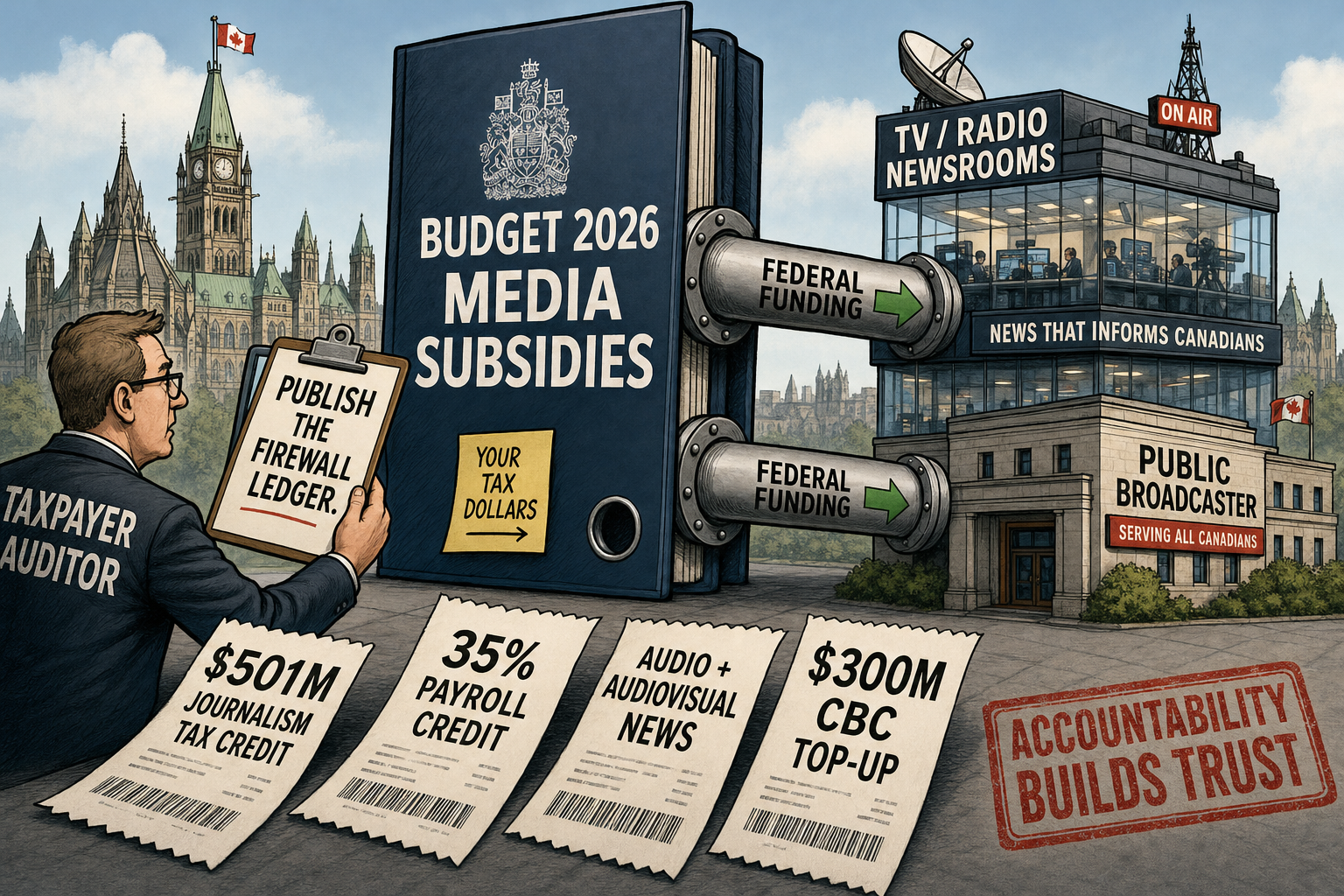
Budget 2026 turns media support into a sharper accountability test. The government is not merely renewing an existing journalism subsidy. It is proposing to extend the Canadian Journalism Labour Tax Credit to audio and audiovisual news production, while also adding a separate $300 million over two years for CBC/Radio-Canada starting in 2026-27.
The tax-measures annex says the journalism credit currently provides qualifying organizations a refundable 35% credit on eligible newsroom wages, with labour expenses capped at $85,000 per eligible employee. That equals up to $29,750 per employee. Budget 2026 proposes to let qualifying audio and audiovisual news organizations claim the same 35% rate and the same $85,000 annual labour-expenditure limit.
The budget table puts the Canadian Journalism Labour Tax Credit measure at $501 million from 2026-27 through 2030-31. Canadian Press coverage carried by Global News and CityNews reported the same $501 million extension and noted the move expands a credit that previously applied only to original written news into audio and audiovisual news.
Supporters will say this protects local news. Fine. Local reporting matters. But a conservative accountability standard starts with a simple rule: if taxpayers are underwriting newsroom payroll, taxpayers get to see the receipts. That does not mean harassing reporters or dictating stories. It means public disclosure of which organizations receive support, how much they receive, which employee counts are being claimed, what ownership structures benefit, and what firewall protects editorial decisions from subsidy dependence.
This is especially important because the same budget also gives CBC/Radio-Canada an additional $300 million over two years. The public broadcaster already occupies a unique position: it is a news organization, a cultural institution, a federal Crown corporation, and a recurring line item in federal spending. When Ottawa boosts CBC funding and broadens payroll relief to private-sector broadcasters in the same budget, the independence question becomes unavoidable.
The answer is not to pretend every subsidized journalist is compromised. The answer is to remove the excuse for suspicion by publishing a broadcaster-subsidy firewall ledger before the cheques normalize. Canadians should know the recipient, credit amount, number of eligible newsroom employees, audio or audiovisual category, ownership group, lobbying contacts, government-advertising exposure, and the written editorial-independence policy attached to each claim.
A free press should not need secrecy around public money. If the Liberal government believes this program strengthens journalism, it should prove the subsidy is transparent, neutral, audited and firewalled from political influence. Anything less turns a media-support program into another Ottawa trust-me file.
- Budget 2026: Chapter 4: A strong and united Canada
- Budget 2026 tax measures: Canadian Journalism Labour Tax Credit details and fiscal table
- Global News / The Canadian Press: Ottawa boosts journalist tax credit by $501M
- CityNews / The Canadian Press: Tax credit extension and broadcaster eligibility
This article criticizes federal subsidy design and transparency. It does not accuse individual reporters of wrongdoing.