October Jobs Report Turns Ottawa’s Capacity Claims Into a Youth-Unemployment Ledger
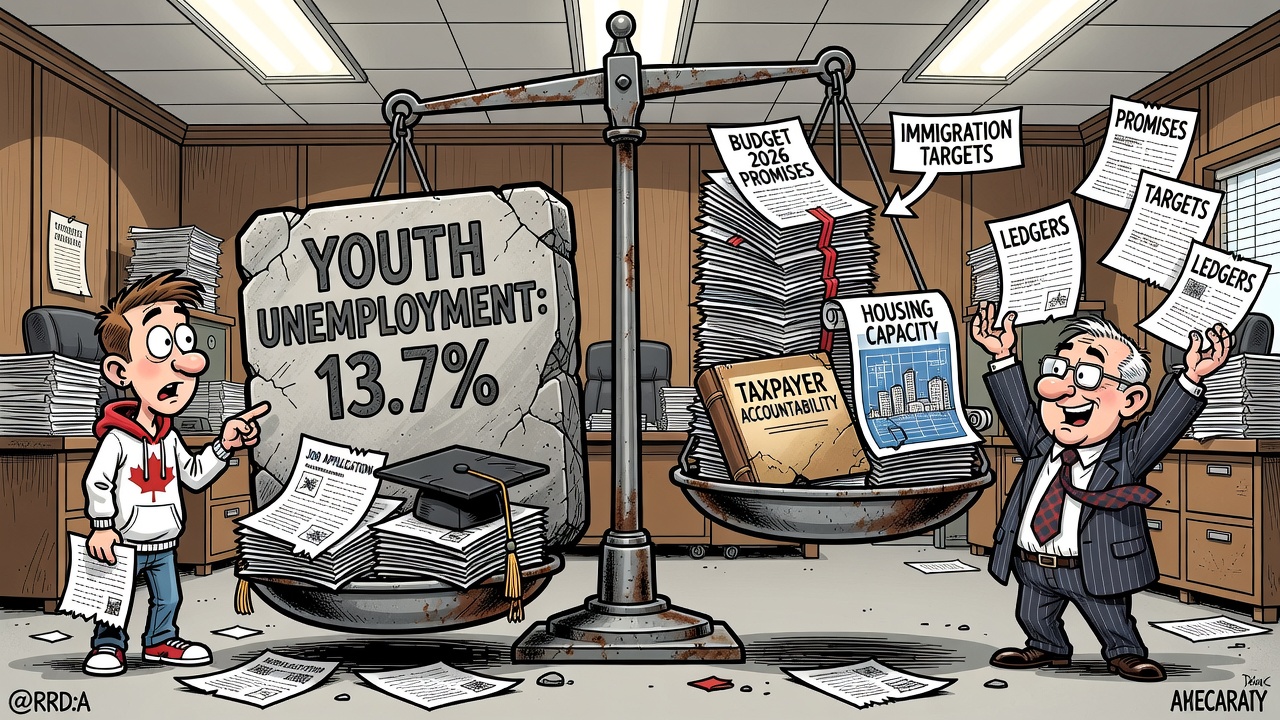
When youth unemployment is 13.7%, Ottawa should not get to sell budget optimism and labour-market plans without the receipts.
Statistics Canada’s October Labour Force Survey is a reality check for Ottawa’s economic messaging. Employment was little changed in October, down 4,700 jobs, while the national unemployment rate rose 0.2 percentage points to 6.7%. That was not a boom. It was another warning light.
The youth number is the one Parliament should put on the front page of every budget and immigration debate. Unemployment among Canadians aged 15 to 24 rose 0.7 percentage points to 13.7% in October, as employment edged down and more young people searched for work. Students faced a 13.5% unemployment rate, while youth not attending school were at 12.3%.
This is where conservative accountability matters. A weak youth labour market does not prove that every federal policy is wrong. It does prove that Ottawa owes Canadians a reconciled ledger before it keeps presenting spending, immigration and “growth” claims as if capacity is unlimited.
The details cut through the slogans. Statistics Canada said 33,000 more people were searching for work in October and that the unemployment-rate increase was the second consecutive monthly rise. Nearly one-quarter of the 1.5 million unemployed Canadians were in long-term unemployment, meaning they had been continuously searching for work for 27 weeks or more. Global News noted economists had expected a gain of 13,600 jobs; instead, the economy shed 4,700.
Ottawa cannot answer that with a press-release adjective. If Budget 2026 claims an investment plan will create opportunity, show the job creation table by sector, province and timeline. If immigration targets are supposed to match labour-market need, show the occupational shortages, wage data, youth displacement risk, training seats, housing capacity and regional service pressure. If public spending is supposed to strengthen productivity, show the project-level results instead of asking taxpayers to trust another round of announcements.
The Hub’s Question Period recap said the new jobs report gave the opposition fresh material the day after the budget debate. Good. Parliament should use it. The right question is not anti-worker, anti-student or anti-immigrant. It is pro-receipts: how many jobs, where, at what wages, for whom, and compared with what intake, housing and training assumptions?
Young Canadians are doing what governments tell them to do: study, work, apply, retrain, move and keep trying. They deserve better than being treated as a footnote in a macroeconomic sales pitch. Before Ottawa asks them to believe another plan, it should publish the labour-market capacity ledger behind it.
- Statistics Canada: Labour Force Survey, October 2026
- Global News: Unemployment ticked up to 6.7% in October, says StatCan
- The Hub: Lines that landed: Question Period for November 6
- CPAC: CPAC schedule
This article argues for labour-market and capacity disclosure. It does not argue that immigration is inherently negative; it argues that federal targets and spending promises must be reconciled with jobs, wages, housing and training capacity.