Military Internet Intelligence Needs a Privacy Ledger
A national-security watchdog says DND and the Canadian Armed Forces can collect public internet information for intelligence purposes — but the privacy guardrails are not good enough.
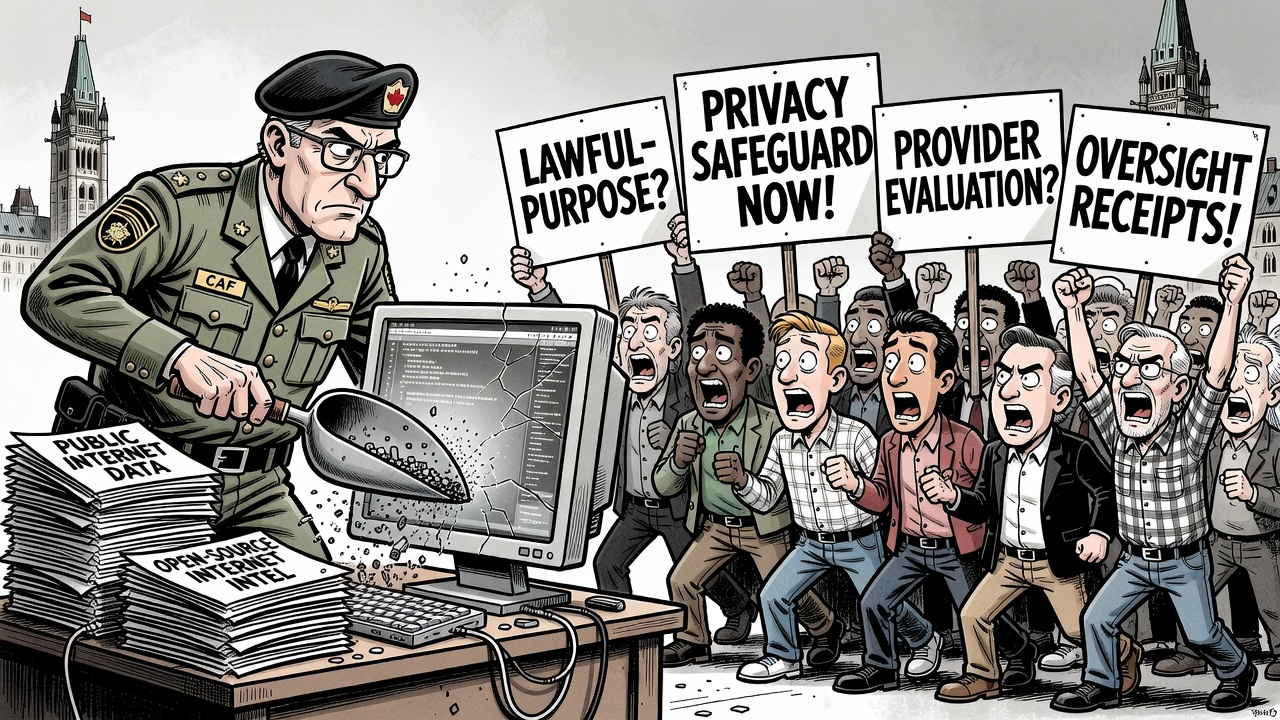
Publicly available does not mean consequence-free. When ordinary Canadians post, search, organize, work, donate or argue online, they should not have to wonder whether scattered public fragments are being quietly assembled by the state without a clear paper trail.
That is the conservative accountability test raised by the National Security and Intelligence Review Agency’s October 29 review of Department of National Defence and Canadian Armed Forces open-source intelligence activities on the internet. NSIRA did not say the military lacks authority. It found DND/CAF has legal authority to conduct these activities for intelligence purposes. The problem is what came next: gaps in documentation, risk management, privacy protections and oversight, particularly when collection involves Canadians.
Those gaps are not technical trivia. NSIRA’s own backgrounder says collection activities are not consistently linked to approved defence operations or activities. It says risk assessments are not regularly updated and do not address all relevant risks. It says 15 third-party providers specializing in collecting information about individuals had not been evaluated. It also says policies and recordkeeping do not adequately address all privacy risks or demonstrate that collection involving Canadians is necessary.
Global News, citing the watchdog report, put the issue plainly: the military’s policy on collecting information about Canadians does not sufficiently address privacy risks posed by online searches. That matters because open-source intelligence can look harmless until it is scaled, automated, purchased from data vendors, combined with other holdings, retained, shared, and searched again later for a different purpose.
Canadians can support a capable military and still demand limits. National defence does require intelligence. It does not require a blank cheque for untracked people-data tools, stale risk assessments, or after-the-fact explanations. If a collection activity is truly tied to an approved defence operation, record the link. If Canadian information is necessary, document the necessity test. If a contractor or data provider is selling person-level collection, evaluate it before using it, not years later after a watchdog asks.
The Carney government should not hide behind the phrase “publicly available.” The accountability standard should be simple: lawful purpose, documented necessity, evaluated tools, strict retention rules, independent oversight and a public summary Parliament can understand without exposing operations.
So publish the military OSINT privacy ledger: the governing authorities, approved-operation links, Canadian-person necessity records, provider evaluations, risk assessments, retention and deletion rules, audit results, ministerial briefings, and the timeline for implementing NSIRA’s five recommendations. The public internet is not a privacy-free zone, and national security is strongest when Canadians can see that power is disciplined by receipts.
- NSIRA: DND/CAF open-source intelligence activities backgrounder
- NSIRA: Review page / report notice
- Global News / Canadian Press: Spy watchdog flags privacy risk from military’s online intelligence activities
This article relies on the cited watchdog material and news report. It does not argue against lawful defence intelligence; it argues that Canadian-person collection needs documented necessity, evaluated tools and auditable safeguards.