The 2027–2029 Immigration Plan Confirms the Capacity Ledger Problem
The numbers are no longer hypothetical. Ottawa owes Canadians the homes, jobs, services, exits, asylum and backlog math behind them.
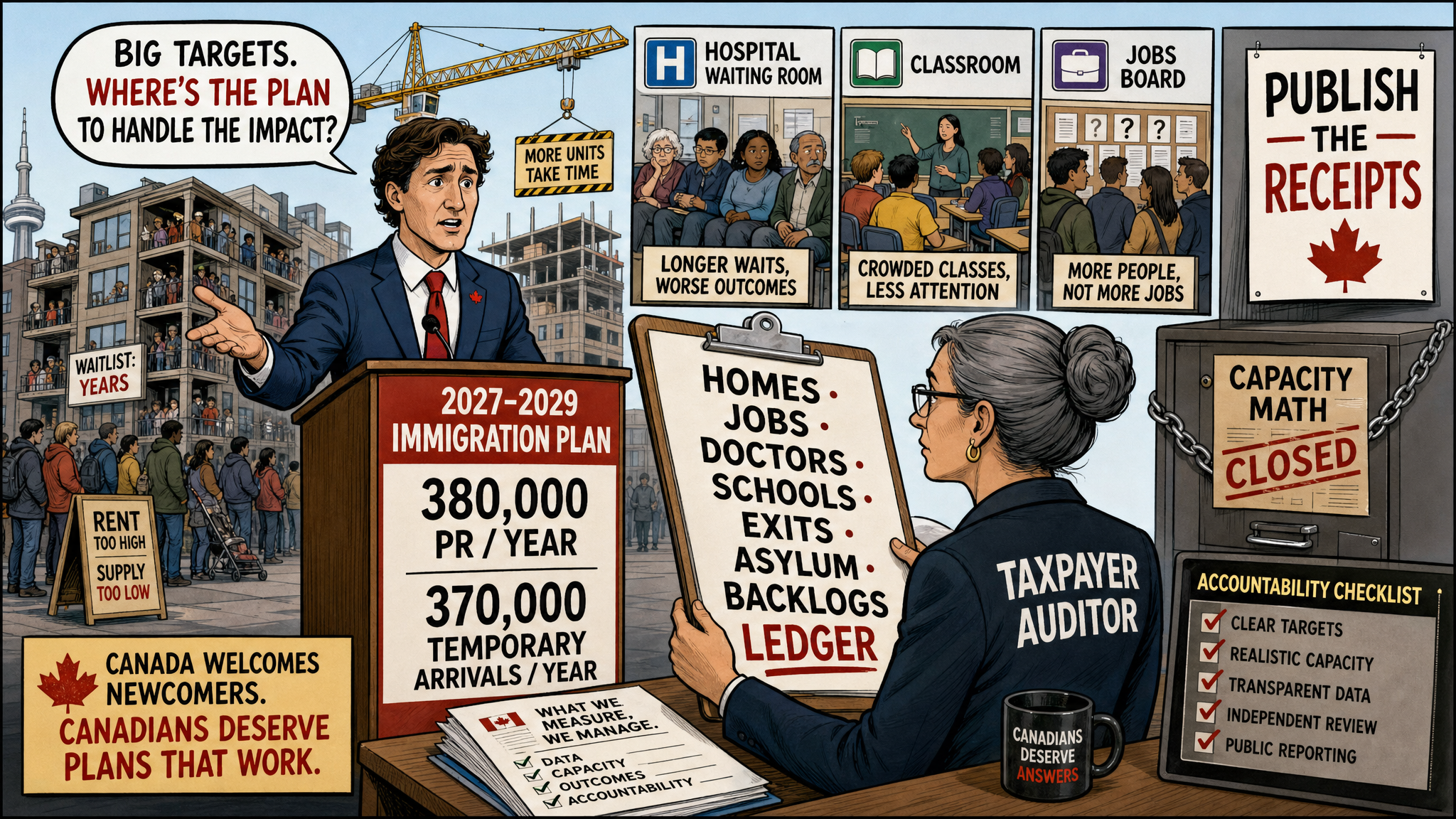
Ottawa has now published the immigration numbers. That makes the accountability question simpler: where is the all-in capacity ledger?
IRCC’s 2027 headline targets are 220,000 new temporary workers, 150,000 new international-student arrivals and 380,000 new permanent residents. Its supplementary 2027–2029 table keeps overall planned permanent-resident admissions at 380,000 in each of 2027, 2028 and 2029, with a range of 352,500 to 422,000 each year.
The temporary side is just as important. IRCC says temporary-resident targets stabilize at 370,000 new arrivals for all three years, split between 220,000 workers and 150,000 students annually. IRCC’s Annual Report also explains that temporary-resident arrival targets are a subset of work and study permits and do not include asylum claimants or in-Canada permit extensions. Its levels page says the plan is meant to work toward reducing the temporary population and keeping non-permanent residents below five per cent of the population.
Budget 2026 reporting adds another layer. The plan sets 370,000 new temporary arrivals and 380,000 permanent-resident admissions in each of 2027, 2028 and 2029, backed by $56.9 million over four years for IRCC implementation. The same budget also says up to 200,000 temporary residents already in Canada would have the opportunity to become permanent residents by the end of 2027, including 100,000 workers through Express Entry or the Provincial Nominee Program, with $302.3 million over four years to support implementation.
That may be defensible policy. It is not defensible as a spreadsheet-free promise. A country can need skilled immigration and still demand proof that the intake plan matches homes, jobs, schools, doctors, credential recognition, shelter capacity, asylum processing, exits and enforcement. That is the conservative accountability test: not slogans about “control,” but a reconciled ledger that lets Canadians see the pressure points before they become local crises.
The government’s own documents admit the capacity question. Budget 2026 says the plan seeks balance between employers, industries and communities and the ability to meet newcomer needs while avoiding undue pressure on housing, health care and social services. Good. Publish the math behind that sentence.
Parliament should require one public immigration capacity ledger. It should show, by year and by province, the 380,000 permanent-resident target, the 370,000 temporary-arrival target, the up-to-200,000 temporary-to-permanent transition stream, expected exits, asylum volumes, current backlogs, housing completions, rental vacancy, health-care attachment, classroom capacity, youth unemployment, credential bottlenecks, enforcement assumptions and provincial service funding.
Separate new arrivals from people already here. Separate admissions from applications. Separate national averages from Toronto, Brampton, Surrey, Calgary, Montreal, Halifax and rural communities. Separate labour-market claims from actual vacancy, wage and placement data.
If the plan is sustainable, the ledger will prove it. If Ottawa will not publish the ledger, Canadians should assume the numbers are being managed politically instead of operationally.
- IRCC: Canada’s immigration levels
- IRCC: Supplementary Information for the 2027–2029 Immigration Levels Plan
- IRCC: 2026 Annual Report to Parliament on Immigration
- Budget 2026: Chapter 3 — A more affordable life
- Global News: Canada’s new immigration level plan revealed in Budget 2026
This article argues for capacity disclosure and operational accountability. It does not argue that immigration is inherently negative; it argues that intake targets must be reconciled with housing, labour-market, health-care, school, asylum, exit and enforcement capacity.