Liberal Fundraising Surge Needs a Budget-Access Ledger
The issue is not whether a legal donation was made. The issue is whether Canadians can see who got access before Ottawa made billion-dollar spending, subsidy and procurement decisions.
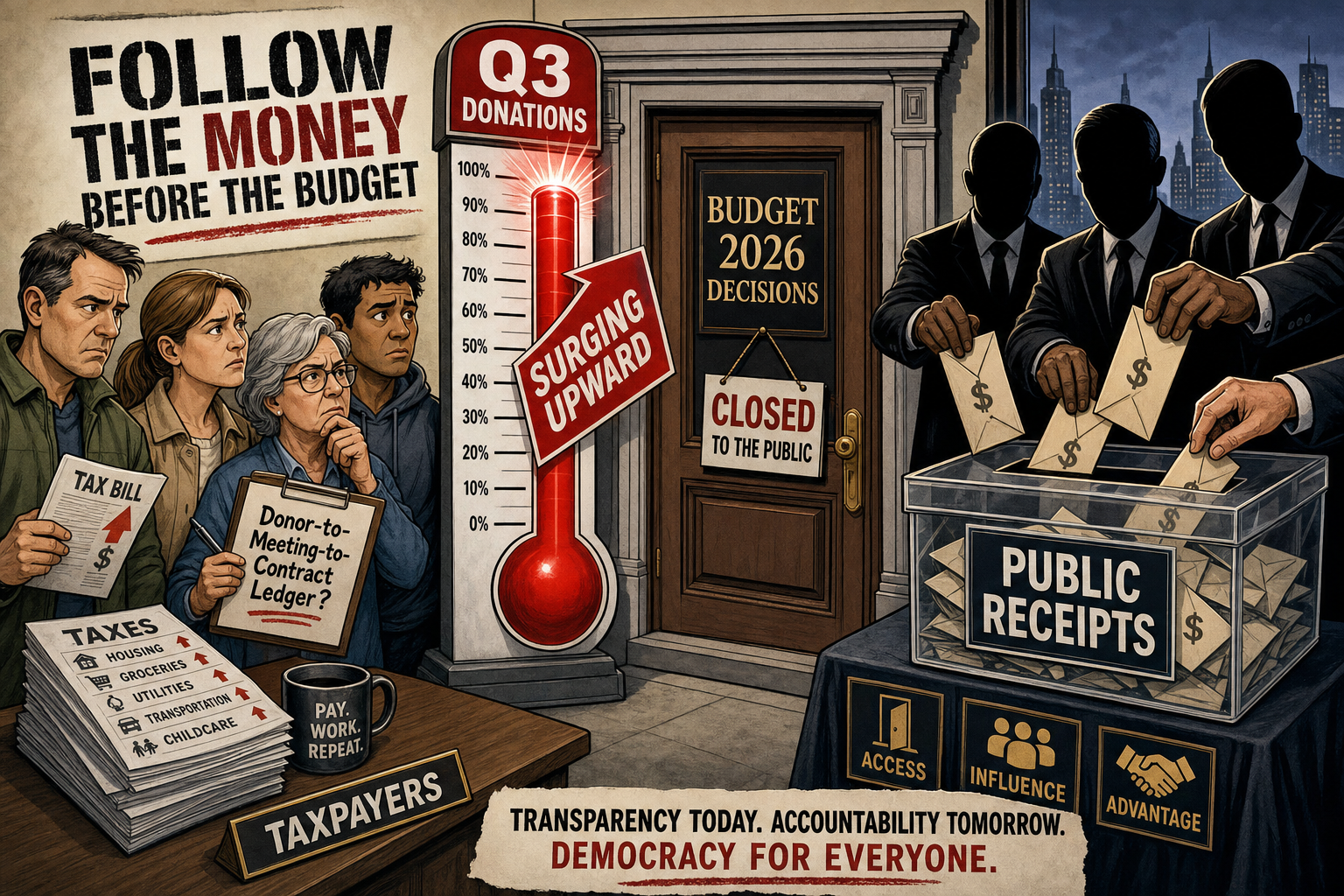
Elections Canada has put the third-quarter party returns online, and the timing should make taxpayers pay attention. The returns cover July 1 to September 30, 2026, the final stretch before Budget 2026 decisions moved from talking points into cabinet, department and ministerial choices.
CityNews, citing Elections Canada records, reported that the federal Liberals raised $4.9 million in the third quarter while the Conservatives raised $3.9 million. The same report noted the Conservatives had led in the second quarter, raising $5 million to the Liberals’ $4.3 million. That is a real reversal, not a rounding error.
The Writ’s review put sharper numbers on the shift: Mark Carney’s Liberals raised $4,948,000 from nearly 36,000 contributions, compared with $3,971,000 from about 29,000 Conservative contributions. It also reported that this was the Liberals’ first quarterly fundraising win since the fourth quarter of 2021, that the roughly $976,000 gap was the largest Liberal-over-Conservative quarterly gap since 2016, and that the Liberals have topped the Conservatives in only seven of the last 87 quarters under the current fundraising regime.
No one needs to allege an illegal donation to demand tougher transparency. In a year when Ottawa is making budget choices on subsidies, Crown financing, procurement, tax measures, housing programs and industrial policy, a sudden fundraising win by the governing party creates a straightforward accountability test: show the access ledger.
The public return tells Canadians totals. It does not, by itself, tell them which donors or bundled networks attended private events, which ministers or senior staff they met, what files those donors were interested in, and whether any grants, contracts, regulatory changes or subsidy decisions followed. That gap matters because political money is most sensitive when it sits beside government discretion.
There is already context. In February, CityNews reported that Carney attended a Liberal fundraiser at a private Vancouver residence where tickets cost $1,775, and that the event was not open to media. The report also noted criticism from ethics experts and the Liberal Party’s position that events comply with Elections Canada rules. Compliance is the floor. Public confidence requires more than the floor.
A conservative accountability standard is simple: before Budget 2026 is sold as a national mission, publish the donor-to-meeting-to-contract ledger. For every high-dollar event involving the prime minister, cabinet ministers, parliamentary secretaries, chiefs of staff or Crown-corporation power brokers, disclose the guest list, lobbyist screens, ministerial files touched, meeting follow-ups, contracts, grants, subsidies and regulatory decisions within a reasonable window.
If there is nothing to hide, the ledger should be easy. If Ottawa wants taxpayers to fund another round of big-government industrial policy, taxpayers deserve to know who was in the room before the cheques were written.
- Elections Canada: Financial Returns of Registered Political Parties for the Third Quarter of 2026 Now Online
- CityNews / Canadian Press: Liberals out-fundraise Conservatives by almost $1M in third quarter of 2026
- The Writ: Liberals beat Poilievre in fundraising for first time
- CityNews / Canadian Press: Carney’s closed-door fundraisers a ‘step back’ for ethics in politics: expert
This article does not allege illegal fundraising. It argues for a public access-and-decision ledger because political donations, private events and federal spending decisions intersect in a high-discretion budget year.