Budget 2026 Turns Fiscal Room Into a $142.1B Receipt Ledger
Carney’s budget should be judged by the receipts, not the branding: new measures, real offsets, borrowing, debt interest and who gets paid.
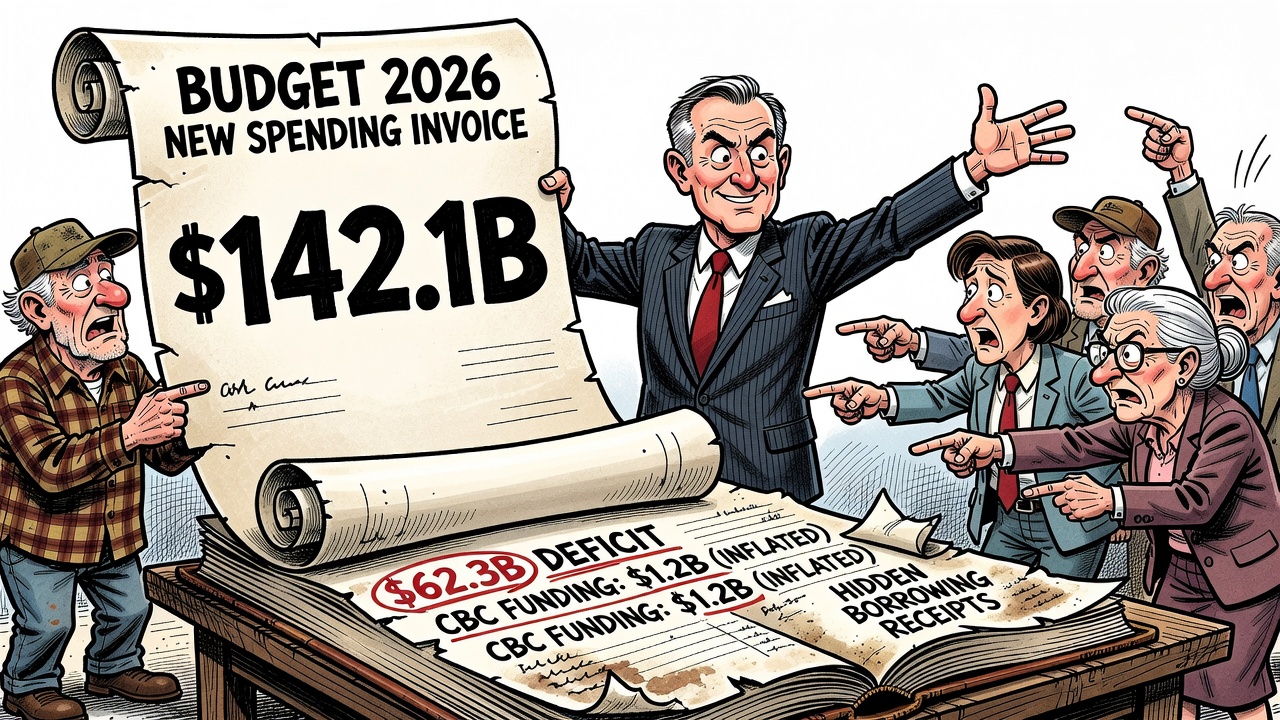
Budget 2026 is no longer a preview. The numbers are now on the table, and the accountability test is simple: if Prime Minister Mark Carney wants applause for fiscal discipline, Canadians deserve a receipt ledger for every dollar of new spending and every dollar of debt used to finance it.
The Associated Press reports that the budget, branded Masters of Our Destiny, proposes $142.1 billion in multiyear spending and tax breaks. The same report puts federal spending at $603 billion for 2026-27 and the projected deficit at $62.3 billion. Those are not small technical adjustments. They are Budget Day evidence that “fiscal room” was quickly converted into a larger federal bill.
Canadian Press “by the numbers” reporting repeats the $142.1 billion new-measures figure and the $62.3 billion deficit, while also flagging $300 million in increased funding for CBC/Radio-Canada. That deserves special scrutiny. A government already defended by a heavily subsidized legacy-media ecosystem should not bury public-broadcaster increases inside a giant budget package without a separate performance ledger.
The factbox breakdown is just as important as the headline total: $51.9 billion for capital and innovation, $15.1 billion for infrastructure, $30.6 billion for affordability, and $34.6 billion for parks, natural resources and Indigenous reconciliation. Some of those items may sound attractive in isolation. Conservative accountability asks a harder question: what is the measurable return, what was cut to fund it, and what happens if the promised growth never arrives?
The Parliamentary Budget Officer warned before Budget Day that new measures since June already cost $52.6 billion over five years, more than offsetting improved fiscal room. The PBO’s October outlook projected $333.3 billion in cumulative deficits and $732.9 billion in federal borrowing over five years, and warned that an operating-budget anchor should not be confused with a balanced fiscal position.
That is the heart of the issue. Ottawa can rebrand spending as investment, separate operating from capital, and talk about nation-building. But taxpayers still pay interest on borrowed cash, departments still spend real money, and political promises still need measurable results.
Parliament should demand one plain-language Budget 2026 receipt ledger: each new measure, each offset, total borrowing, debt-service costs, Crown-corporation financing, CBC/Radio-Canada funding, project-level capital returns, and a minister responsible for delivery. If the plan is strong, the receipts will prove it. If the receipts are missing, Canadians should assume the slogan is doing work the numbers cannot.
- Associated Press: Canada’s Budget 2026 proposes new spending and tax breaks
- iNFOnews / Canadian Press: Budget 2026 by the numbers: key figures in the Liberals’ spending plan
- Yahoo Finance / Reuters factbox: Key proposed measures in Canadian federal budget
- Government of Canada: Budget 2026 report, Chapter 5
- Parliamentary Budget Officer: Economic and Fiscal Outlook — October 2026 news release
This article relies on mainstream wire reporting, the federal budget document and the Parliamentary Budget Officer’s pre-budget fiscal outlook. It argues for disclosure and reconciliation; it does not claim every listed measure is inherently wasteful.