Carney’s Spending Reset Needs a Program-Review Ledger
Before Ottawa asks Canadians to trust another budget reset, it should show the program-by-program receipts.
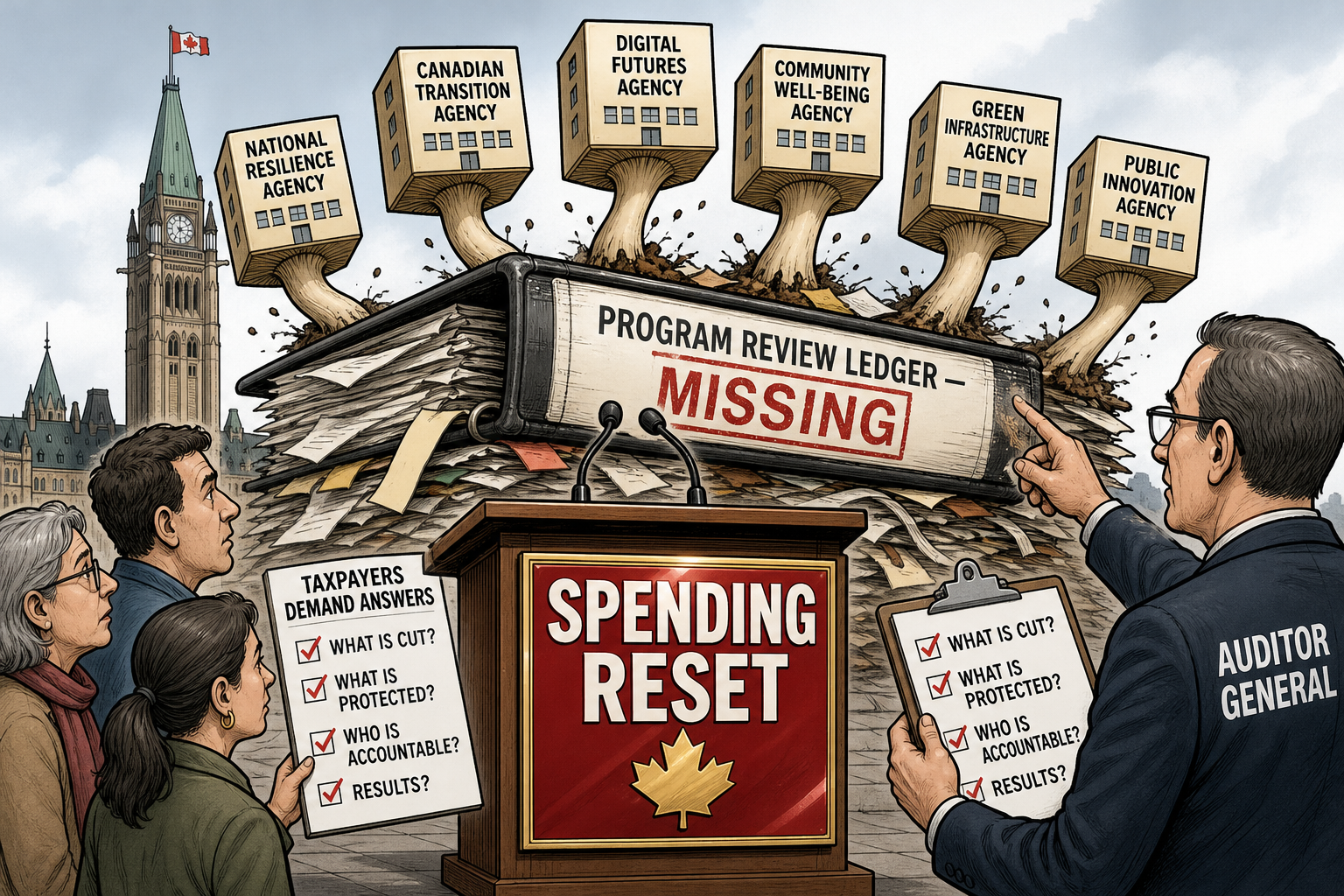
Budget 2026 arrives Thursday with the Carney government promising discipline, investment and a reset. The missing document is the one taxpayers actually need: a program-review ledger that says what Ottawa has examined, what will be cut, what will be protected, what will be merged, and who will be held responsible when the promised savings do not appear.
This is not an abstract management complaint. A Johnson Shoyama Graduate School of Public Policy brief by Kevin Lynch and Jim Mitchell argues that Ottawa’s problem is rooted in how government works: centralization, weak execution, poor service delivery and a public service culture tilted toward process over results. Their warning on the Carney reset is blunt. They say there have been across-the-board reductions in public-service numbers, but no program-review exercise to cut programs and guide those reductions. They also note that six special-purpose agencies have been created to speed implementation in priority areas instead of fixing the core machinery of government.
That should alarm fiscal conservatives and anyone who remembers what real program review is supposed to do. Across-the-board restraint is the easiest political spreadsheet in Ottawa: every department trims, nobody admits priorities, and the public finds out later which services broke. A real program review does the harder work. It asks whether a program still has a federal role, whether it is duplicative, whether it delivers measurable results, whether another level of government or the private sector is better placed to act, and whether the money should be stopped rather than renamed.
The fiscal backdrop makes the ledger urgent. The Parliamentary Budget Officer’s October outlook says measures announced since the spring update cost a net $52.6 billion over five years. It projects cumulative deficits of $333.3 billion and federal borrowing rising by $732.9 billion from 2026-27 through 2030-31. The PBO also warns that the operating-balance anchor should not be mistaken for a balanced fiscal position because debt-financed capital spending can still push borrowing higher.
Canadian Press pre-budget reporting says fiscal watchers are already looking for debt-sustainability signals, clearer operating-versus-capital definitions and proof that Ottawa is not using temporary revenue strength to justify permanent commitments. That is the correct test. A budget can call spending “investment,” but the label does not prove productivity, affordability or value for money.
The conservative accountability standard is simple: publish the program-review ledger with the budget. List every reviewed program, its mandate, annual cost, performance result, duplication risk, staffing impact, protected-service rationale and savings timeline. List every new special agency, its statutory authority, budget, sunset clause and minister accountable for outcomes.
If Carney wants credit for a serious spending reset, he should show the work. Without that ledger, Budget 2026 is not a reset. It is another trust-us budget layered on top of bigger deficits, faster borrowing and an Ottawa machine still marking its own homework.
- Johnson Shoyama Graduate School of Public Policy: How is Prime Minister Carney Doing in Reshaping Government?
- Parliamentary Budget Officer: Economic and Fiscal Outlook — October 2026
- iNFOnews.ca / Canadian Press: Here’s what fiscal hawks are watching for in Budget 2026
This article uses the policy brief for the public-service and program-review critique, the PBO for fiscal projections, and Canadian Press reporting for Budget 2026 context.