Ottawa’s Thermal Coal U-Turn Needs a Decision Memo
A public climate promise stayed on the books while the work behind it quietly stopped. That is not transparency. It is government by missing memo.
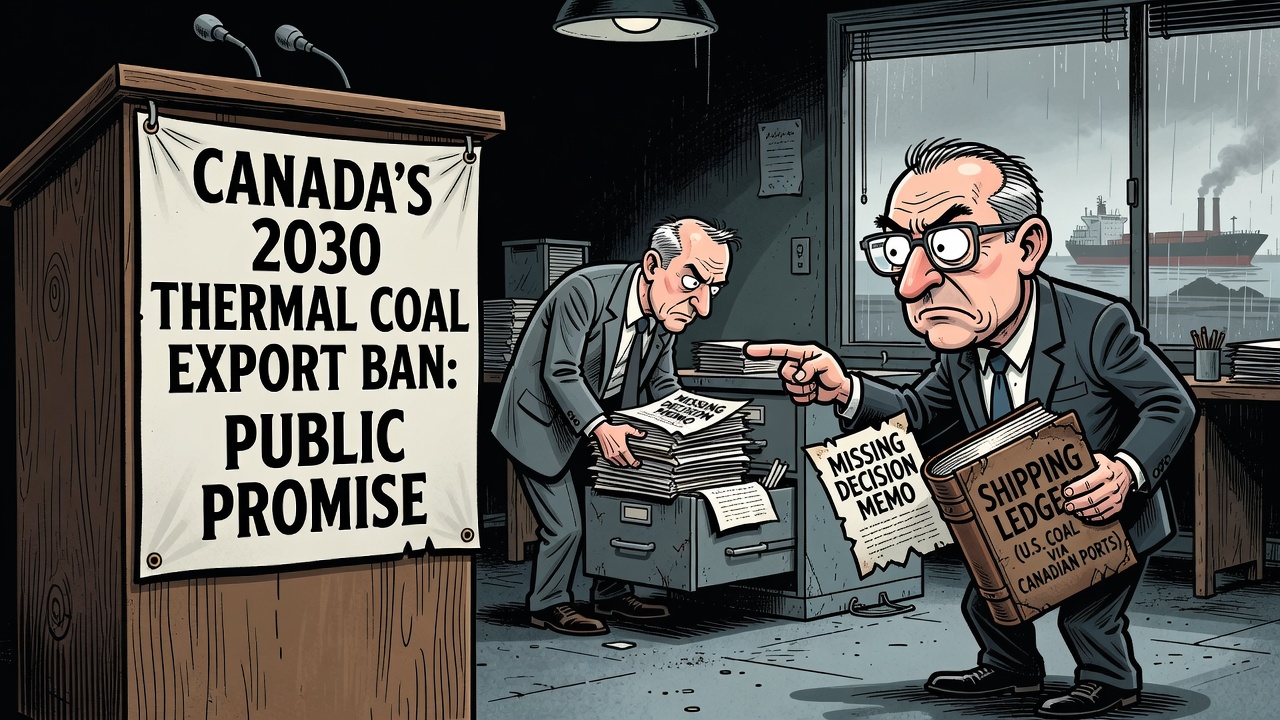
The Commissioner of the Environment and Sustainable Development has handed Parliament a simple accountability question: who told Ottawa to stop working on Canada’s 2030 thermal-coal export ban, and why were Canadians not told?
The October 2026 audit says Environment and Climate Change Canada and Global Affairs Canada did not take effective action toward Canada’s commitment to ban thermal coal exports from and through Canada by 2030. Even worse, the watchdog found that ECCC discontinued work on the ban in 2024 without documented official direction, while the public commitment remained in place.
That is the part conservatives should not let disappear into climate-policy fog. Governments can change policy. They can decide a promise is too costly, too hard, or no longer their priority. What they cannot defensibly do is keep advertising a promise to the public while the machinery behind it has been parked with no clear decision record.
The audit’s details make the gap harder to excuse. ECCC spent about three years exploring options, but did not complete planned impact assessments and did not engage affected or interested parties during the audit period. If Ottawa believed a ban would hit workers, ports, railways, provinces, allies or trading partners in a way that required a rethink, then publish the analysis. If industry or foreign pressure changed the file, publish the contact logs. If cabinet, a minister, or senior officials made the call, publish the direction.
Meanwhile, thermal coal kept moving. The Commissioner reported that 2025 thermal-coal exports shipped from Canada remained above 2021 levels, and that about 61 per cent of 2025 shipments originated in the United States. In plain English: Canada was still serving as a pathway for foreign thermal coal while Ottawa’s public 2030 language suggested a phase-out was coming.
The climate-finance side needs the same receipt test. Canada committed $1 billion to the Climate Investment Funds’ Accelerating Coal Transition program and $15 million to the Women-Led Coal Transition Mechanism. But by the end of the audit period, only about one per cent of program funding had been made available to coal-to-clean-energy projects.
This is not about letting the Liberals hide behind slogans about ambition, transition or leadership. It is about basic file control. A competent government knows what it promised, who changed course, what evidence justified the change, who was consulted, and when Parliament and the public were informed.
If Prime Minister Mark Carney wants to sell competent government, this is an easy test: publish the thermal-coal decision memo, the impact assessments, lobbying and diplomatic contacts, export volumes, U.S.-origin share, climate-finance project ledger, and the communications plan explaining why Canadians were not told when work stopped.
- Office of the Auditor General of Canada: Canada’s Thermal Coal Commitments
- Office of the Auditor General of Canada: News release on stopped work toward the export ban
- Canadian Press via Yahoo Finance: Ottawa quietly abandoned promise to end thermal coal exports
- Stand.earth: Reaction to the Auditor General report
This article relies primarily on the Commissioner’s audit and news release, with additional public-interest context from Canadian Press and Stand.earth.