The Omitted Telesat Contract Ledger Needs Receipts
One bid. Non-competitive. Sole sourced. Omitted from a previous disclosure. Ottawa needs to reconcile the Telesat receipts.
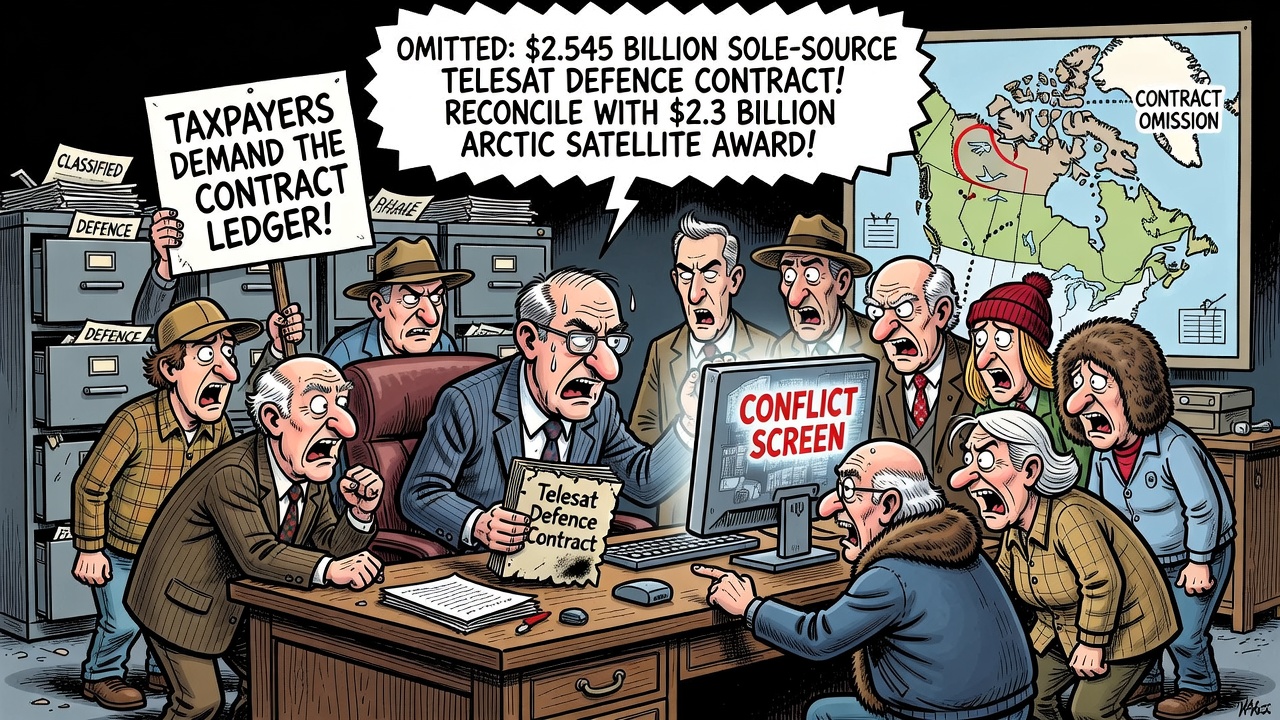
Ottawa does not have to prove every big defence contract is scandal-free by press release. It has to prove it by ledger.
The latest test is Telesat. A Government of Canada proactive-disclosure record for National Defence lists Telesat LEO ULC as the vendor on contract CW2462679, dated July 31, 2026. The value is not a rounding error: $2,545,744,111.61. The record describes the work as “Engineering consultants-Other,” says the solicitation procedure was non-competitive, lists one bid, and includes the comment: “This contract was omitted from a previous public disclosure. This contract was sole sourced.”
Four days later, on August 4, the Defence Investment Agency announced an initial contract of approximately $2.3 billion before tax to Telesat LEO ULC for the Enhanced Satellite Communications Project – Polar. Ottawa said the project would strengthen secure military communications for the Canadian Armed Forces in the Arctic and high-latitude regions, and that the contract also included option periods of roughly $214 million and $218 million before tax.
Arctic sovereignty is real. Secure satellite communications matter. Canadian defence procurement should move faster than the usual decade-long fog. None of that excuses a public record that appears to leave Canadians comparing a $2.545 billion disclosure entry with a $2.3 billion announcement and guessing whether they are the same instrument, a tax-inclusive version, a related contract, or something else.
The ethics context makes the receipt test more important, not less. SpaceQ reports Conservative MP Jamil Jivani has asked the Conflict of Interest and Ethics Commissioner to examine whether Prime Minister Mark Carney’s friendship with Telesat CEO Dan Goldberg requires a conflict screen. SpaceQ also reported Telesat and Ottawa’s position that the award was made at arm’s length; Rebel News separately highlighted the omitted-disclosure wording and the mismatch between the public announcement and the contract record.
That is why the standard should be factual, narrow and immediate. Do not allege corruption without proof. Do not pretend friendship automatically means misconduct. But do not ask taxpayers to accept “trust us” when the official record says sole sourced, one bid and omitted.
The government should publish the reconciliation ledger: whether the $2.545 billion disclosure is the same award as the $2.3 billion announcement; why the description says engineering consultants; why the record was omitted from an earlier disclosure; who approved non-competitive treatment; what ministers, agencies and officials were screened from the file; and what options or future project decisions remain outstanding.
If the contract is clean, the paperwork should be easy. If Ottawa wants trust on national security procurement, it can start by showing Canadians the Telesat receipts.
- Government of Canada: Contract disclosure record CW2462679
- Defence Investment Agency: Military communications contract announcement
- SpaceQ: Conservatives take Carney’s Telesat friendship to ethics watchdog
- Rebel News: Ottawa’s $2.55 billion sole-sourced Telesat contract
This article does not allege wrongdoing. It asks Ottawa to reconcile official contract-disclosure details with the public procurement announcement and to publish the relevant conflict-screen receipts.