Carney’s Flight-Food Bill Needs a Reimbursement Ledger
The menu details are now reported. Ottawa still owes taxpayers the reimbursement ledger, vendor records and invoices.
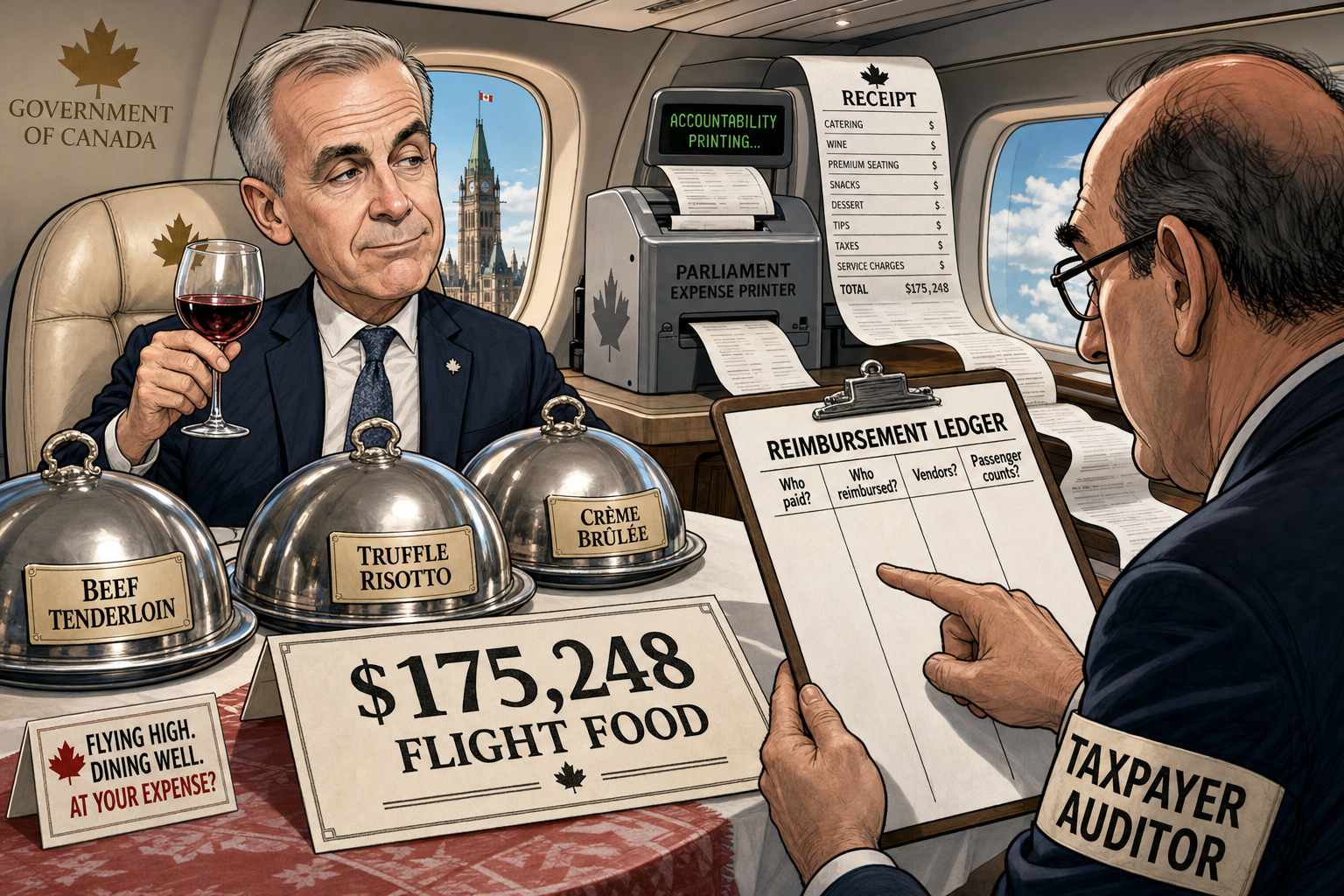
Parliament asked for receipts. Ottawa answered with totals. Now that independent watchdogs say menu details have surfaced for the biggest prime-minister aircraft catering bill, the accountability question has moved from “what was served?” to “who paid, who reimbursed, and where is the invoice ledger?”
The paper trail begins with Order Paper Question Q-1111. Conservative MP Scot Davidson asked for the dates, origins, destinations, passenger counts, total catering bills, specific menu items, quantities and unit prices for meals and beverages served on government aircraft transporting the prime minister. The House of Commons page confirms the scope of that request, and the response was posted for June 10, 2026.
Rebel News, citing the Department of National Defence response, reported that food and catering aboard prime-minister aircraft totalled $962,633.24 on official trips between March 2025 and March 2026. The largest reported bill was $175,248.48 for a January 2026 trip with stops in Vancouver, Beijing, Doha and Zurich.
That number was already unacceptable without itemization. The new development is that Big Spender, citing menus obtained by the Canadian Taxpayers Federation through access-to-information requests, reports the January 13-22 trip included beef tenderloin, veal, salmon, seabass, truffle risotto, burrata with pesto, crème brûlée and chocolate mousse. Big Spender says the trip involved a 72-person entourage, worked out to roughly $2,400 per passenger, and about $300 per passenger per meal service.
None of that proves every dollar was personally consumed by the prime minister, and the prime minister is required to use secure aircraft for security reasons. Those facts do not end the story. They sharpen it. If some passengers, travelling media or delegation members reimbursed costs, taxpayers deserve to see the reconciliation. If vendors billed unusual amounts because of routing, timing, security requirements or local purchases, taxpayers deserve to see the invoices and the procurement records.
National Defence reportedly told Parliament that records did not capture meals and beverages by individual menu item, quantity or per-item cost, and that food-related costs were recorded as totals per flight. That is the core failure. A government that can total nearly $1 million in airborne food costs can build a spreadsheet showing dates, legs, passengers, gross charges, reimbursements, net taxpayer cost and vendor documentation.
There is also a comparison problem. Big Spender says the CTF highlighted an August 2025 Poland, Germany and Latvia trip with 62 passengers and $9,270 in aircraft catering costs. Different trips can have different costs. But when one itinerary is reported at $175,248 and another at $9,270, “trust us” is not a fiscal-control system.
The conservative accountability standard is simple: publish the Q-1111 table, the January invoices, the passenger counts by leg, the media and delegation reimbursement totals, and the policy governing VIP-aircraft catering. Until then, Ottawa has not produced a receipt. It has produced an expensive menu and a missing ledger.
- House of Commons: Order Paper Question Q-1111 on prime-minister aircraft catering
- Big Spender: Carney’s gourmet airplane meals rack up $175,000 bill on China, Qatar and Davos trip
- Rebel News: Carney government spent nearly $1 million on in-flight catering in first year
- iVoteLiberal archive: Carney’s $963K Flight-Food Bill Still Needs the Menu Receipts
This is a follow-up to the June 18 article. It does not present the $962,633.24 total or $175,248.48 January bill as newly discovered; it focuses on reported menu details and the still-missing reimbursement and invoice ledger.