Ottawa’s Deficit Awareness Gap Is a Budget-Day Warning
Finance Canada paid to learn Canadians are not tracking the deficit invoice. That makes Budget Day a transparency test, not a slogan contest.
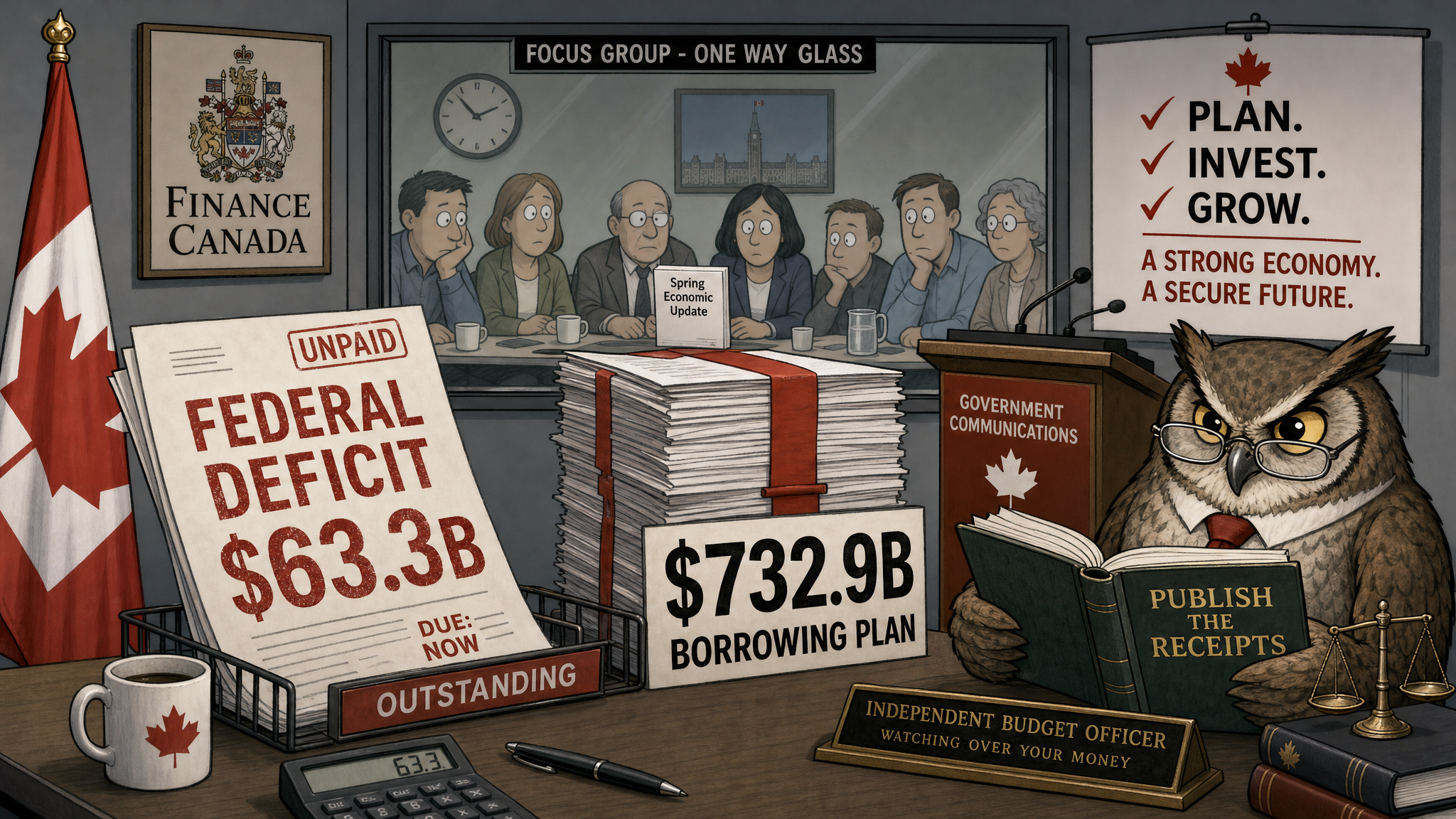
Two days before Budget 2026, Ottawa’s own research has exposed the most convenient political fact in federal finance: many Canadians are not watching the bill land.
Canadian Press reports that Finance Canada hired Environics to run 10 online focus groups with 73 Canadians after the April 28 spring economic update. The final report, delivered June 4 and recently published, found very low awareness of the update, even after participants were prompted. Only two or three older participants who described themselves as news junkies recalled it.
That is not a voter failure. It is a governing opportunity Ottawa has every incentive to exploit. When fiscal updates disappear into process language, the government can celebrate affordability cheques, capital plans and “fiscal anchors” while the debt track keeps moving in the background.
The Environics report, according to Canadian Press and the Government of Canada publication record, explored attitudes toward the deficit and new deficit projections. Participants showed little concern about the deficit; many treated it as just a number, while still recognizing that deep deficits can harm the economy and require a plan. That gap is exactly where accountability has to live.
The Parliamentary Budget Officer has already published the invoice. Its October outlook projects a $63.3-billion deficit in 2026-27, $333.3 billion in cumulative deficits over five years, and $732.9 billion in federal borrowing over the same period. The federal debt-to-GDP ratio is projected to rise from 40.8 per cent in 2026-27 to 42.6 per cent in 2030-31.
The fiscal-anchor story is no comfort. The PBO says the government is projected to meet its operating-budget anchor in 2028-29, but not its anchor for a declining deficit-to-GDP ratio, which is expected to rise in 2027-28 and 2029-30. The operating anchor also excludes debt-financed capital spending. In plain English: Ottawa can hit one carefully designed target while borrowing and debt continue to grow.
Conservative Leader Pierre Poilievre is using those PBO numbers to demand spending cuts before Thursday’s budget. That is fair politics, but the minimum public standard should be broader than one opposition news conference. Every party, every MP and every taxpayer should demand the same ledger: what is operating spending, what is capital spending, what is being borrowed, what is being booked as an asset, what will debt service cost, and which programs are being funded by money Ottawa does not have?
Prime Minister Mark Carney’s government wants Canadians to trust its technocratic language. Trust starts with showing the math. If Finance Canada knows Canadians are not seeing the deficit risk, the answer is not better spin. It is a plain-language Budget 2026 debt invoice published before the applause lines.
- Canadian Press via CityNews Calgary: Ottawa’s focus groups report low awareness of federal deficit, budget updates
- Government of Canada Publications: Post-economic update focus group research – spring 2026
- Parliamentary Budget Officer: Economic and Fiscal Outlook – October 2026
- Global News: Poilievre urges Carney to cut spending ahead of budget
This article relies on the official PBO release and Government of Canada publication record, with Canadian Press and Global News reporting for public and political context.