Carney’s EU Digital-ID Deal Needs a Privacy-and-Parliament Ledger
The issue is not panic. It is whether Ottawa will publish the rules before digital credentials become interoperable across borders.
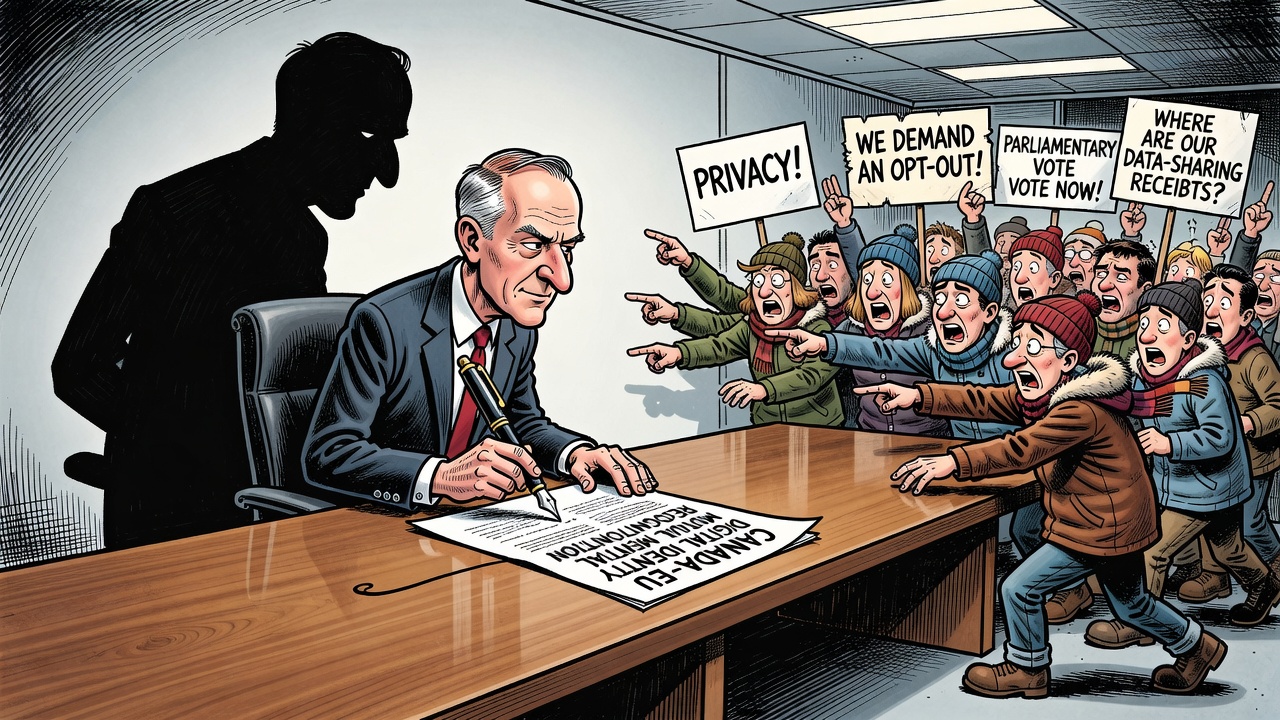
Prime Minister Mark Carney’s new Canada-EU statement contains a digital-government commitment that deserves more daylight than it has received. Juno News reported Monday that the deal opens the door to closer Canada-EU digital identity integration. The careful, verified point is narrower than the loudest online version: Ottawa has not announced a mandatory national digital ID. But Canada and the European Union have agreed to work toward mutual recognition of digital identity, digital credentials and trust services. That is serious enough to require receipts.
The October 30 joint statement from the Prime Minister’s Office says Canada and the EU have signed memoranda of understanding on Artificial Intelligence and on “Digital Credentials, Digital Identity Wallets and Trust Services.” It later says both sides will work toward mutual recognition in three high-priority digital spheres: digital identity, digital credentials and trust services; conformity assessment results for artificial intelligence systems; and cybersecurity. That is not a throwaway line. Mutual recognition is how separate systems begin to rely on each other.
Global Affairs Canada also says Canada and the EU announced the conclusion of negotiations toward a Canada-EU Digital Trade Agreement on October 30. The government says the agreement is meant to support open, secure and trustworthy digital trade while preserving Canada’s ability to regulate privacy, public-sector data, procurement, culture, cybersecurity, financial regulation and national security. Those assurances matter. They also need to be tested against the actual text, annexes, memoranda and implementation plan.
A conservative accountability standard starts with a simple question: who decides when a Canadian digital credential is recognized abroad, what data moves with it, and what recourse citizens have when something goes wrong? If a credential is used for travel, licensing, banking, government services, education or employment, the rules cannot be buried inside technocratic “interoperability” language. Canadians need to know whether participation is voluntary, whether paper or in-person alternatives remain protected, whether provinces control their own credentials, and whether private vendors can build identity rails around public services.
Ottawa should also be clear about the parliamentary path. Is mutual recognition being implemented by treaty, regulation, procurement, standards bodies, memoranda of understanding, or departmental pilots? Which committees will review it? Which privacy impact assessments have been completed? Which cybersecurity audits apply? Which data-sharing limits are binding instead of aspirational?
Digital identity can be convenient. It can also become infrastructure for exclusion if government builds first and answers questions later. A wallet that begins as optional proof of credentials can, through procurement and institutional habit, become the only practical way to access essential services. That is why the burden is on the Carney government to publish the guardrails before integration advances.
Canada can cooperate with Europe on trade, cybersecurity and digital standards without asking citizens to trust blank pages. Release the digital identity MOU. Release the privacy analysis. Release the opt-out guarantees. Release the provincial consultation record. Release the parliamentary timetable. If this is harmless, the receipts should be easy.
- Juno News: Carney’s deal opens door to Canada-EU digital ID integration
- Prime Minister of Canada: Joint Statement: Canada and the European Union building together an Alliance for the Future
- Council of the European Union: Canada-EU summit, 29-30 October 2026
- Global Affairs Canada: Canada-European Union Digital Trade Agreement
This article argues for transparency, privacy safeguards and parliamentary review. It does not claim Canada has announced a mandatory national digital ID.