CRA’s Buy-Canadian Guard Contract Needs an Ownership Ledger
If “Buy Canadian” can mean a Canadian office of a U.S.-owned security giant, Canadians deserve to see the evaluation sheet, ownership test and veteran-employment impact.
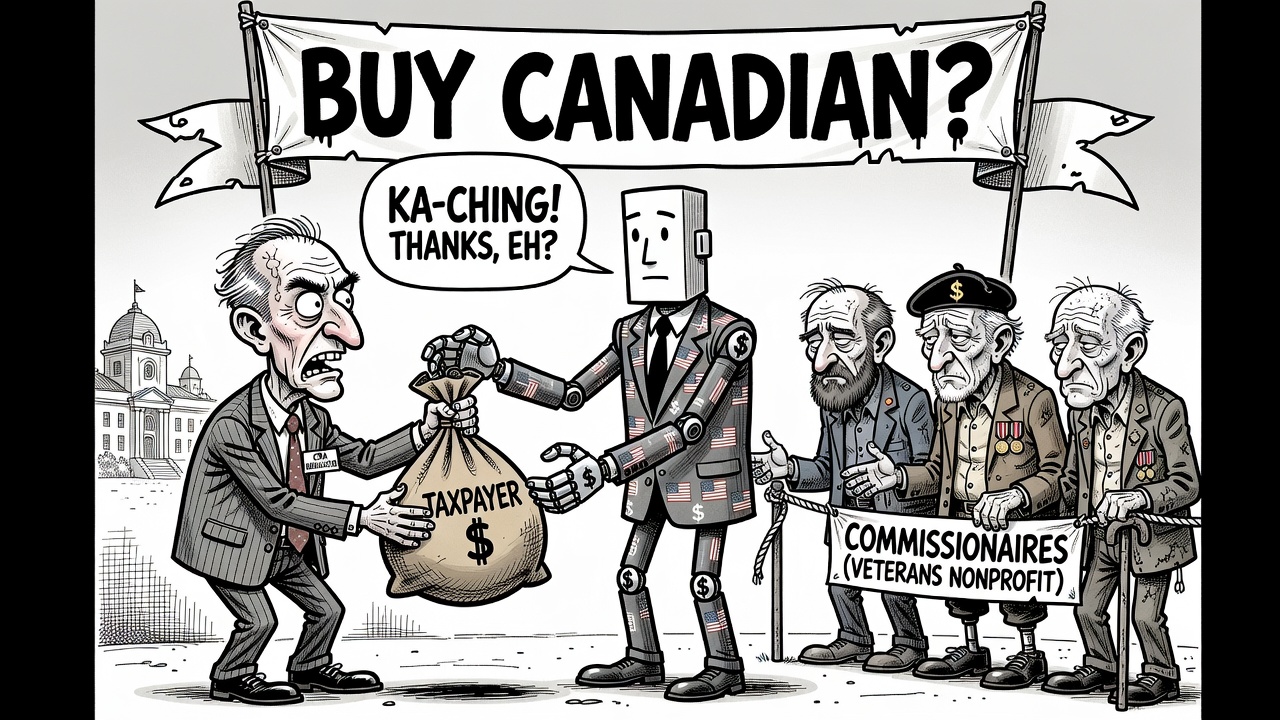
The Canada Revenue Agency’s security-guard contract is exactly the kind of procurement case that turns a slogan into a receipts test. CanadaBuys-derived award data lists Universal Protection Service of Canada Corporation as the winner of CRA’s “National Security Guard Services” contract, worth $11,916,604 and awarded June 16, 2026. CBC reported the award went to a Canadian subsidiary of Allied Universal Security Services over Commissionaires.
The government’s defence is straightforward: under the Buy Canadian policy, a Canadian supplier can qualify by having a permanent place of business and regular activities in Canada. In the Senate on October 28, Government Representative Pierre Moreau said Allied Universal Canada is based in Mississauga, employs 8,000 Canadians and therefore “fits the bill.” That answer may satisfy the paperwork. It does not settle the accountability question.
Conservatives should be careful here. Lowest-price procurement is not automatically wrong, and a Canadian subsidiary employing Canadians is not automatically disqualified from public work. Taxpayers also deserve competitive bids, reliable guards and value for money. But if the government is selling “Buy Canadian” as an industrial-policy promise, ownership and control matter. A policy that treats a foreign-owned firm the same as a Canadian-controlled organization can be legal and still be politically hollow.
The Commissionaires are not just another disappointed bidder. PSPC says the Corps have had a special guard-services role for federal clients since 1945, originally created after the Second World War to provide meaningful employment for veterans. The same federal page says about 5,100 veterans currently provide services to federal clients and notes a national-hours condition tied to veteran work. That history does not guarantee any one contract. It does mean CRA should be able to show how veteran-employment value was weighed when a roughly $12-million federal security file changed hands.
The timing adds another wrinkle. Independent analysis by The Borealian notes CRA’s tender was published December 4, 2025, before the Buy Canadian policy took effect on December 16, and that the original strategic-procurement threshold was $25 million, above this award. If the policy technically did not bind this file, ministers should say that plainly instead of using a Canadian-office definition as if it answers every concern.
So publish the ledger: the bid-score table, price spread, technical evaluation, ownership-and-control analysis, security-risk review, Buy Canadian applicability memo, veteran-employment impact, right-of-first-refusal record, conflict checks and final sign-off. If the answer is that Allied’s Canadian subsidiary won fairly under the rules, the documents should support that. If the rules define “Canadian” too loosely, Canadians should see that too.
“Buy Canadian” cannot just be a podium line. It has to survive the contract file.
- TenderComps / CanadaBuys-derived data: Universal Protection Service of Canada Corporation federal awards
- Senate of Canada: Debates, Issue 97, October 28, 2026
- Public Services and Procurement Canada: Guard services standing offer and supply arrangement
- The Borealian: CRA guard contract goes to a U.S.-owned firm
- CBC News: CRA awards $12M contract to subsidiary of U.S. company over non-profit Commissionaires
This article argues for stronger procurement disclosure. It does not allege misconduct by CRA officials, Universal Protection Service of Canada Corporation, Allied Universal, or Commissionaires.