Carney’s Commonwealth Trip Needs a Public Ledger Before Budget Day
Closed-door diplomacy can be legitimate. Closed-door diplomacy days before a high-stakes federal budget still needs public receipts.
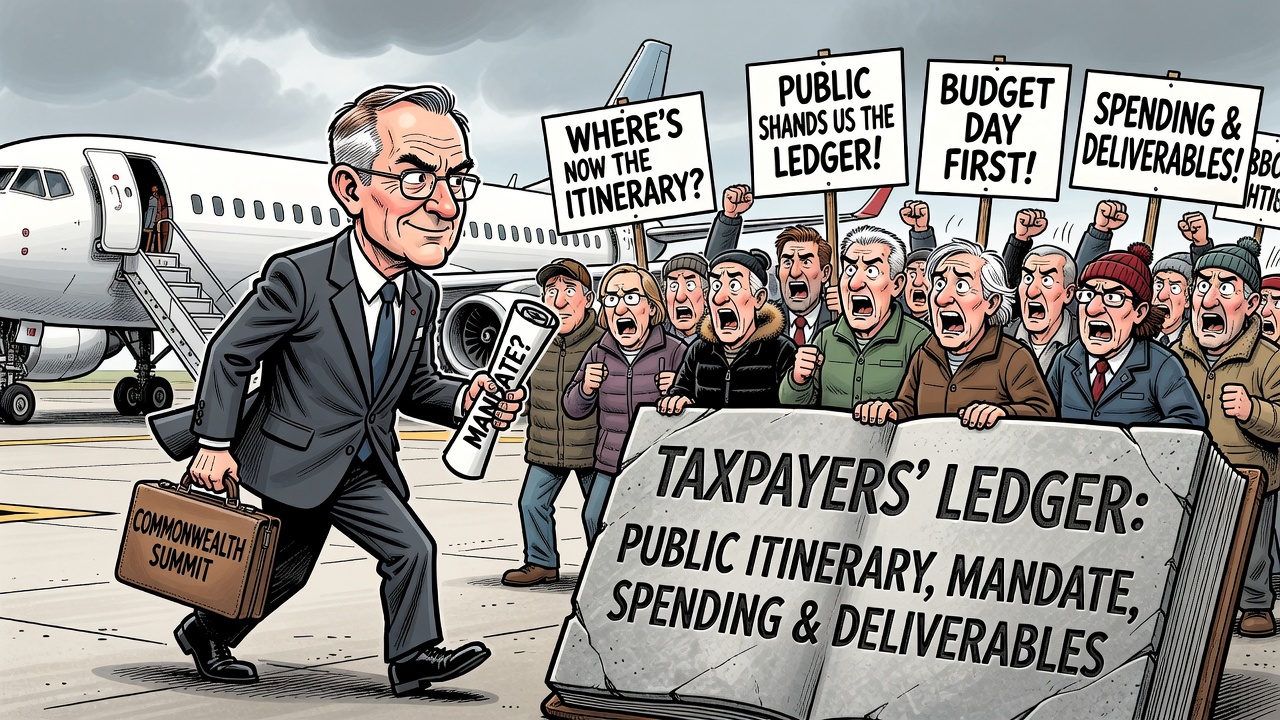
Prime Minister Mark Carney is scheduled to travel to St. John’s, Antigua and Barbuda, from November 2 to 4 for the Commonwealth Heads of Government Meeting. According to the Prime Minister’s Office, the summit agenda includes trade and investment ties, climate resilience, renewable energy, geopolitical challenges and collective security. Those are real subjects. They are also exactly the sort of subjects that can create expensive promises, soft commitments and policy trade-offs before Parliament has seen the budget.
The timing matters. Ottawa is heading into Budget Day with Canadians already asking how much new spending, borrowing, defence pressure, climate financing and foreign commitments the government intends to load onto taxpayers. A prime minister leaving the country for multilateral meetings in the final days before that budget should not be treated as a ceremonial footnote. If the trip is important enough to take, it is important enough to explain.
The official October 28 release says the Commonwealth includes 56 countries representing 2.7 billion people and that Canada is the organization’s second-largest financial contributor. It also says this will be Carney’s first participation at CHOGM as prime minister. That combination makes the accountability test simple: Canadians should know what Canada is trying to get, what Canada is being asked to give, and what any new commitments could cost.
So far, the public itinerary is thin. The November 1 PMO advisory for Monday lists a departure from the National Capital Region and an arrival in St. John’s, both as pooled photo opportunities. It does not list bilateral meetings, Canadian delegation members, briefing themes, spending estimates, negotiating red lines or expected deliverables. Some details may be fluid, and not every diplomatic conversation can be broadcast in advance. But that is not an excuse for publishing almost nothing.
A conservative accountability standard is not anti-diplomacy. It is pro-Parliament, pro-taxpayer and pro-results. Canada can engage allies and Commonwealth partners while still telling citizens what mandate the prime minister is carrying. Trade and security discussions can be sensitive without hiding the basic framework. Climate and development conversations can be constructive without turning into blank-cheque announcements after the fact.
Before the budget lands, Carney should publish a CHOGM ledger: the delegation list, travel-cost estimate, meeting schedule, Canadian objectives, contribution exposure, trade and investment asks, climate-finance parameters, security commitments under discussion and a post-summit deliverables table. If new money is not being promised, say so. If new money is on the table, identify the envelope and the approval path. If Canada is pursuing specific commercial or strategic wins, list the metrics Canadians can use to judge success.
Diplomacy belongs to the country, not to the travelling political class. When Ottawa conducts foreign policy on the eve of a budget, taxpayers deserve more than photo opportunities and broad themes. They deserve receipts before the bill arrives.
- iPolitics: PM Carney heads to Commonwealth summit ahead of high-stakes budget reveal
- Prime Minister of Canada: Prime Minister Carney to attend Commonwealth Heads of Government Meeting
- Prime Minister of Canada: Itinerary update for Monday, November 2, 2026
This article argues for transparency around public travel, foreign-policy commitments and taxpayer exposure. It does not allege unlawful conduct or oppose Canada’s participation in Commonwealth diplomacy.