Carney’s Borrowing Anchor Has a $732.9 Billion Cash-Debt Problem
An operating-budget target is not fiscal discipline if Ottawa can still borrow hundreds of billions through capital spending, Crown loans and asset accounting.
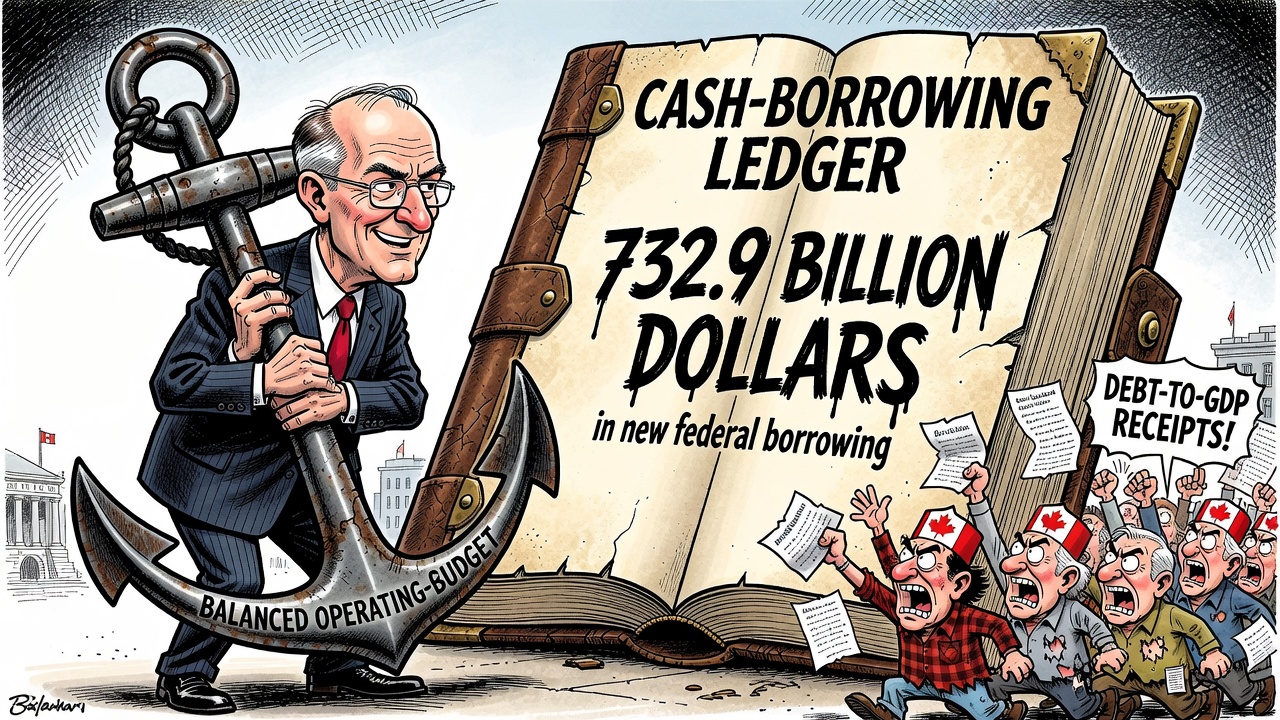
Prime Minister Mark Carney wants Canadians to believe his fiscal anchor proves discipline. The Parliamentary Budget Officer’s October 2026 outlook shows why taxpayers should be skeptical.
The PBO projects real GDP growth of just 0.9% in 2026 and 1.5% in 2027, both weaker than its June outlook. At the same time, Ottawa’s new tax and spending measures since June are estimated to cost $52.6 billion over five years, more than offsetting the revenue improvement from higher nominal GDP. That is the first warning sign: the government found new fiscal room and spent past it.
The second warning sign is the anchor itself. PBO says the government is projected to meet its operating-budget fiscal anchor in 2028–29 with a $6.2 billion surplus. But PBO also says that should not be read as a balanced fiscal position, because the anchor excludes debt-financed capital spending. In plain English, Ottawa can claim operating discipline while still borrowing heavily for capital investments, Crown-corporation loans, defence procurement and other financial assets.
The numbers are not small. PBO projects cumulative deficits of $333.3 billion over five years, while federal borrowing rises by $732.9 billion. That gap is the accountability story. If the cash debt is growing by more than twice the accrual deficit, Canadians deserve a bridge table that reconciles every dollar from the budget headline to the borrowing plan.
Debt sustainability is moving the wrong way too. PBO projects the federal debt-to-GDP ratio rising every year, from 40.8% in 2026–27 to 42.6% in 2030–31. Per-person federal debt is projected to rise from $33,436 in 2026–27 to $39,191 in 2030–31. That is not a fiscal anchor holding firm. That is a heavier debt load being renamed as investment.
The interest-rate backdrop makes the test sharper. On October 28, the Bank of Canada raised its policy rate by 25 basis points to 2.5%, citing inflation around 3% since April and expecting CPI inflation to rise to about 3.5% by year-end. When rates rise, debt-service costs matter more, not less. A government that is increasing cash borrowing cannot hide behind an accounting category and call it prudence.
Conservatives should support productive infrastructure, defence readiness and real capital investment. But spending is not productive just because Ottawa labels it capital. The government should publish a plain-language borrowing ledger before the budget vote: every capital-classified measure, every Crown loan, every expected repayment, every interest-cost assumption, every debt-to-GDP impact and every clawback if promised economic returns do not arrive.
Carney’s credibility test is simple. Stop selling the anchor. Publish the cash-borrowing receipts.
- Parliamentary Budget Officer: Federal spending, borrowing and debt continue to rise amid weaker economic growth
- Parliamentary Budget Officer: Economic and Fiscal Outlook — October 2026
- Bank of Canada: Bank of Canada raises the policy rate by 25 basis points to 2½%
- Bank of Canada: Policy interest rate table
This article argues for fiscal transparency and borrowing disclosure. It does not allege unlawful conduct by any public official.