FINTRAC’s Four-Month Clock Is a Dirty-Money Accountability Test
If Ottawa says it is serious about dirty money, it should publish the timeliness ledger police actually need.
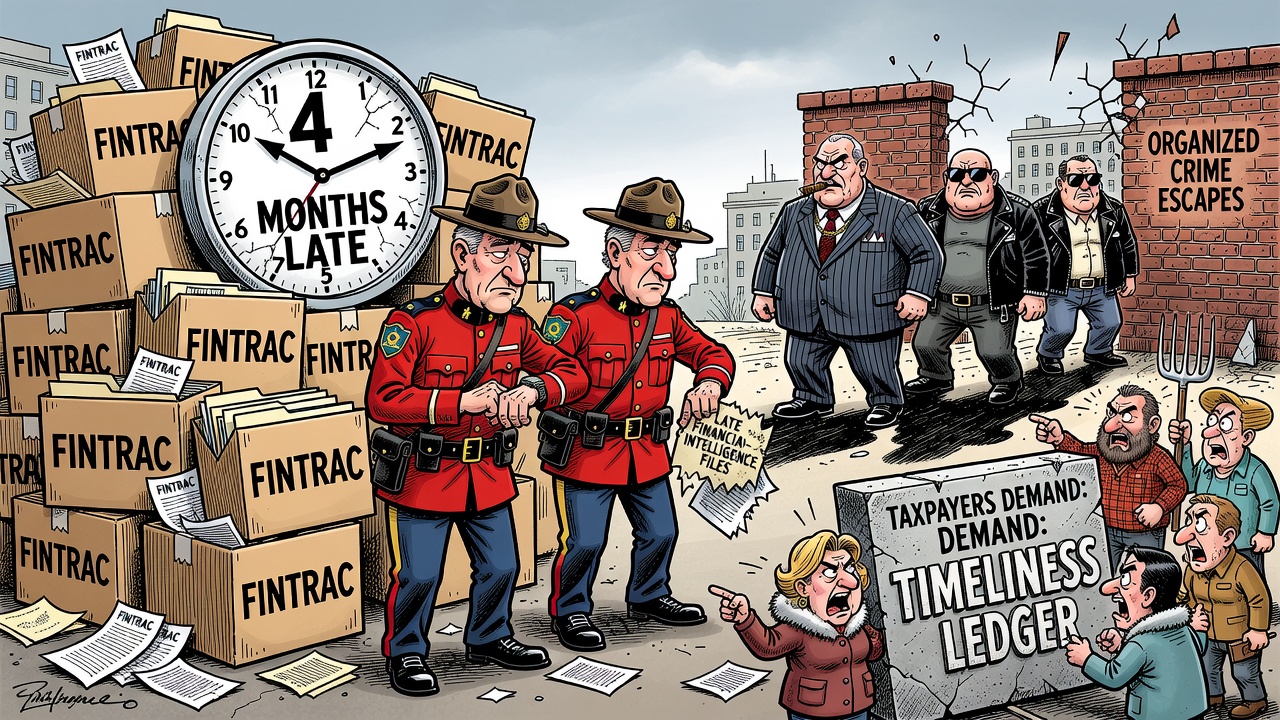
Dirty money does not wait politely while Ottawa processes paperwork. Criminal networks move cash, property and shell-company records quickly. That is why the Auditor General’s October 29 audit of FINTRAC matters: Canada’s financial-intelligence agency was supposed to help police follow the money, but the watchdog found the clock was often running against investigators.
Auditor General Karen Hogan concluded that FINTRAC did not effectively carry out key parts of its anti-money-laundering role, including compliance oversight and production of useful financial intelligence. The most damaging number is the delay. According to the Auditor General’s release, FINTRAC took an average of nearly four months to provide financial intelligence to law enforcement and other agencies.
That is not a minor service-standard problem. In an active fraud, trafficking, sanctions-evasion or organized-crime investigation, four months can mean assets moved, witnesses gone cold, accounts emptied and corporate trails buried. The audit’s user feedback makes the point sharper: half of surveyed recipients said the intelligence arrived too late to be useful in ongoing criminal investigations, while just over one third said FINTRAC intelligence often helped identify new leads.
FINTRAC’s response deserves to be read fairly. The agency says it accepts or is leveraging the recommendations, points to 7,214 disclosure packages in 2025–26, and cites the Financial Action Task Force’s view that FINTRAC intelligence is used in 94% of relevant investigations. Volume matters. International validation matters. But neither answers the central accountability question: when police need intelligence fast, how often does Ottawa deliver it on time?
This is where a conservative accountability test is useful. Canadians do not need another promise that systems will be modernized someday. They need a public ledger with dates, standards and outcomes: urgent-file response times; average and median disclosure delays; how many packages missed their targets; how many recipients rated the information late or useful; how many compliance inspections found repeat failures; how many referrals led to asset restraints, charges, convictions, penalties or recovered proceeds.
The Liberal government has repeatedly presented anti-money-laundering reforms as evidence that Canada is getting tougher. The Auditor General’s findings show why announcements are not enforcement. A regime can look serious on paper and still fail if intelligence reaches police after the window to act has closed.
Ottawa should publish the FINTRAC four-month clock ledger before asking Canadians to trust the next reform package. If the system is improving, prove it with monthly timeliness data and recipient usefulness scores. If urgent files are being triaged, show the triage rules. If technology or staffing is the bottleneck, name the fix, the deadline and the minister responsible.
Dirty money is a public-safety threat and a housing-market threat. The minimum taxpayers should expect is simple: when federal agencies have the financial trail, police should not be waiting nearly four months to receive it.
- Auditor General of Canada: FINTRAC activities to combat money laundering audit
- Auditor General of Canada: Weak oversight and slow financial intelligence limited FINTRAC effectiveness
- FINTRAC: Statement responding to the Auditor General’s report
- CBC News: Coverage of the Auditor General’s FINTRAC report
This article relies on the Auditor General’s audit findings and FINTRAC’s official response. It argues for public performance reporting and does not allege misconduct by individual FINTRAC employees.