Carney’s Trade Reset Needs a Foreign-Interference Firewall
Ottawa says economic security and national security are now inseparable. Prove it before the next trade reset.
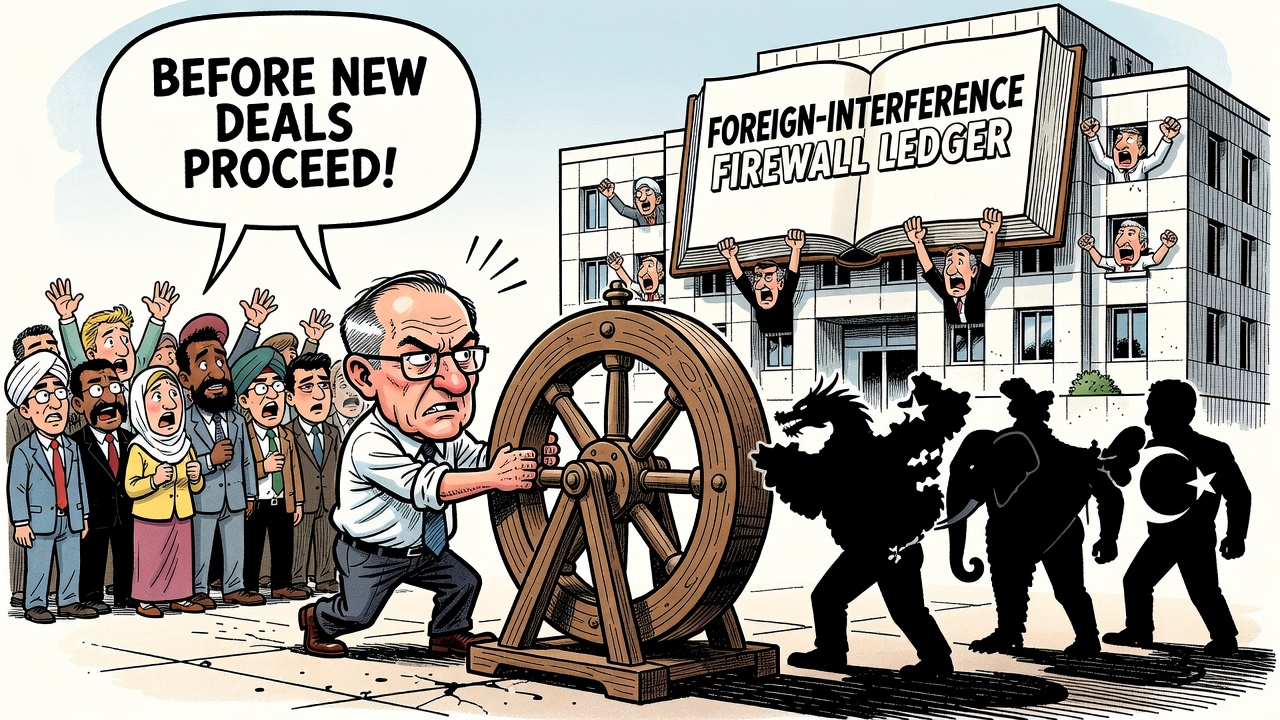
Prime Minister Mark Carney’s own national-security release says Canada faces threats ranging from cyberattacks to the “weaponisation of trade deals.” That sentence should now govern every commercial reset Ottawa signs.
The Bureau reported October 29 that it obtained classified 2019 NSICOP material describing foreign governments reaching into Canadian communities to monitor dissidents, manipulate organizations and influence political decisions. Its story says the material cited a December 2018 CSIS assessment on Türkiye’s anti-Gülenist activities in Canada, including alleged blacklisting and surveillance of suspected Gülen movement affiliates. Those are serious claims, and they deserve careful attribution. They are also exactly the sort of warning that should trigger a public security checklist before Ottawa deepens trade, defence or diaspora-facing ties.
That test is not theoretical. The PMO says Carney and President Recep Tayyip Erdoğan launched a Canada-Türkiye Strategic Partnership on October 22 covering trade, investment, defence and security, energy, and people-to-people ties. It also says the first Canada-Türkiye free-trade negotiation round is scheduled for November 30 to December 4 in Ankara. Commercial opportunity may exist. But if intelligence concerns about foreign-state pressure inside Canada exist too, Ottawa cannot ask Canadians to trust the sales pitch while hiding the safeguards.
The public NSICOP report already explains why this matters. It says foreign interference can be a long-term effort using inducements, threats and covert pressure; it also identifies the PRC as a sophisticated, persistent foreign-interference threat to Canada, and says India emerged during the review period as the second-most significant foreign-interference threat to Canada’s democratic institutions and processes. The report’s section on transnational repression describes monitoring, coercion, harassment, threats to family members abroad, forced repatriation and other tools used against ethnocultural communities in Canada.
So the conservative accountability standard is straightforward: diplomacy is allowed; blind trust is not. Before Ottawa expands partnerships with governments named in interference reporting, it should publish a foreign-interference firewall. That means a public checklist for diaspora-intimidation response, party-donation screening, community-organization influence checks, consular consequences, CSIS/RCMP disruption metrics, ministerial sign-off, and a written explanation of how commercial policy was prevented from overriding intelligence warnings.
Carney’s government wants to diversify away from overdependence on Washington. Fine. But independence cannot mean replacing one dependency with new leverage for governments accused of coercing people on Canadian soil. A serious trade reset starts with this rule: if a foreign state wants expanded access to Canadian markets and institutions, it must understand that intimidation inside Canada carries real costs.
Ottawa says sovereignty now depends on economic resilience, public safety and modern intelligence. Then publish the firewall before the next signing ceremony.
- The Bureau: Carney’s trade reset risks deepening the foreign interference Ottawa was warned about seven years ago
- Prime Minister of Canada: Prime Minister Carney launches The Plan for a Stronger Canada
- Prime Minister of Canada: Carney’s historic visit to Türkiye launches new Strategic Partnership
- NSICOP: Special Report on Foreign Interference in Canada’s Democratic Processes and Institutions
This article supports lawful diplomacy and trade diversification. It argues that partnerships with governments named in foreign-interference reporting require transparent safeguards for Canadians.