The Condo Lobbying Probe Needs a Public Ledger
If the lobbying watchdog has opened a preliminary probe, the Carney government should stop asking Canadians to trust the condo plan and start publishing the receipts.
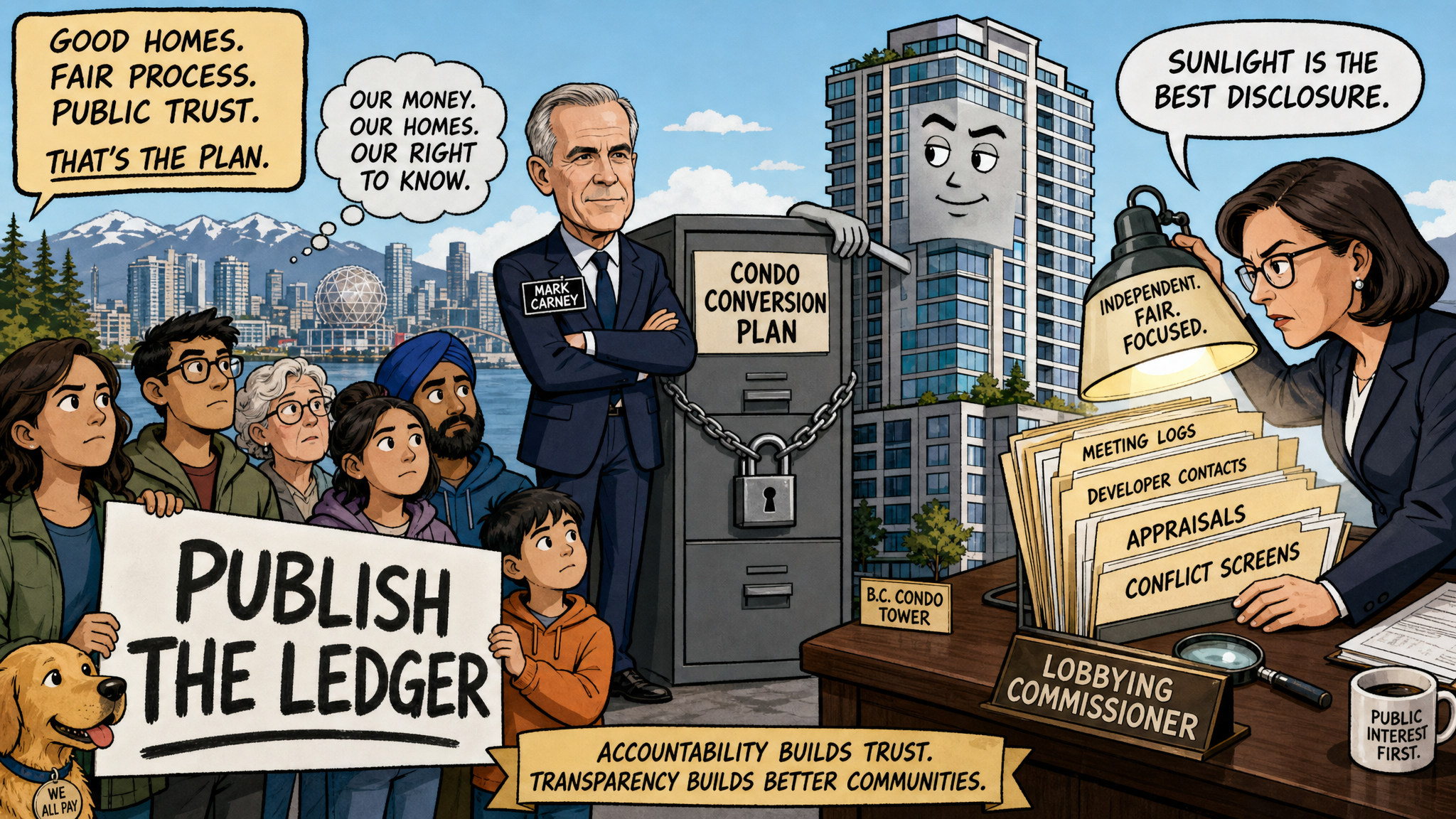
Western Standard reported October 27 that Lobbying Commissioner Nancy Bélanger told the House ethics committee her office had opened a “preliminary investigation” into Prime Minister Mark Carney’s federal-B.C. vacant-condo plan. That is the new accountability fact. The government does not need to prejudge the commissioner’s work. It does need to stop treating the condo file as if disclosure can wait until after the money moves.
The official announcement was already large enough to require a public ledger. On June 18, the Prime Minister’s Office announced more than $5 billion over 10 years for British Columbia infrastructure and housing, including nearly $1.6 billion in federal funding, matched by B.C., for up to $3.2 billion to cut development charges and support housing-enabling infrastructure. The same release said Ottawa and B.C. would launch a condo-conversion partnership through Build Canada Homes and BC Housing to convert more than 2,200 vacant condo units in priority growth areas into affordable homes.
That may be sold as speed. It is also a buyer-selection problem. Which buildings qualify? Who owns them? Which developers, lenders or advisers met federal officials before the announcement? What appraisal method determines a discount? Who verifies that taxpayers are not absorbing private-sector losses that the market should price on its own?
Carney tried to calm the controversy in June. Global News reported that he said no developer had asked him “directly” for the plan, that the idea came from the province, and that the goal was to turn distressed condos into rent-to-own homes. He also admitted the federal and B.C. governments had not done a particularly good job explaining the proposal. That admission has aged poorly. A bad rollout becomes a bigger problem when a lobbying watchdog is reportedly examining the file.
A conservative accountability standard is not complicated: publish the access trail before public financing creates winners and losers. Ottawa should release the non-confidential meeting logs, lobbying registry cross-checks, seller shortlist rules, appraisal rules, discount formula, conflict screens, recusal records, BC Housing and Build Canada Homes decision memos, and any written communications with developers or their representatives that can legally be disclosed.
The point is not to assume guilt. The point is to prevent government housing policy from becoming a quiet rescue lane for politically connected assets. If the plan really buys units below replacement cost, protects taxpayers and helps renters become owners, the receipts should strengthen the case. If the receipts are missing, Canadians should not be asked to bankroll trust.
The housing crisis demands speed, but speed without transparency is how Ottawa turns urgency into cover. The condo file now has a simple test: no ledger, no cheque.
- Western Standard: Lobbying Commissioner tells ethics committee Fed-BC condo scheme is under investigation
- Prime Minister of Canada: Canada and British Columbia forge new partnership to accelerate homebuilding, lower costs, and build new local infrastructure
- Global News: Developers didn’t ask “directly” for B.C. vacant condo plan, Carney says
This article treats the lobbying matter as a reported preliminary investigation and focuses on disclosure, taxpayer risk and procurement-style safeguards.