Will Carney Testify? The Pre-Budget Finance Committee Ledger
Before Budget 2026 lands, the Prime Minister should bring Canadians the deficit, borrowing, debt-interest and tax receipts.
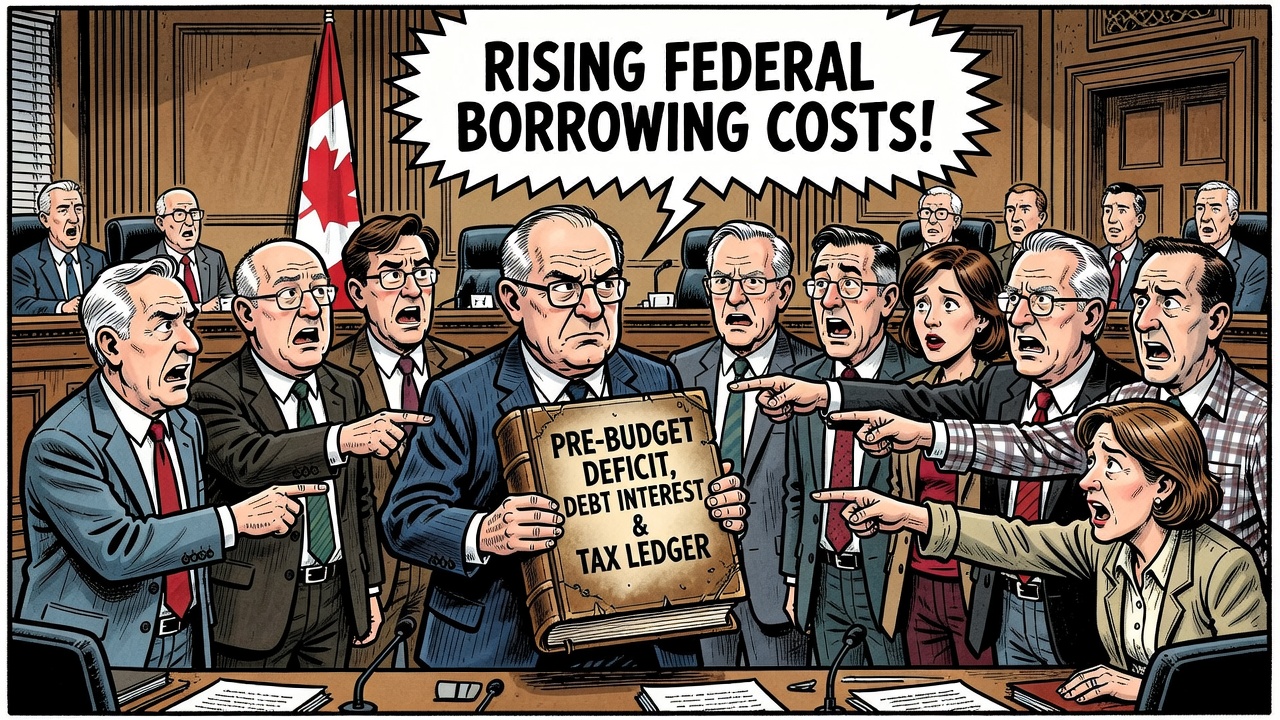
One week before the November 5 federal budget, the Conservatives are forcing a simple question into the open: will Prime Minister Mark Carney defend the fiscal plan in front of the House Finance Committee, or will Canadians be asked to accept another budget on trust?
iPolitics reports that MPs were set to vote October 28 on a Conservative motion inviting Carney to appear before Finance Committee to testify on “saving Canadians money by cutting deficit spending, debt interest and taxes.” The motion may not pass if Liberal MPs close ranks. But the accountability test should not depend on party arithmetic. A prime minister who is asking Canadians to finance a larger, more complicated federal balance sheet should be willing to explain it before Parliament.
The timing matters. The Hub reports the motion arrived days before Budget 2026, scheduled for November 5 at 4 p.m. ET, and after repeated Conservative attacks on debt interest. That is not a side issue. The Parliamentary Budget Officer’s October outlook projects cumulative federal deficits of $333.3 billion over five years and federal borrowing rising by $732.9 billion over the same period. PBO also projects the federal debt-to-GDP ratio rising each year, from 40.8 per cent in 2026-27 to 42.6 per cent in 2030-31.
The Liberals will say they have an operating-budget anchor. PBO says the government is projected to meet that anchor in 2028-29. But PBO also says the government is not projected to meet its second anchor: a declining deficit-to-GDP ratio. Worse, the operating anchor can make the picture look cleaner than the cash reality. PBO notes that borrowing can grow faster than accrual deficits because loans, capital investments, defence procurement and financial assets still require cash and still add to market debt.
That is why Carney should not arrive with slogans. He should bring a ledger. First, a deficit bridge showing how the budget moves from the spring update to the November plan. Second, a year-by-year debt-interest table, including the risk if rates or borrowing needs run higher. Third, a tax plan that states plainly whether households, businesses or future Canadians are being asked to pay. Fourth, a reconciliation between operating spending, capital labels and actual cash borrowing. Fifth, a borrowing schedule that shows how much Ottawa will add to federal market debt and why.
This is not an unreasonable demand. It is the minimum standard for a government that campaigned on competence and now governs with rising debt-service costs. If the Carney budget is disciplined, committee testimony should help prove it. If the numbers only work because costs are relabelled, delayed or pushed outside the headline deficit, Canadians deserve to know before the vote, not after the invoices arrive.
- iPolitics: PM Carney set to face MPs before House vote on Conservative call for him to appear before Finance Committee
- The Hub: Parliament Today: Conservatives target debt interest ahead of the Nov. 5 budget
- Conservative Party of Canada: Will Carney Defend His Plan?
- Parliamentary Budget Officer: Economic and Fiscal Outlook — October 2026
This article focuses on Parliament’s oversight role before Budget 2026 and relies on public reporting, party statements and the Parliamentary Budget Officer’s fiscal outlook.