Ottawa’s NATO Clearance Fix Needs Receipts
If officials now say basic open-source checks were missing before a NATO clearance, “we fixed it” is not enough. Publish the reform ledger.
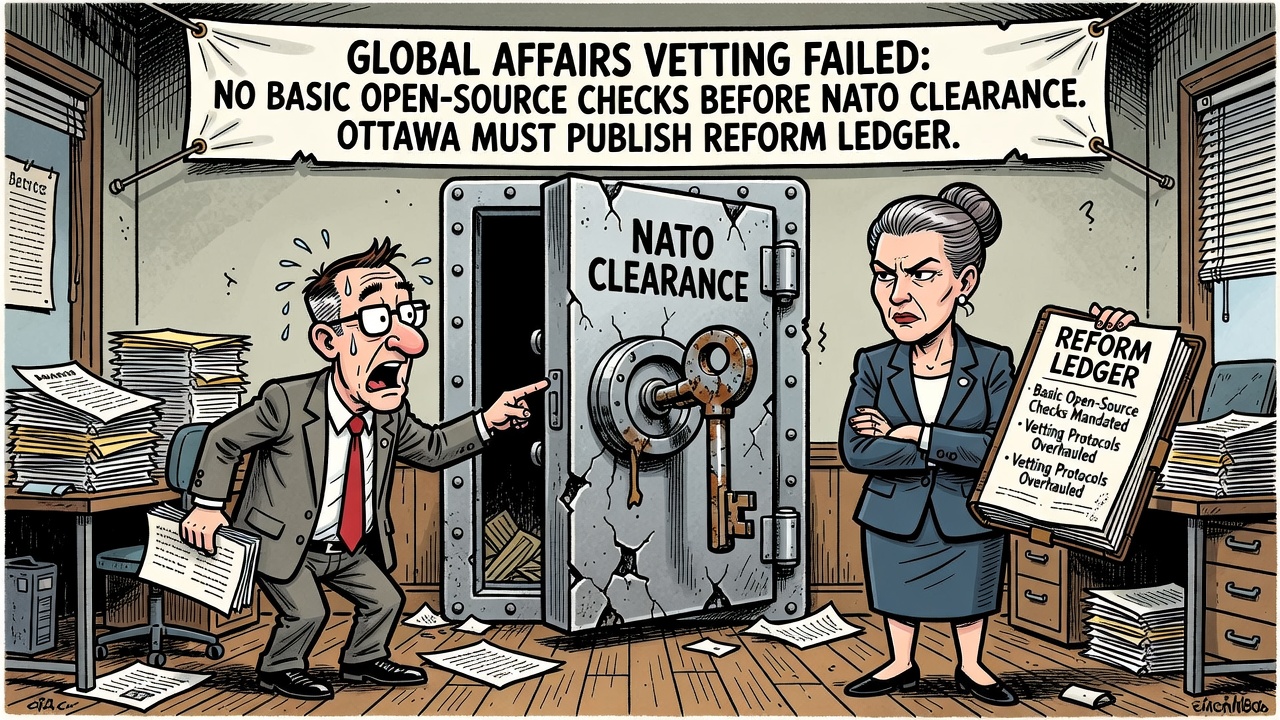
The NATO intern espionage case should not become another Ottawa fog machine: serious allegation, closed-door process, vague promise that lessons were learned, and no public trail showing what changed. Juno News and Unpublished.ca reported that David Morrison told MPs open-source, Google-style checking should be a standard part of vetting, but “was not part of the system at the time” and has now been rectified according to Global Affairs colleagues.
That admission matters because the case involves national security, allied trust and the basic competence of Canada’s clearance system. The allegations against the Canadian woman arrested in Belgium remain allegations; guilt belongs to a court, not a headline. But Ottawa does not need to prejudge the Belgian case to answer the process question. If Canada issued the clearance required for work at NATO’s SHAPE headquarters, Canadians can ask whether the clearance workflow was adequate.
NATO’s internship material says final offers require a valid security clearance and that the clearance is issued by the applicant’s national authorities, not NATO. That puts the accountability chain squarely in Ottawa for the Canadian clearance piece. The public does not need operational intelligence methods. It does need proof that a basic missing step was actually added, dated, assigned and audited.
The Carney government has an extra reason to be precise. Morrison is not a random retired official commenting from the sidelines; the Prime Minister’s Office announced in March that he was serving as Senior Diplomatic and International Affairs Advisor to the Prime Minister. When someone that close to the centre of government says a screening gap existed and has been fixed, the fix should be documented in a form Parliament can inspect.
A conservative national-security standard is not theatrical secrecy. It is seriousness, discipline and receipts. Publish the non-operational vetting reform ledger: the old policy, the new open-source-check requirement, effective date, responsible official, training notice, quality-control test, files rechecked where legally possible, allied notification, privacy safeguards and audit deadline. If parts must be redacted, say why and have a parliamentary security-cleared body review the unredacted record.
Canada’s allies do not need slogans about values. They need to know Canadian clearances are reliable. Canadians do not need to know every investigative tool. They need to know that when a basic screen fails, Ottawa fixes the system instead of burying the receipt. “Rectified” is a claim. The ledger is the proof.
- Juno News: Carney adviser admits Global Affairs failed to Google accused NATO spy
- Unpublished.ca: Global Affairs did not Google staff during vetting
- Global News: Carney says Canada has been involved since start of NATO intern case
- Associated Press: Canadian woman accused of espionage while working at NATO headquarters
- NATO: Internship programme FAQ — security clearance
- Prime Minister of Canada: David Morrison backgrounder
This article treats the Belgian espionage case as an allegation and focuses on Canada’s clearance and vetting process, not on adjudicating guilt.