Carney’s Emergencies Act Appeal Needs an Emergency-Powers Ledger
The Supreme Court file is not ancient history. Ottawa is still fighting for the legality of emergency powers that courts found unreasonable and Charter-infringing.
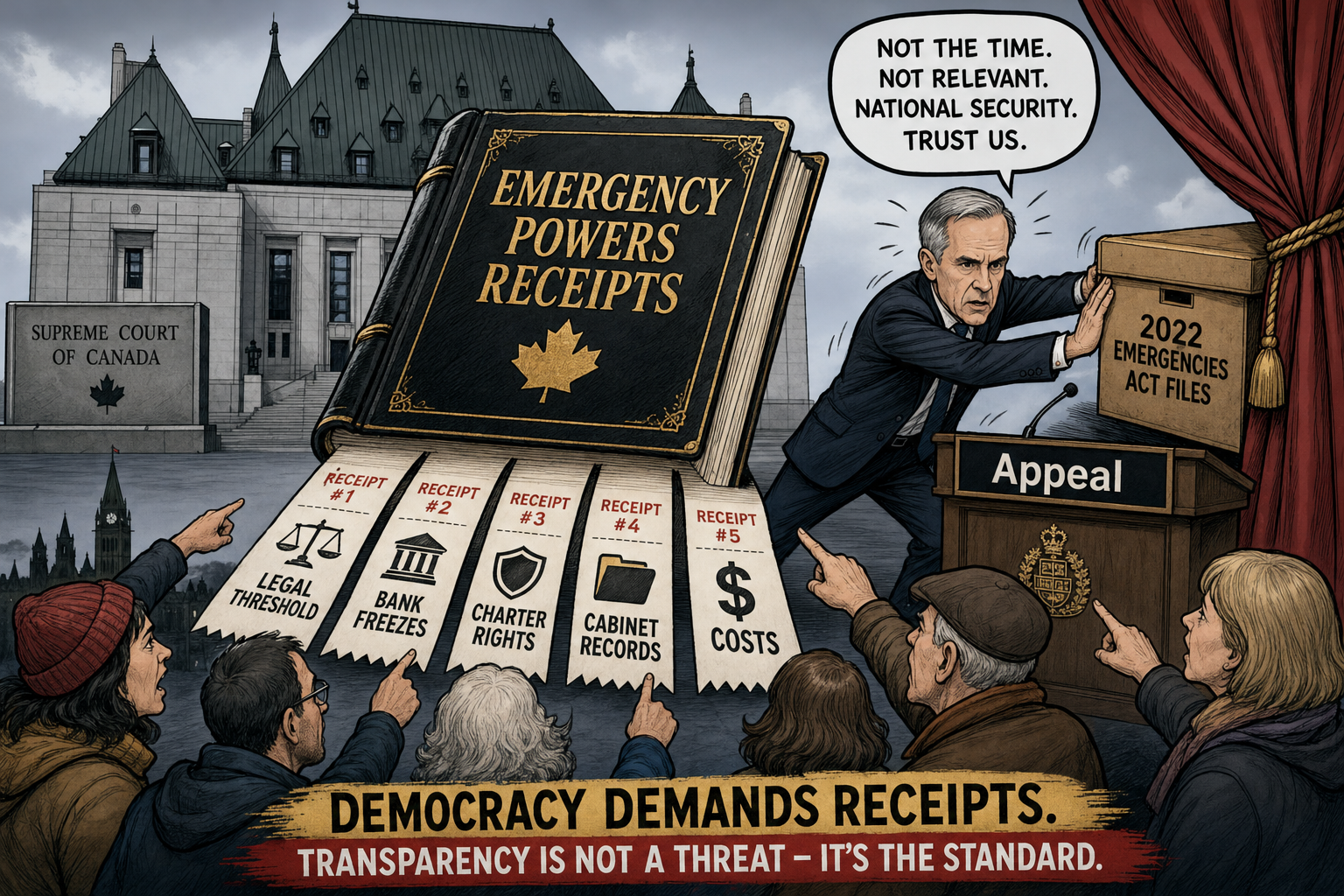
The Supreme Court of Canada has agreed to hear Ottawa’s appeal over the 2022 Emergencies Act invocation. That puts the legal threshold for national emergency powers back at the centre of Canadian politics, and it makes one thing unavoidable: Prime Minister Mark Carney’s government now owns the appeal it is carrying forward.
The official Supreme Court docket, file 42261, frames the case around how courts should review a public order emergency proclamation, whether temporary emergency measures unjustifiably limited Charter rights, and the legal relationship between the Governor in Council and Cabinet. Those are not abstract law-school questions. They go directly to whether a federal cabinet can freeze accounts, restrict assemblies and claim extraordinary authority when existing laws are allegedly insufficient.
The record Ottawa is trying to overturn is blunt. On January 23, 2024, Federal Court Justice Richard Mosley ruled that the Emergencies Act proclamation was unreasonable and that some temporary measures infringed Charter sections 2(b) and 8. On January 16, 2026, the Federal Court of Appeal dismissed the government’s appeals and confirmed that the invocation was unreasonable, beyond the authority granted by the Act, and Charter-infringing.
That does not mean every protest tactic in 2022 was wise, lawful or harmless. Conservatives should be clear-eyed about disorder. Blockades, intimidation and lawbreaking require enforcement. But that is exactly why the threshold matters. Emergency law is supposed to be the last legal tool, not a political shortcut when ordinary policing and existing statutes are hard, embarrassing or slow.
Carney cannot wave this away as Trudeau-era baggage while his own Attorney General asks the Supreme Court to rescue Ottawa’s position. If the government believes the lower courts were wrong, it should publish the emergency-powers ledger now: outside legal costs, departments involved, records still withheld, bank-freeze statistics, account-unfreeze timelines, compensation claims, Charter-risk memos that can be released, and the precise threshold Ottawa says should govern the next crisis.
Civil-liberties organizations are right to treat this as a major government-power case. Canadians do not need operational policing secrets to evaluate the appeal. They need the public receipts showing how cabinet power was used, how citizens were affected, and what limiting principle Ottawa is asking the Supreme Court to bless.
The emergency is over. The accountability is not. The government’s position in court should be matched by discipline in public: no selective memory, no hidden price tag, no quiet expansion of cabinet discretion by litigation. If Ottawa wants Canadians to accept that extraordinary tools were necessary in February 2022, it can start by releasing the non-operational record that lets citizens test that claim.
Before the Carney government argues for more deference at the Supreme Court, it should show Canadians the ledger.
- Supreme Court of Canada: Attorney General of Canada v. Canadian Civil Liberties Association et al., file 42261
- Federal Court of Appeal: 2026 FCA 6 plain-language summary
- Federal Court: January 23, 2024 public order emergency bulletin
- Global News: Supreme Court to hear federal Emergencies Act appeal
- Justice Centre for Constitutional Freedoms: Civil-liberties response to Supreme Court leave decision
- Canadian Constitution Foundation: Supreme Court to hear Emergencies Act appeal
Correction from the candidate note: the verified Supreme Court file is 42261, and the Federal Court of Appeal decision was issued January 16, 2026, dismissing the government’s appeals and confirming the lower-court findings.