Carney’s EU Associate-Member Push Needs a Sovereignty Ledger
Closer trade with Europe may be defensible. Moving Canada toward an undefined political framework without receipts is not.
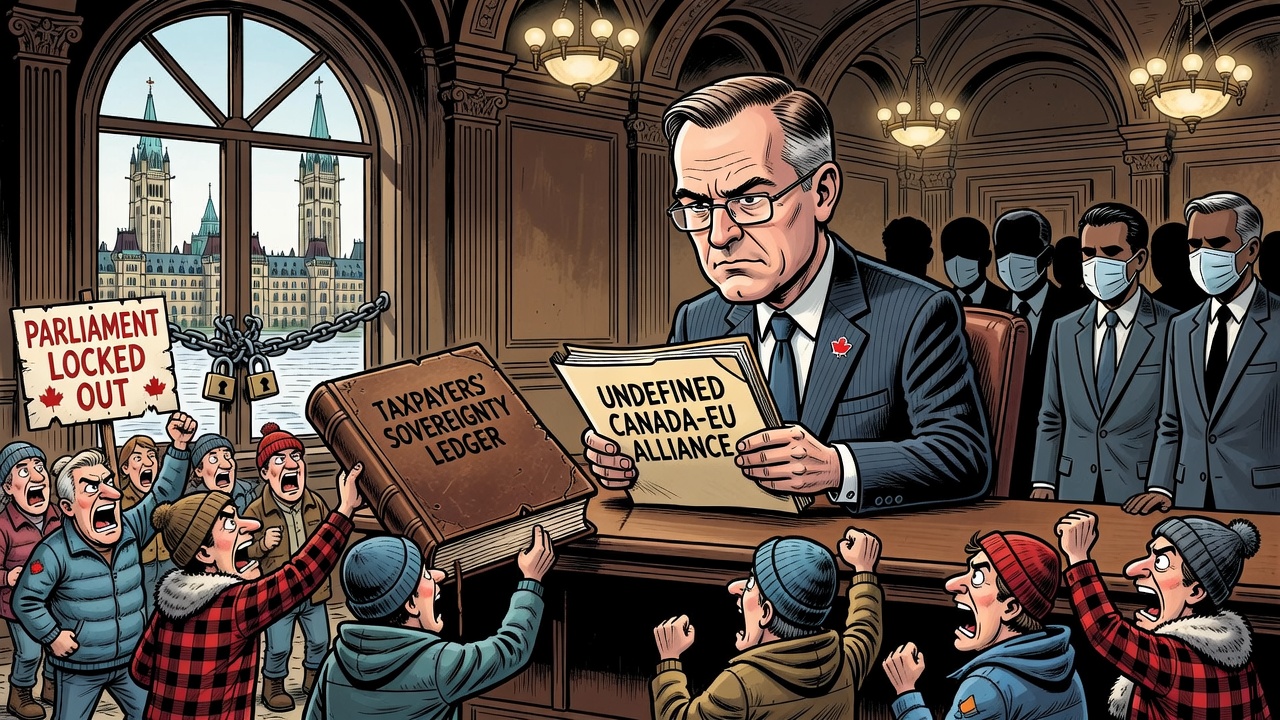
Prime Minister Mark Carney is hosting European Union leaders in Montreal on October 29 and 30 to pursue what his office calls an ambitious new Canada-EU partnership. The official pitch sounds attractive: more markets, more security cooperation, more defence opportunity, more resilience against pressure from larger powers. Conservatives should not reject diversification simply because it involves Europe. Canada needs more customers than Washington.
But the accountability problem is obvious. The European Council says the summit is expected to launch an “alliance for the future” covering trade, digital policy, critical raw materials, defence and security, education, research, innovation and youth. AP reported Monday that European Commission President Ursula von der Leyen has proposed making Canada the EU’s first “associate member,” while that status has yet to be defined. That is exactly the moment for a sovereignty ledger, not a trust-us summit photo.
Global News reported that Carney’s September European Parliament speech pitched deeper ties in artificial intelligence, critical minerals and defence. It also reported that the proposed associate-member designation has no current basis in the EU treaty framework. Carney told reporters the final structure would be debated in Parliament and put to a vote, and that the Montreal summit would “roll out transparently.” Good. Now define transparency before the commitments are made, not after officials have drafted the political script.
The issue is not “Europe bad.” The issue is who controls Canadian law, procurement, labour mobility, data rules, industrial policy and defence priorities when Ottawa signs a new transatlantic framework. If this is mostly upgraded CETA cooperation, publish the text. If it creates alignment obligations, common procurement preferences, regulatory harmonization, youth mobility expansions or defence-industrial commitments, publish those too. Canadians deserve to know whether “associate member” is branding, a pathway to binding obligations, or a political category invented first and explained later.
A conservative accountability standard is simple: trade freely, defend sovereignty fiercely, and never let executive diplomacy outrun Parliament. Before the summit becomes a fait accompli, Ottawa should release the negotiating mandate, draft joint statement, legal opinion, provincial consultation record, cost table, regulatory-alignment list, procurement implications, immigration and labour-mobility terms, data-governance commitments, defence-industry access rules and the exact parliamentary vote process.
If Carney is right that the arrangement strengthens Canadian sovereignty, the ledger will prove it. If the deal requires Canadians to accept EU-style rules by stealth, the ledger will expose it. Either way, Parliament and the public should see the receipts before Canada is moved into a new category nobody has clearly defined.
- Associated Press: Carney hosts EU leaders as associate-member status remains undefined
- Global News: Carney says Europe and Canada are stronger together
- Council of the European Union: EU-Canada summit, 29-30 October 2026
- Prime Minister of Canada: Canada-EU summit announcement
- European Commission: EU-Canada relations and associate-member proposal
This article argues for publication of decision records before any new Canada-EU framework is finalized; it does not claim a final associate-member agreement has already been signed.