Publish the China Defence-Contact Ledger
If Ottawa is restarting military contacts with Beijing while Canadians are told China remains a national-security concern, the public deserves the approval memos, risk screens and after-action receipts.
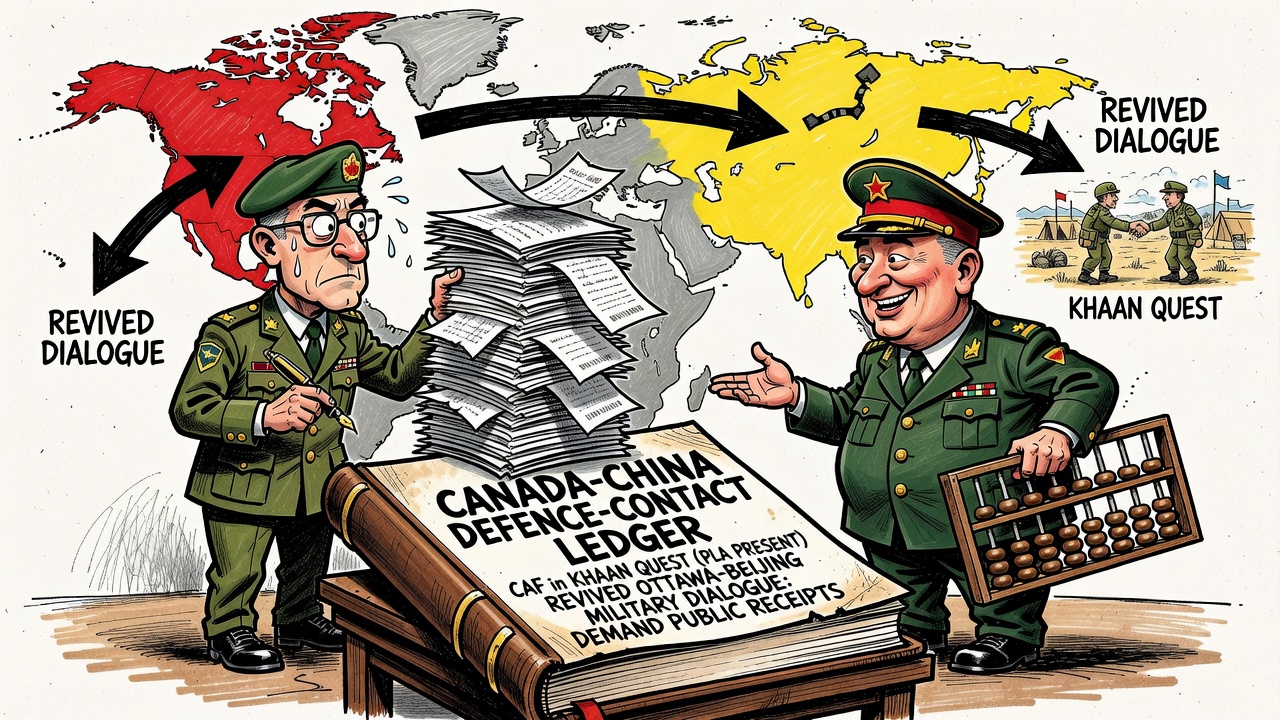
The issue is not whether Canada should ever speak to China’s military. Serious governments keep channels open with adversaries to reduce miscalculation. The issue is whether the Carney government expects Canadians to accept quiet defence engagement with Beijing on trust, while its own briefing materials describe China as a hard national-security problem.
Juno News reported that Conservative defence critic James Bezan wants the National Defence committee to study the Fifth Canada-China Defence Coordination Dialogue and reports that three Canadian Armed Forces specialists took part in Exercise Khaan Quest 2023, a multinational exercise in Mongolia where People’s Liberation Army personnel were also present. Dominion Review’s caution is important: this was not fairly described as Canada “sending troops to China” for a bilateral training mission. It was a multinational exercise. Accuracy matters.
But accuracy does not make the accountability question disappear. If CAF specialists participated in an exercise where PLA personnel were present, who approved it? What restrictions governed contact? What information, tactics, systems or procedures were protected? Was there an after-action assessment? Were allies consulted? Was Parliament told?
The same question applies to renewed defence diplomacy. Juno reported that Canadian and Chinese officials met in Ottawa on September 4, 2026, for the first defence coordination dialogue since 2018, with China announcing the meeting before Ottawa confirmed it after media inquiries. That is exactly backwards for a government that says transparency and national security can coexist.
National Defence’s own 2026 material says Canada remains concerned about China’s Arctic ambitions, Taiwan-area activity and South China Sea militarization, while also engaging the PLA to reinforce guardrails and reduce miscalculation risk. Global Affairs briefing material likewise describes a recalibration of China policy, not a disappearance of risk.
So publish the China defence-contact ledger. List every CAF or defence-official contact with PLA counterparts since 2018, including exercises, dialogues, delegations and staff-level meetings. Release the approval authority, purpose, agenda, participating units or offices, risk assessment, information-security rules, allied-notification record, after-action findings and any commitments made.
A conservative foreign policy is not reckless silence and it is not naive engagement. It is peace through strength, transparency through receipts, and Parliament doing its job before sensitive channels become another “trust us” file. If the government believes these contacts are prudent, it should be able to show the guardrails.
- Juno News: Tories Demand Inquiry Into China Military Training Reports
- Dominion Review: Should Canada Risk Training Chinese Troops?
- Parliament of Canada committee index: National Defence Committee Meetings
- National Defence: Briefing Materials — Mandate Priorities and NATO 2%
- Global Affairs Canada: Briefing Documents — Canada-China Relationship
This article distinguishes between reported CAF participation in a multinational exercise where PLA personnel were present and an unproven bilateral “training China” claim.