PBO’s $733B Borrowing Warning Needs a Real Debt Ledger
An operating-budget target is not a balanced budget. The cash-borrowing ledger is where the real pressure shows up.
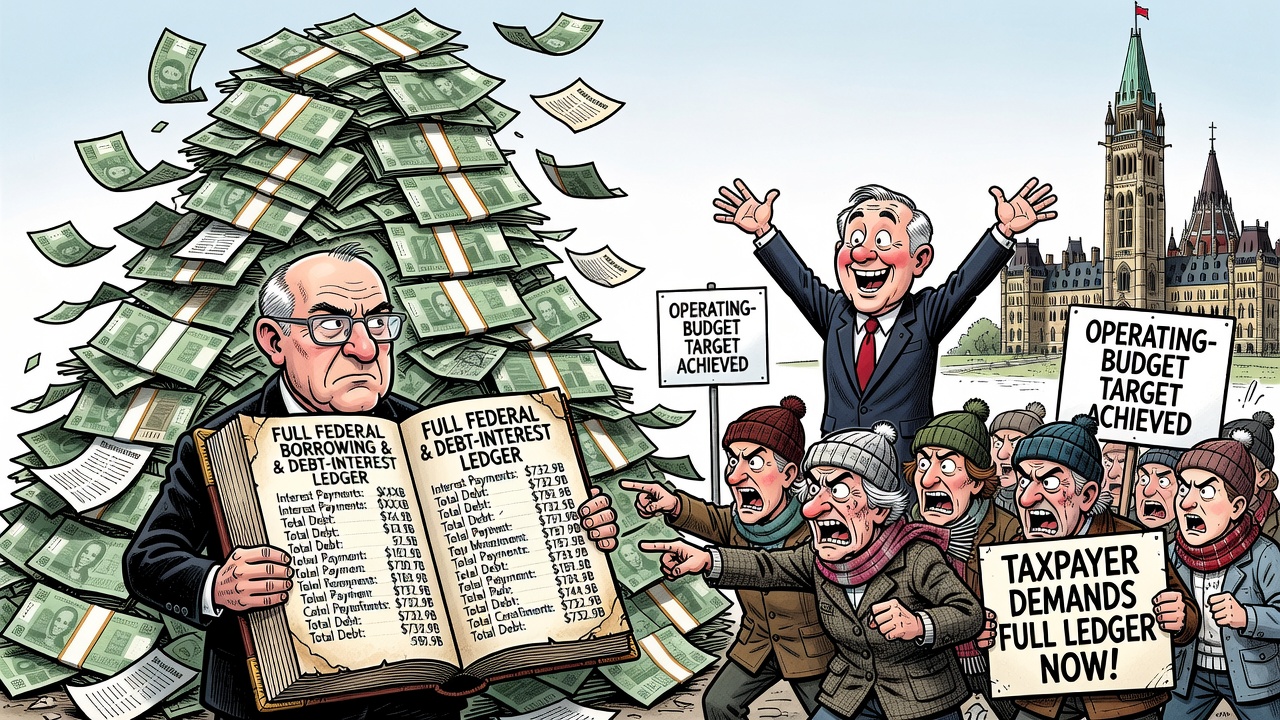
The Parliamentary Budget Officer’s October 2026 outlook gives Canadians the fiscal sentence Ottawa would rather mumble: spending, borrowing and debt are still rising even as the government points to an operating-budget anchor. The PBO projects a $63.3 billion deficit in 2026-27, a $70.2 billion deficit in 2027-28, and cumulative deficits of $333.3 billion over the next five years.
That is bad enough. But the bigger accountability problem is the cash side of the ledger. PBO projects federal borrowing will rise by $732.9 billion over the same five-year period — more than double the cumulative deficits. The office explains why: government can borrow to finance loans, capital investments, defence procurement and other financial assets that do not flow through the deficit the same way under accrual accounting.
That distinction matters because Prime Minister Mark Carney’s fiscal sales pitch leans heavily on balancing the operating budget. PBO says the government is projected to meet that operating anchor in 2028-29 with a $6.2 billion surplus. But the watchdog also says a balanced operating budget should not be read as a balanced fiscal position. By design, the operating target excludes debt-financed capital spending, so borrowing and debt can keep growing while the podium line sounds disciplined.
Conservatives should not let Ottawa hide behind labels. Capital spending can be justified when it produces real assets, higher productivity and transparent returns. Defence procurement, infrastructure and Crown-corporation loans may all have legitimate purposes. But taxpayers still carry the financing risk, the interest bill and the opportunity cost. Calling something capital does not make it free, and booking it differently does not make it disappear.
The PBO’s second warning is that the government is not projected to meet its fiscal anchor of a declining deficit-to-GDP ratio. The federal debt-to-GDP ratio is projected to rise every year from 40.8 per cent in 2026-27 to 42.6 per cent in 2030-31. The report also projects per-capita federal debt rising to $39,191 by 2030-31.
Before the next budget, Ottawa should publish a plain-English five-year borrowing ledger: every major capital envelope, Crown loan, defence procurement line, Build Canada Homes commitment, Canada Strong Fund item, expected borrowing requirement, maturity profile, interest-cost sensitivity and per-capita debt impact. The public should be able to compare the deficit speech with the debt invoice.
If Carney wants credit for fiscal discipline, he should start by showing the whole bill.
- Parliamentary Budget Officer: Economic and Fiscal Outlook — October 2026
- Parliamentary Budget Officer: News release and key findings
- The Deep Dive: PBO Identifies $43.8 Billion Outside Carney’s Operating Budget Target
This article relies primarily on the PBO’s October 20, 2026 outlook and news release. It does not argue that all capital borrowing is improper; it argues that borrowing, interest costs and debt impacts should be disclosed in one public ledger.