India’s 15-Million-Worker Math Needs a Canadian Capacity Ledger
A foreign diplomat’s 15-million-worker arithmetic is not an official Canadian plan. That is exactly why Ottawa needs to publish the official capacity ledger.
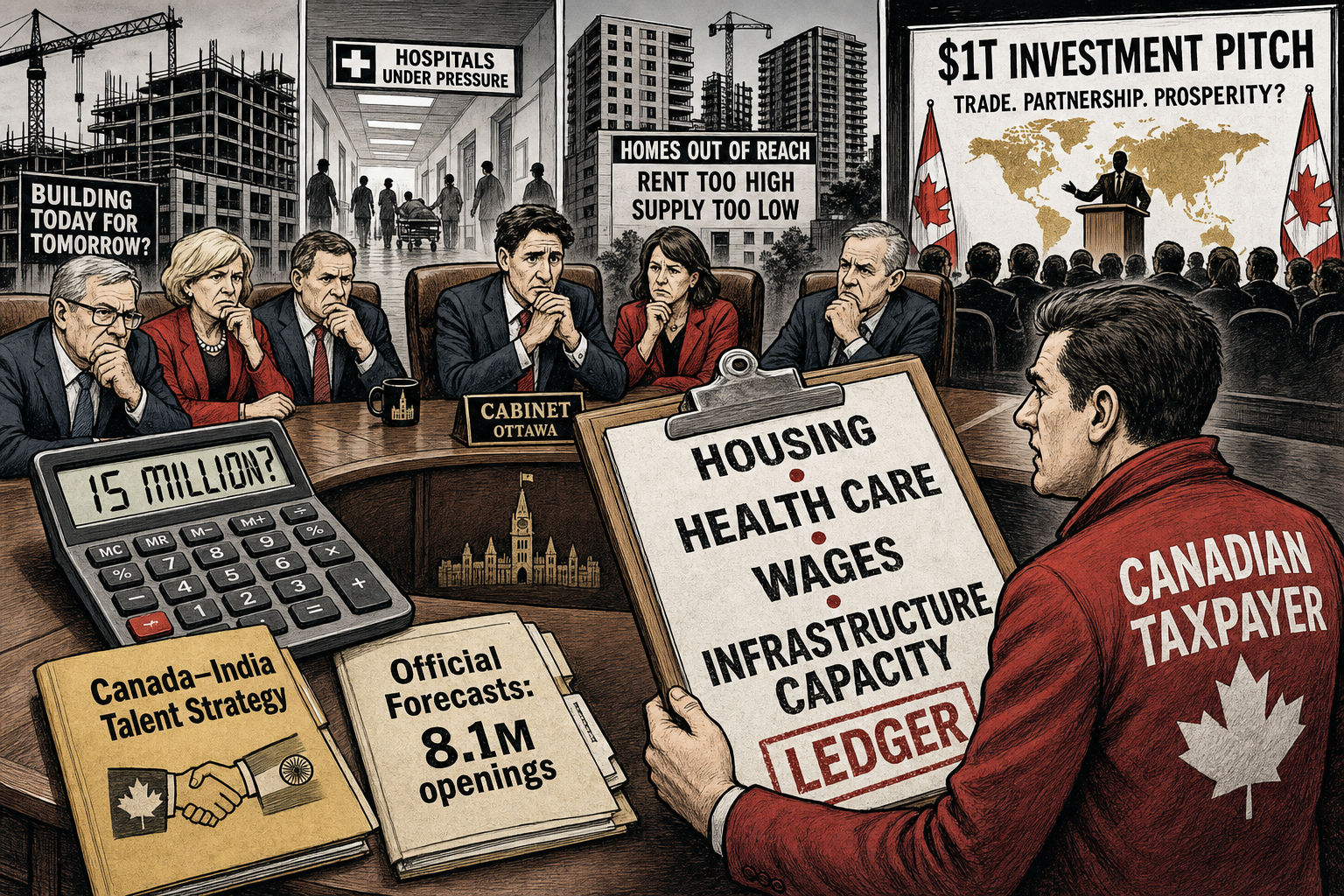
India’s High Commissioner to Canada, Dinesh Patnaik, has handed Ottawa an accountability problem it cannot solve with slogans. Juno News reported that Patnaik used an October 9 CPAC interview to argue that Canada’s workforce is shrinking and that Canada needs far more people and jobs. Rebel News reported the sharper version: Patnaik tied Prime Minister Mark Carney’s investment ambitions to a calculation that could imply 15 million jobs over 10 years.
That is not the same thing as an official Canadian immigration target. It is not proof of a secret plan. But it is serious enough that the Prime Minister’s Office should stop hiding behind ambiguity and publish the math Ottawa is actually using.
The investment push is real. In September, Carney told investors that Canada had secured nearly half a trillion dollars in new investment commitments from the Canada Investment Summit and promised “tens of thousands” of jobs in construction, trades, technology and strategic sectors such as energy, critical minerals, artificial intelligence and defence. In March, the PMO also announced a Canada–India partnership built around energy, talent and technology, including a Canada–India Talent and Innovation Strategy, education exchanges, AI cooperation and a goal to more than double trade to $70 billion by 2030.
Those are major policy commitments. They also create an obvious question: how many workers does Ottawa believe this agenda requires, by sector, by province and by year?
Immigration News Canada’s fact-check is useful because it separates rhetoric from official forecasting. It says the 15-million figure traces to an interview calculation, not a government labour-market forecast, and notes that Employment and Social Development Canada’s official 2024–2033 occupational projections estimate 8.1 million job openings over the decade. That is still a huge number, but it is not the same as 15 million new foreign workers, 15 million permanent residents or 15 million net-new jobs.
A conservative accountability standard is simple: if Ottawa wants Canadians to accept a build-faster, invest-bigger, import-talent strategy, it must publish a talent-and-capacity ledger before expanding any labour-mobility stream tied to that strategy. The ledger should show official job-opening forecasts, domestic worker supply, expected graduates, regional unemployment, wage impacts, housing starts, rental vacancy rates, hospital capacity, school capacity, transit pressure and the specific Canada–India commitments that could affect student, worker or research flows.
Canada can trade with India. Canada can welcome skilled newcomers. Canada can build major projects. But a country is not managed by diplomatic arithmetic. It is managed by public forecasts, capacity planning and democratic consent.
If the 15-million number has no role in federal planning, Carney should say so clearly and table the real numbers. If Ottawa is using any version of that math behind closed doors, Canadians deserve to see it before the housing market, health system and wage base are asked to absorb the consequences.
- Juno News: India’s top diplomat says Canada ‘needs’ 100M people, 15M new jobs
- Rebel News: India’s ambassador says Canada needs 15 million workers in 10 years
- Immigration News Canada: Canada Needs 15 Million More Workers? Here’s What’s Actually True
- Prime Minister of Canada: Carney remarks at the 2026 Canada Investment Summit
- Prime Minister of Canada: Canada–India partnership on energy, talent and technology
- ESDC COPS: Occupational projections 2024–2033
This article treats the 15-million figure as an unofficial interview calculation, not as a confirmed federal plan. It argues for disclosure of Ottawa’s actual labour and capacity assumptions before any related policy expansion.