Ottawa’s Aid-Promotion Grants Need a Receipts Ledger
If Ottawa is cutting, recalibrating and selling foreign aid all at once, taxpayers deserve the ledger.
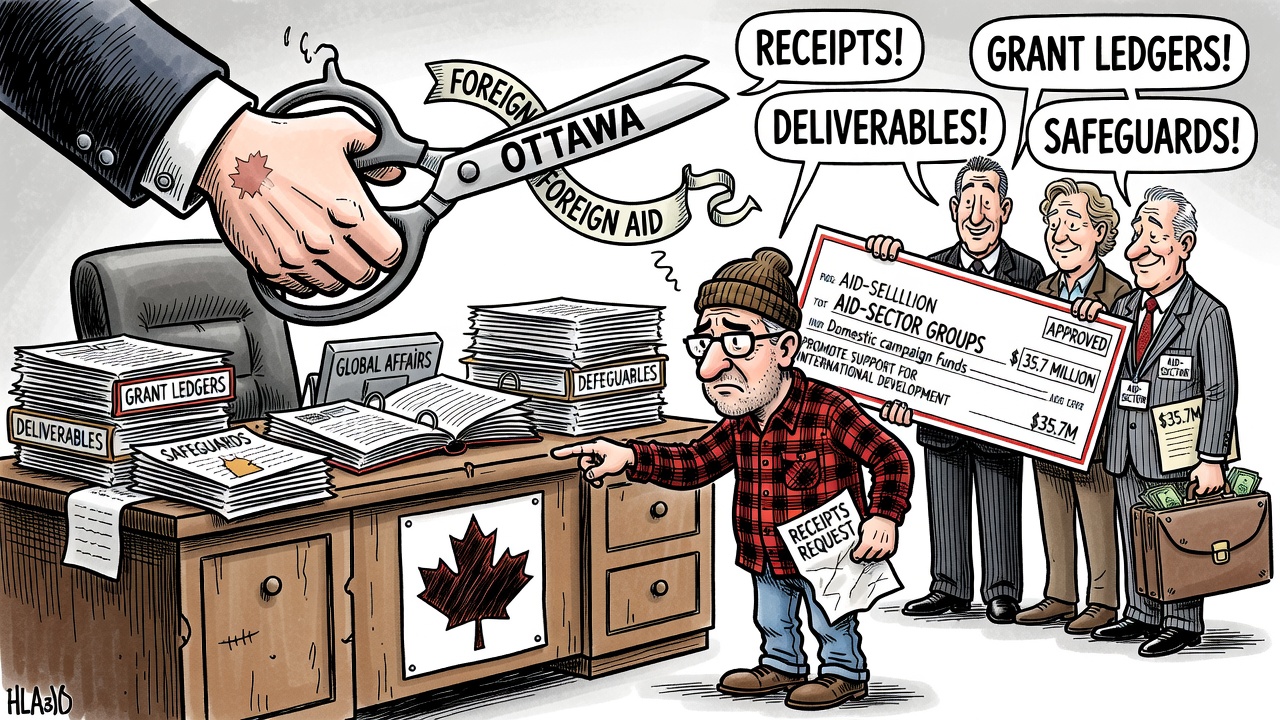
Ottawa’s foreign-aid message has become a credibility problem. Budget 2025 says Global Affairs Canada will “refocus” and “re-baseline” international assistance, including a $470.4 million recalibration in 2026-27 and larger annual reductions after that. At the same time, federal grant records show Global Affairs funding a five-year domestic public-engagement push designed to build support for international development assistance.
The program is called Engage: Global Citizens, Global Impact. Rebel News reported Monday that eight contribution agreements total $35,682,659. The government’s own grants database shows the pattern: British Columbia, Atlantic, Alberta and Manitoba councils each appear with $4,191,057 agreements, while the Ontario Council for International Cooperation has a $7,292,439 agreement running from April 27, 2026 to July 31, 2031.
The Ontario record is unusually plain about purpose. It says the project seeks to increase awareness, understanding and engagement regarding international cooperation, gender equality and the Sustainable Development Goals. Its expected ultimate outcome is to “enhance the support for Canada’s international development assistance.” Activities include storytelling, awareness campaigns, International Development Week work, youth leadership, community dialogues, global knowledge exchanges and micro-grants.
That may all be legal. It may even be well-intentioned. But conservatives should ask the obvious accountability question: why is money from the International Development Assistance program, whose stated purpose is poverty reduction in countries where Global Affairs engages in development, being used to persuade Canadians at home to support the very envelope cabinet says must be recalibrated?
The Inter-Council Network announced the initiative in February as a $36 million Canadian investment, saying it was shared by Randeep Sarai at an International Development Week parliamentary reception. ICN said the program was expected to reach more than four million Canadians, particularly underrepresented communities. That sounds less like a quiet administrative grant and more like a national persuasion infrastructure.
If the government wants to defend that choice, it should publish the receipts instead of relying on slogans. Canadians need the full list of recipients, agreements, subcontractors, communications vendors, campaign plans, paid-media budgets, micro-grant rules, performance metrics and final deliverables. They also need safeguards proving public money will not become partisan advocacy, lobby pressure or a government-funded echo chamber against future restraint.
Foreign aid can be debated honestly. Poverty reduction, humanitarian relief and Canadian interests abroad all deserve scrutiny. What does not deserve a pass is a government that cuts and “recalibrates” aid in one document, then pays sector councils millions to build domestic support for aid in another.
Publish the aid-promotion ledger.
- Government of Canada grants database: Global Affairs grants search page listing Engage agreements
- Government of Canada grants database: Ontario Council for International Cooperation agreement record
- Budget 2025: Comprehensive expenditure review — Global Affairs reductions
- Inter-Council Network: ICN announcement of $36M Engage initiative
- Rebel News: Report calculating eight agreements at $35,682,659
This article argues for disclosure and value-for-money scrutiny. It does not allege unlawful conduct by any recipient, public servant or elected official.