Hikvision Cameras Need a Public Compliance Ledger
National-security orders are only real if departments obey them. Canadians deserve the inventory, removal and network-isolation receipts.
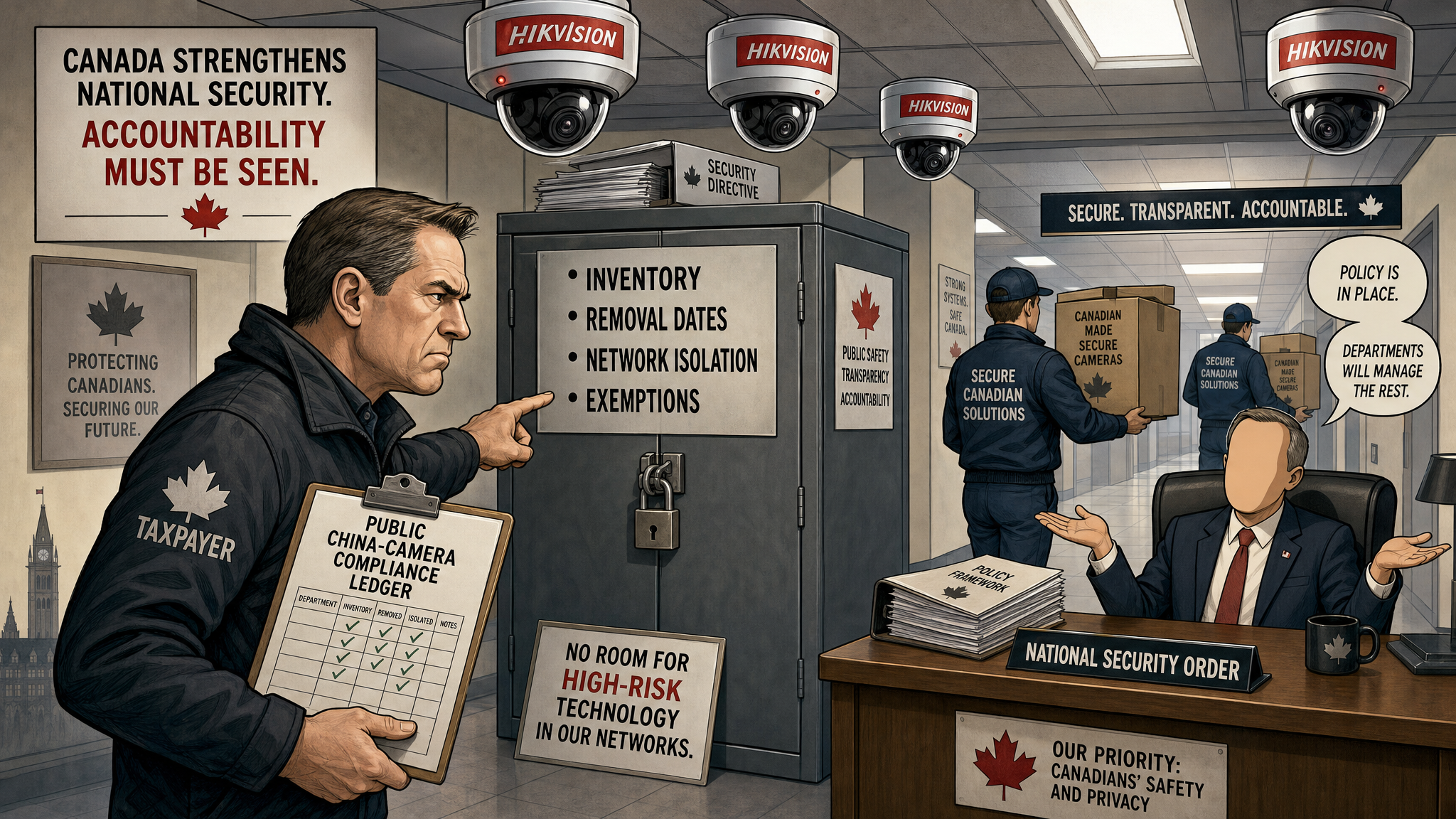
Ottawa cannot claim a national-security victory over Hikvision and then leave Canadians guessing whether federal buildings still contain the company’s cameras.
The official record is clear on the first half. Innovation, Science and Economic Development Canada’s national-security decisions page says that, on June 27, 2025, the Governor in Council ordered Hikvision Canada Inc. to wind up its Canadian business and cease all operations in Canada. Reporting on the order says the government also moved to bar federal departments, agencies and Crown corporations from purchasing or using Hikvision equipment, while reviewing existing properties so legacy products would not be used going forward.
The second half is where accountability breaks down. National Post reporting republished by Unpublished says several federal organizations declined to say whether they still used Hikvision cameras, while the National Research Council and the Windsor-Detroit Bridge Authority acknowledged continued use in limited settings. According to that reporting, NRC said remaining cameras were not connected to the internet or NRC networks and were used for non-sensitive experiments and work areas; WDBA said cameras at a community office would be out of service by November 2026.
Those explanations may or may not be sufficient. The public cannot know without a ledger. If a device is risky enough for a federal national-security order, taxpayers should not have to accept vague assurances, litigation references or department-by-department silence. They should see which agencies had Hikvision gear, where it was located in general non-sensitive terms, whether it was connected to any network, when it was removed, who approved any temporary exception, and what replaced it.
This is not a call to publish security vulnerabilities or camera maps. It is a call to publish compliance receipts. A serious government can protect operational security while still telling Canadians whether its own departments followed a national-security order. “Trust us” is not a control system.
Hikvision has denied that its products endanger Canadian national security and has challenged Ottawa’s shutdown order, arguing the review was procedurally unfair. That legal fight is part of the record. But it does not erase Ottawa’s responsibility to manage its own procurement estate. If the government says the risk justifies a wind-up order, it must also prove federal entities complied.
Conservatives should press for an agency-by-agency China-camera compliance ledger: inventory counts, acquisition dates, removal dates, network-isolation status, replacement contracts, costs, exemption rationales, inspection methods and accountable officials. If any cameras remained after the ban, Canadians should know why, for how long and under whose authority.
National security cannot be a press release. It has to be an auditable chain of decisions, removals and sign-offs. Publish the Hikvision ledger.
- ISED: National security decisions under the Investment Canada Act
- National Post via Unpublished: Chinese surveillance cameras are still around, despite ban in government buildings
- National Post via Unpublished: How a Chinese surveillance camera giant operated “illegally” in Canada before being banned
- CityNews / Canadian Press: Hikvision challenge to Ottawa’s national-security order
This article argues for procurement and compliance transparency. It does not allege wrongdoing by any individual federal employee and does not call for disclosure of sensitive facility layouts or security vulnerabilities.