Carney Says Vote No. His Minister Says Immigration Talks Are Already Happening.
If Ottawa is already talking with Alberta about immigration autonomy, voters deserve the dates, topics, constraints and service-capacity receipts before referendum day.
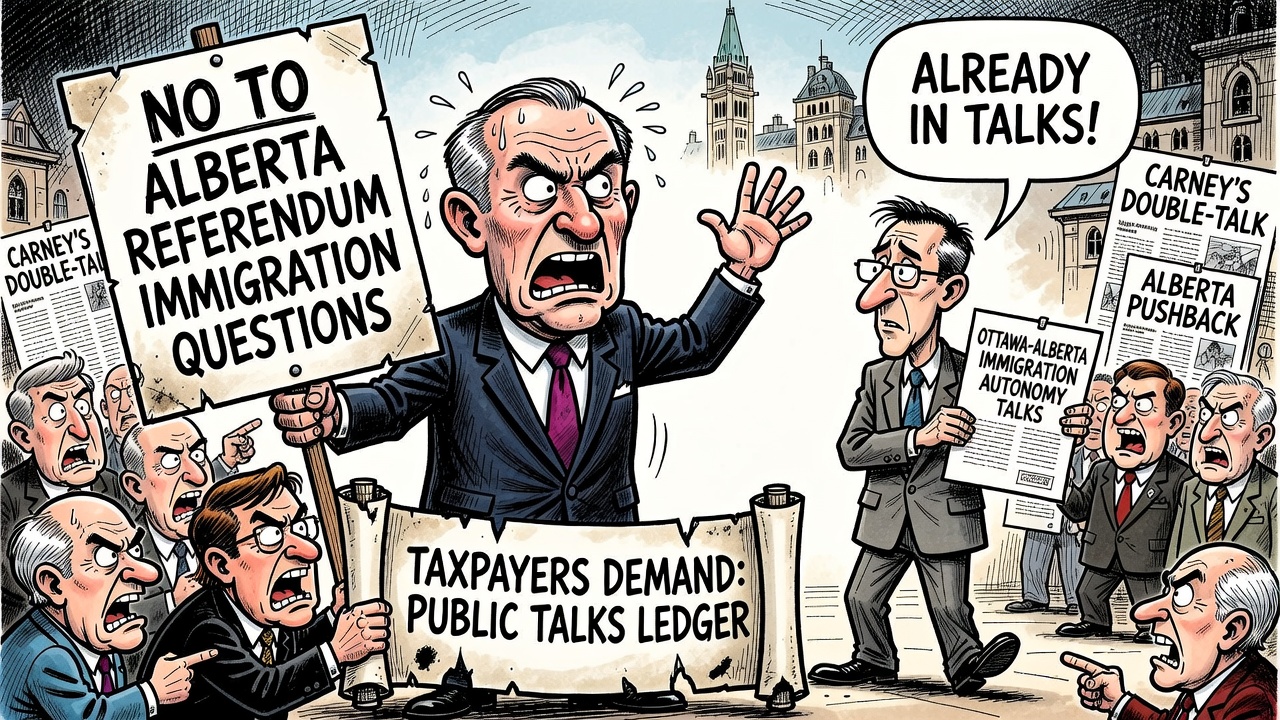
Prime Minister Mark Carney is asking Albertans to vote “No” to the non-separation referendum questions. His own government now has a simpler problem: one of Alberta’s federal ministers says Ottawa is already in talks with the province on immigration autonomy.
CTV News reported Sunday that Emergency Management and Community Resilience Minister Eleanor Olszewski said the federal government has worked to reset its relationship with Alberta, and that Ottawa and the province are already engaged on the immigration file. That matters because Alberta votes Monday, October 19, on a provincewide referendum package that includes questions about more provincial control over immigration, service eligibility, fees or waiting periods for non-permanent residents, proof of citizenship for voting, and an Alberta-priority newcomer stream.
There is nothing inherently wrong with federal-provincial talks. Conservatives should support a serious negotiation when Ottawa’s immigration decisions have strained housing, classrooms, hospitals, shelters and local labour markets. The problem is the contradiction. If Carney says Albertans should reject the questions, while a cabinet minister says Ottawa is already discussing the substance of those questions, the public deserves a ledger instead of a slogan.
That ledger should be basic. When did the Alberta immigration discussions begin? Who attended from the Prime Minister’s Office, Immigration, Refugees and Citizenship Canada, Public Safety, Finance, Employment and Alberta’s government? Which referendum topics are on the table? Has Ottawa modelled the housing, health-care, school-capacity and social-service impacts of any proposed change? What legal limits has Justice Canada identified? What anti-fraud and enforcement safeguards are being considered?
Carney’s Calgary message leaned on national unity and warned Albertans against opening a separation process. Fine. National unity is serious. But unity is not strengthened by telling voters “No” in public while negotiating pieces of the same agenda in private. It is strengthened by showing the work, admitting the tradeoffs and treating provincial concerns as legitimate enough to answer with evidence.
The old immigration consensus has already cracked under post-pandemic population growth, affordability pressure and uneven service capacity. Ottawa cannot repair that confidence gap with managed talking points. It must publish the meeting chronology, policy options, fiscal estimates, legal advice summary, consultation record and decision timeline.
If the federal answer to Alberta is truly “we hear you,” then prove it. If the answer is “vote No because Ottawa already has this handled,” then publish the receipts. Either way, Albertans should not be asked to cast ballots in the dark.
- CTV News: Immigration in Alberta: Ottawa, province already in talks, minister says
- CityNews / The Canadian Press: How Canada’s fractured immigration consensus is starting to show up at ballot boxes
- The Hub: Prime Minister Carney’s increased immigration proposal risks fracturing Canada further
This article argues for transparency around federal-provincial immigration talks. It does not endorse Alberta separation; it asks Ottawa to publish the evidence behind its position before voters cast ballots.