PBO Says Ottawa’s French-Rules Regime Needs a Cost Ledger
The issue is not whether French-language rights matter. The issue is whether Ottawa will show taxpayers and employers the true cost, coverage and enforcement receipts before the regime starts.
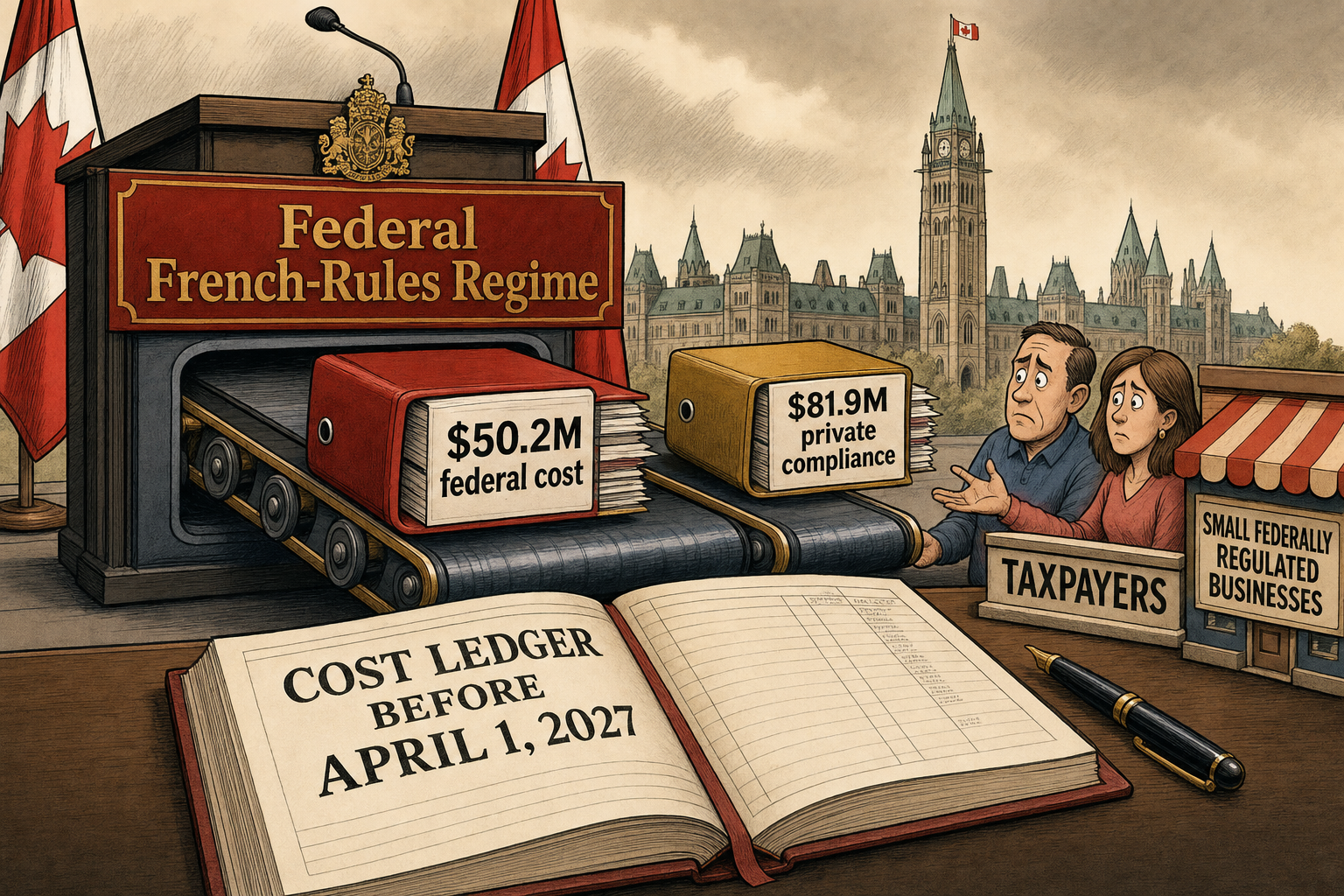
The Parliamentary Budget Officer has put numbers on Ottawa’s new federal French-rules regime, and they deserve more than a press-release answer from the Liberal government.
The regime is the Use of French in Federally Regulated Private Businesses Act, created when Parliament passed the official-languages overhaul in 2023. Canadian Heritage says the draft regulations would build the framework for new consumer and employee French-language rights and new employer obligations for federally regulated private businesses in Quebec and in regions with a significant or strong Francophone presence. The rights are real. So are the costs.
PBO’s updated estimate says the Act is not yet in force and, for costing purposes, assumes the relevant provisions and regulations begin on April 1, 2027. Under that assumption, PBO estimates federal implementation costs at $50.2 million from 2027–28 through 2031–32. The same report estimates private-sector compliance costs at $81.9 million over that period, mostly language training.
That is the accountability headline: Ottawa is preparing a national workplace-and-service language regime that moves costs both onto taxpayers and onto private federally regulated employers. PBO says $35.6 million of the federal cost is expected at the Office of the Commissioner of Official Languages because of new complaint-investigation duties. It also identifies private-sector costs tied to training, translation and signage, including $61.9 million for training, $18.8 million for translation and $1.1 million for signage over five years.
The coverage is not trivial. Federal materials say the regime applies in Quebec and designated regions outside Quebec, including all of New Brunswick, parts of Nova Scotia and Ontario, areas in Winnipeg and an area in Edmonton. Canadian Heritage says proposed thresholds are 25 or more employees in Quebec and 100 or more employees across Canada in designated strong-Francophone-presence regions. The affected sectors can include banks, telecommunications, parcel and courier companies and interprovincial transportation businesses.
Conservatives should be clear and fair here: protecting lawful official-language rights is not the problem. Hiding the operational bill is. If Ottawa believes this regime is worth the cost, it should be able to publish a plain ledger before implementation: which departments receive the $50.2 million, which businesses and regions are covered, how many firms fall above each threshold, what training hours are assumed, what exemptions apply, how complaints will be triaged and what results will be measured.
Rights policy without receipts becomes another Ottawa machine: forms, complaints, enforcement staff and costs nobody owns once the rules take effect. Before April 1, 2027, taxpayers and affected employers deserve the full ledger — not slogans about equality and not after-the-fact explanations when the bills arrive.
- Parliamentary Budget Officer: Updated Cost Estimate for An Act for the Substantive Equality of Canada’s Official Languages
- Canadian Heritage: Draft regulations announcement
- Justice Laws Website: Use of French in Federally Regulated Private Businesses Act
- Canadian Heritage: An Act to Support the Use of French
This article supports lawful official-language rights and argues for transparent cost, coverage and enforcement disclosure before implementation.