Ottawa’s $62.9M Toronto Asylum-Shelter Grant Needs a Year-End Ledger
A one-day, fiscal-year-end grant record for nearly $63 million is not enough. Publish the agreement, payment, audit and shelter-results receipts.
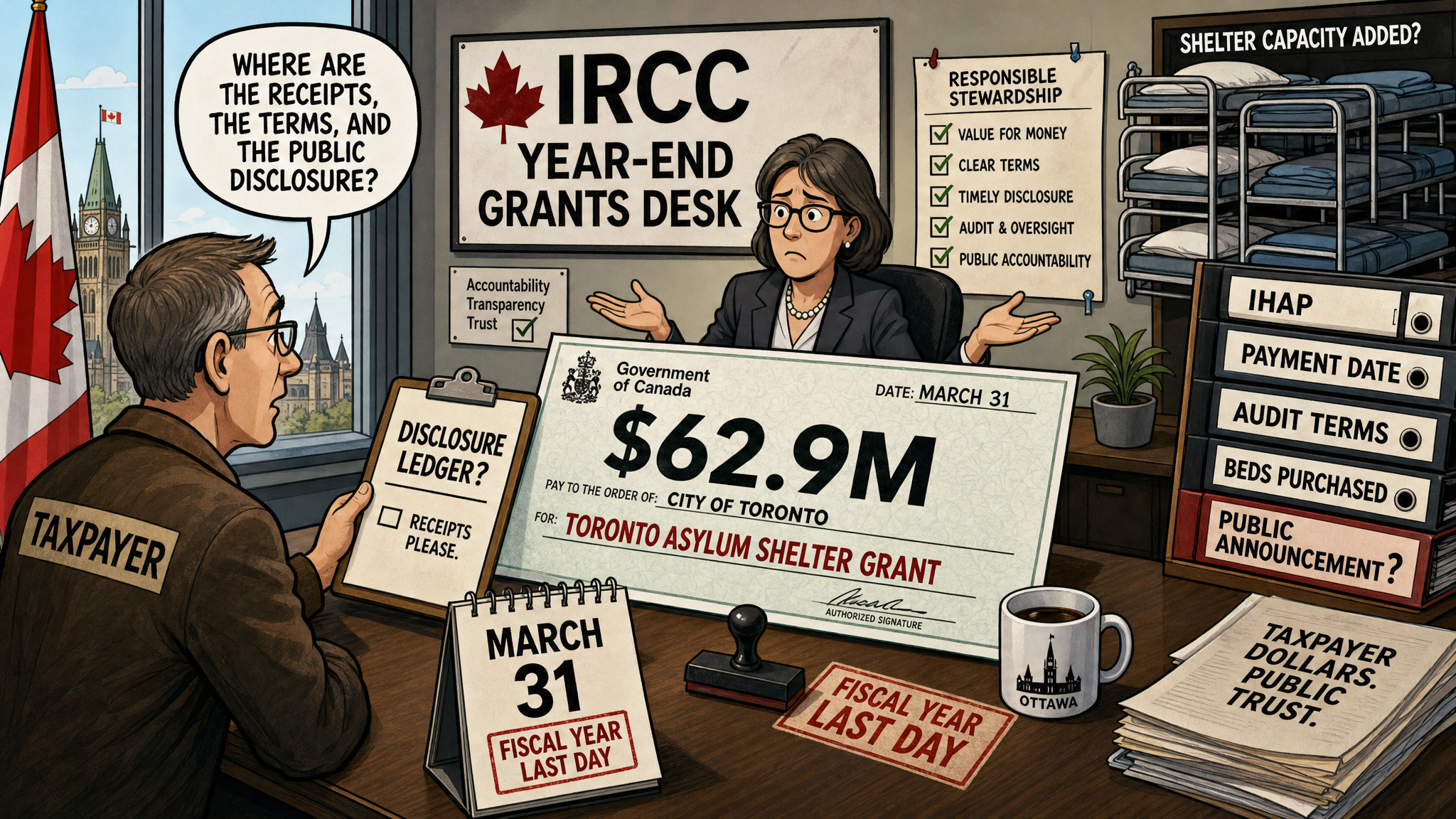
Ottawa’s asylum-shelter spending problem now has a very specific receipt: a $62.9 million grant to Toronto dated March 31, 2026 — the last day of the federal fiscal year.
The Government of Canada grants database lists an Immigration, Refugees and Citizenship Canada grant to “The City of Toronto / La ville de Toronto” titled “Funding to support the asylum claimants in Toronto.” The agreement value is $62,900,000. The agreement date is March 31, 2026 to March 31, 2026. The description says it was “One time Emergency Shelter Funding for City of Toronto including interim housing and support services for asylum claimants and newcomers.”
That may be lawful. It may even be necessary. But a one-day, year-end disclosure line for nearly $63 million is not enough accountability for taxpayers, Toronto residents, or the people relying on a strained shelter system. If the Carney government is going to move money this large through emergency shelter channels, Canadians deserve to see the agreement, the approval record, the payment timing and the results.
IRCC’s own committee briefing material confirms the broader context. As of January 31, 2026, the federal government said it had provided approximately $1.8 billion through the Interim Housing Assistance Program since 2017. It also said Budget 2024 extended and renewed IHAP to March 2027 with $1.1 billion, and that Ontario municipalities had received $1.2 billion through IHAP. In the same briefing, IRCC said it had finalized a $261.8 million IHAP agreement with Toronto for 2025–2027, plus an additional $62.9 million grant in 2025–2026 to support interim housing for asylum claimants and other newcomers while Toronto transitions to more sustainable, cost-effective approaches.
That is precisely why the March 31 record needs a public ledger. What beds, spaces, services, staffing or supports did the $62.9 million buy? Was the money paid on March 31, merely approved on March 31, or recorded that day after earlier negotiations? What reporting did Toronto owe Ottawa? What audit terms apply? How many claimants and newcomers were served? What was the per-person or per-night cost? What measurable shift toward “sustainable” shelter capacity was delivered?
There is a second disclosure problem. IRCC’s formal departmental plan describes the Canada-Québec Accord grant as ongoing compensation for settlement and integration services to permanent residents in Quebec, with $867.335 million listed in planned grants and a formula that cannot reduce the payment from the previous year. Yet the grants database also needs to be clear and consistent when large immigration-related entries use wording tied to asylum, irregular migration or extraordinary costs. If open data labels, program purposes and departmental plans do not line up cleanly, the public cannot follow the money.
This is not an argument against emergency shelter support. It is an argument against emergency-government bookkeeping becoming normal. A serious government would publish the Toronto agreement, ministerial authorization, payment date, performance measures, audit rights, public announcement history, and a year-end reconciliation showing exactly what taxpayers bought.
Nearly $63 million should not live as a lonely line item. It should come with receipts.
- Government of Canada grants database: Funding to support the asylum claimants in Toronto
- IRCC committee briefing: Support for Asylum Claimants — March 23, 2026
- IRCC departmental plan: Details on transfer payment programs
- Rebel News lead: Ottawa lists $62.9 million asylum shelter grant to Toronto
This article argues for public spending disclosure. It does not allege that the City of Toronto, IRCC officials, asylum claimants or newcomers committed wrongdoing.