The Hikvision Ban Needs a Compliance Ledger
A national-security order is only as strong as the follow-through.
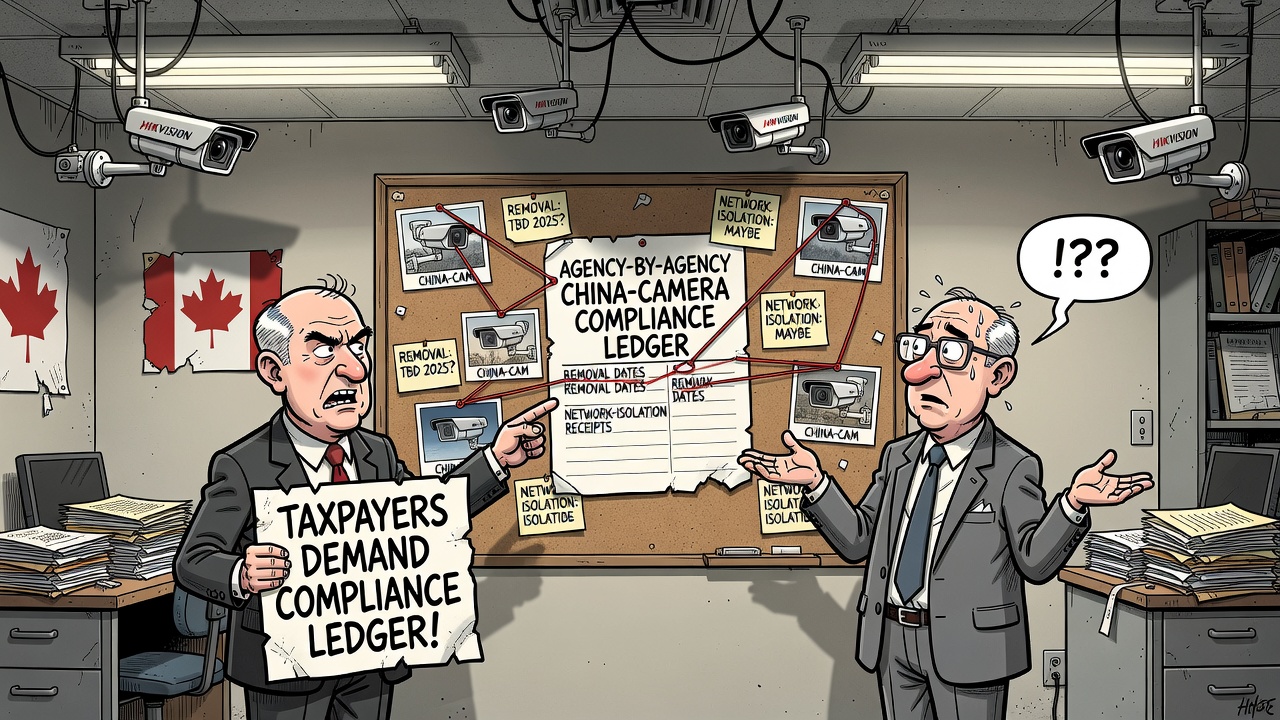
Ottawa cannot treat national security like a press-release exercise. If the government bans a Chinese surveillance company, then federal departments, agencies and Crown corporations should be able to show Canadians the inventory, the removal dates and the executive who signed off on compliance.
That is the problem raised by new reporting on Hikvision cameras. The federal Investment Canada Act national-security decisions page says that on June 27, 2025, the Governor in Council ordered Hikvision Canada Inc. to wind up its Canadian business and cease all operations in Canada. Global News reported at the time that Industry Minister Mélanie Joly also said Ottawa was moving to ensure federal departments, agencies and Crown corporations do not use or purchase Hikvision equipment.
Now comes the accountability gap. National Post reporting mirrored by Unpublished says Joly called it “unacceptable” that some federal organizations continued using Hikvision cameras after the ban. The report identified continued use at the National Research Council and the Windsor-Detroit Bridge Authority, while saying the NRC described remaining cameras as being in “non-sensitive experiments and work areas” and expected removal by year-end. It also reported the bridge authority confirmed continued use in a community meeting space until November.
Maybe some of those cameras were isolated. Maybe some were in low-risk spaces. Maybe replacements were already ordered and delayed by procurement. Those explanations may be true. But they are not a substitute for a public compliance ledger, especially after Ottawa told Canadians the company’s Canadian operations posed national-security concerns.
The silence matters too. The same reporting says five federal bodies declined to say whether they had complied: the Canadian Space Agency, Employment and Social Development Canada, Environment and Climate Change Canada, Agriculture and Agri-Food Canada, and Parks Canada. National security does not require broadcasting building schematics or camera blind spots. It does require basic public assurance that prohibited equipment is not quietly lingering across the federal estate.
A conservative accountability standard is straightforward: if Cabinet issues a national-security order, the bureaucracy must execute it and prove execution without hiding behind vague talking points. Ottawa should publish an agency-by-agency Hikvision inventory as of the June 2025 order, the number removed, the number still installed, the planned removal date for each exception, and the reason any device remained after the ban. It should include Crown corporations, leased offices, laboratories, third-party managed buildings and federally funded facilities where Ottawa controls procurement or security policy.
Canadians also deserve technical receipts. Were any remaining devices connected to government networks? Were they physically disconnected, firewalled or operating only in closed test environments? Who verified that isolation? Which senior official accepted the residual risk? Which replacement contracts were issued, and were replacement vendors screened for foreign-state risk?
The point is not to panic over every camera in a hallway. The point is competence. A government that cannot track banned surveillance equipment after a national-security decision is asking Canadians to trust words instead of systems. Publish the Hikvision compliance ledger.
- Government of Canada / ISED: Investment Canada Act national-security decisions
- Global News: Ottawa orders Chinese tech firm to close Canadian operations over national security
- Unpublished / National Post mirror: Joly says it is unacceptable that government offices continue to use banned Chinese cameras
- Government of Canada / ISED: Committee briefing materials referencing Hikvision order and legal challenge
This article argues for federal compliance transparency. It does not claim any specific remaining camera was connected to a sensitive network unless public records establish it.