Bill C-31 Needs a Secrecy Schedule Ledger
A budget bill should not quietly expand mandatory secrecy without a public explanation, a necessity test and a sunset review.
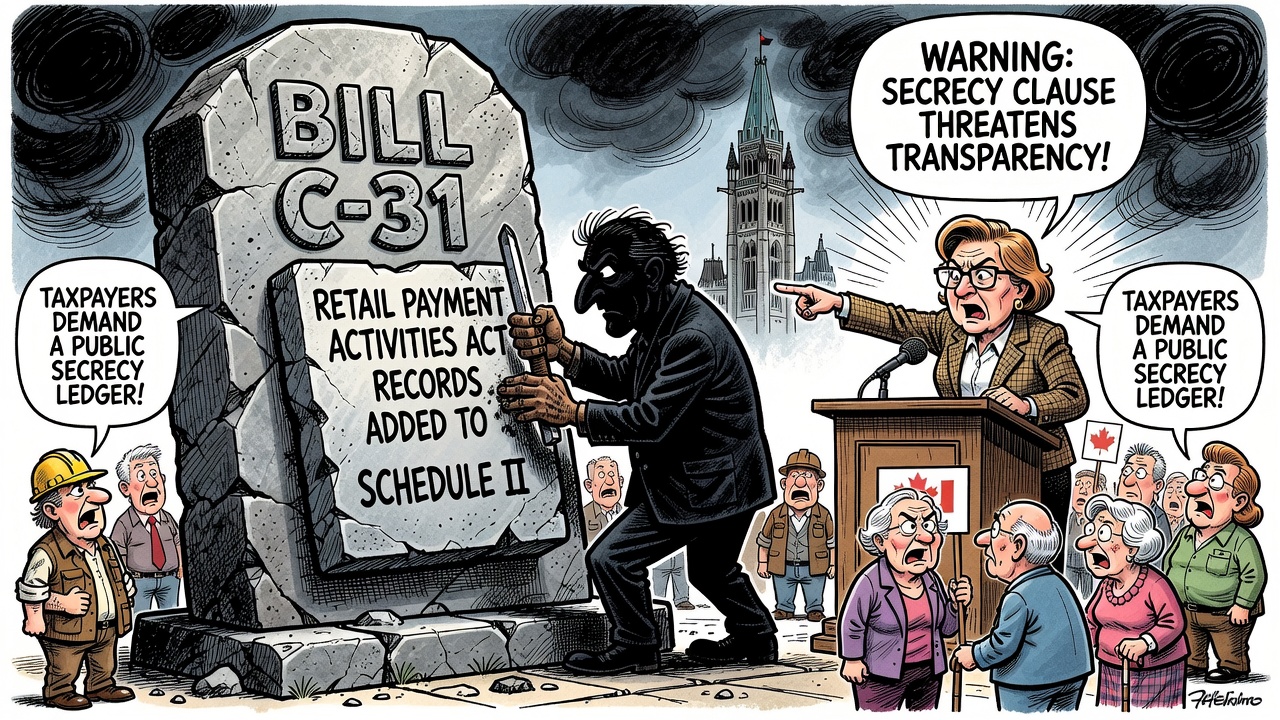
Bill C-31 has a transparency problem. The issue is not whether payment-system regulators sometimes need confidentiality. They do. The issue is whether Mark Carney’s Liberal government can keep adding mandatory access-to-information carveouts through budget legislation while the public is told to trust that every new lock is necessary.
Information Commissioner Caroline Maynard flagged the problem in a September 21 letter to the Senate Banking, Commerce and the Economy committee. Her office said Bill C-31 would add subsections 62(1) and 63(1) of the Retail Payment Activities Act to Schedule II of the Access to Information Act. That matters because section 24 of the Access to Information Act creates a mandatory exemption for information restricted by provisions listed in Schedule II.
In plain English: once a confidentiality provision is placed on that schedule, departments do not simply weigh disclosure against harm. They must refuse disclosure where the scheduled provision applies. That is a powerful tool. It should come with a public burden of proof, not a quiet line item in an omnibus budget bill.
Maynard’s letter says her office was not consulted. It also says the proposed change does not appear to address a genuine gap and may add protection that is not necessary, because the Access to Information Act already contains exemptions that can protect law enforcement, regulatory investigations, commercial confidences and other sensitive records when the evidence supports withholding them.
This is exactly where conservatives should insist on institutional discipline. Limited government is not just lower spending. It is a government that has to show its work before closing another file drawer. If Ottawa wants more secrecy around retail payment supervision, then Ottawa should publish the legal memo explaining why existing exemptions are inadequate, who requested the change, what records will be covered, how often the provision is expected to be invoked and when Parliament will review it.
The broader trend is not reassuring. Maynard warned senators that Schedule II has expanded from 33 listed provisions in 1983 to 73 today. Every addition narrows the public’s right to know. Some additions may be justified. But a government that keeps expanding the secrecy schedule without consulting the access watchdog is asking Canadians to accept accountability on faith.
That is not good enough. Before Bill C-31 moves further, the Carney government should table a Schedule II ledger: each proposed secrecy clause, the requesting department, the consultation record, the specific harm being prevented, the existing exemptions considered, the expected volume of withheld records and a sunset or review date. If the case is strong, publish it. If it cannot survive daylight, it should not become law.
- Office of the Information Commissioner of Canada: Letter to the Standing Senate Committee on Banking, Commerce and the Economy (BANC), September 2026
- Parliament of Canada LEGISinfo: Bill C-31, 45th Parliament, 1st Session
- Blacklock’s Reporter: Warns Of Expanding Secrecy
This article argues for disclosure controls and parliamentary review. It does not claim that all Retail Payment Activities Act confidentiality protections are improper; it asks Ottawa to prove why another mandatory Access to Information Act Schedule II exemption is necessary.