Pacific Link’s Métis Consultation Gap: Publish the Missing-Invite Ledger
A national-interest designation is not a consultation receipt.
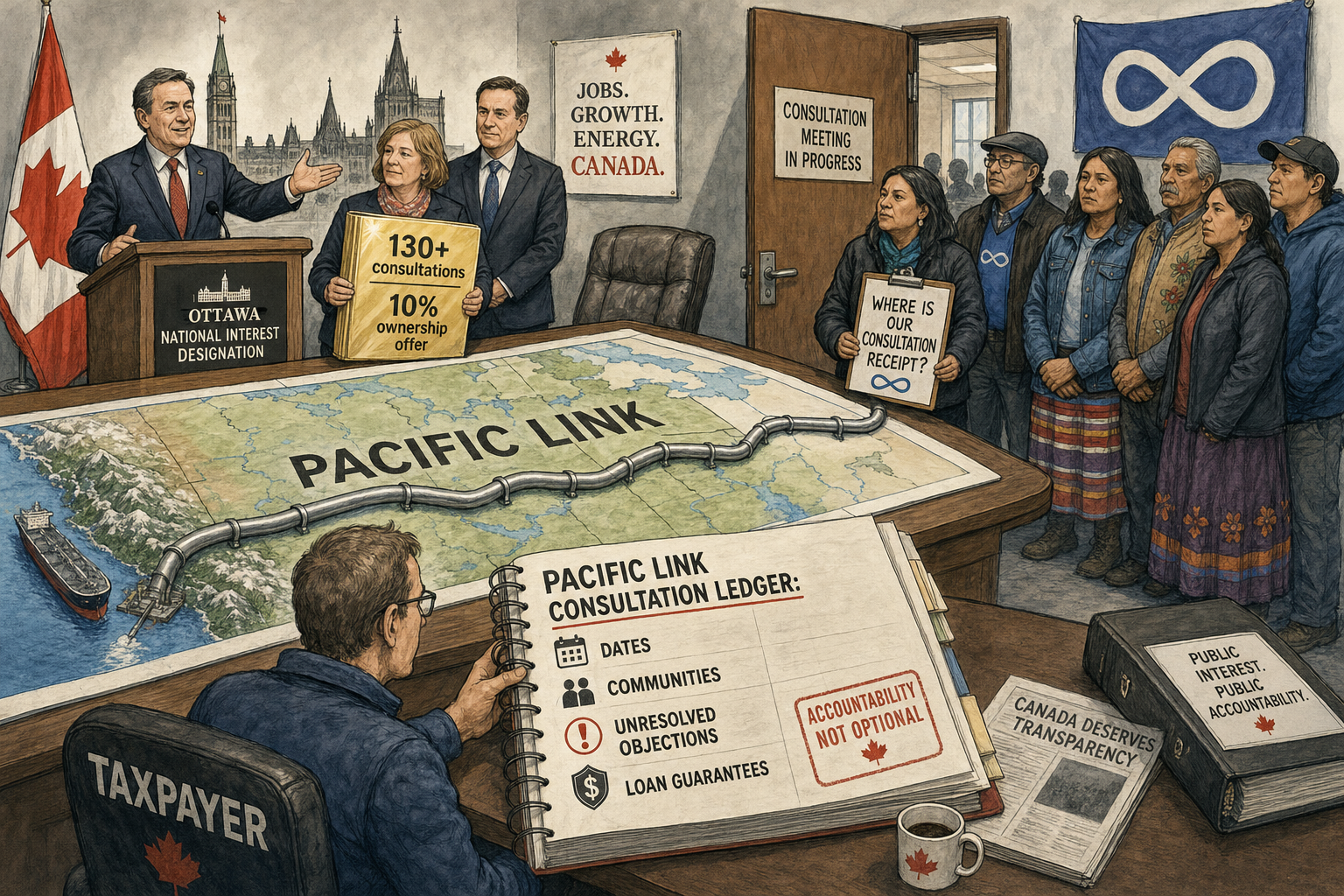
Pacific Link may be sold as a nation-building energy project. It still has to pass a basic accountability test: Ottawa must be able to show who was consulted, when, what they raised, and what remains unresolved before approvals are locked in.
CBC reports that Métis leaders in Alberta’s Wood Buffalo region say Prime Minister Mark Carney did not meet with them before the Oct. 1 national-interest designation for the proposed Pacific Link pipeline. The leaders represent six communities — Fort McMurray, Fort Chipewyan, Fort McKay, Willow Lake, Conklin and Chard — and say they were also not invited to the federal-provincial announcement or briefed on ownership stakes before the public rollout.
That matters because Ottawa’s own announcement leaned heavily on consultation as a selling point. The Prime Minister’s Office said the Major Projects Office consulted more than 130 Indigenous communities near or along potential routes in Alberta and British Columbia. It also said Indigenous communities would be offered at least 10 percent ownership, financed through federal and Alberta Indigenous loan-guarantee programs.
Those claims may be true as far as they go. They are not enough. A large number on a press release is not a receipt. If six affected Métis communities in the oilsands region say they were not at the table, the public should see the table: the contact list, meeting dates, officials present, issues raised, written responses, unresolved objections, and whether Métis-specific rights and governance were treated as an afterthought.
The government is promising speed. PMO says Pacific Link would move an additional one million barrels per day to Asian markets, create 140,000 jobs, generate more than $20 billion in GDP per year, and target final project conditions by Sept. 1, 2027. Conservatives should not reflexively oppose that ambition. Canada needs projects, exports and private-sector investment. But conservatives should be first in line demanding that governments stop laundering risk through slogans.
Indigenous consultation cannot become a checkbox for a project Ottawa has already politically blessed. Athabasca Tribal Council publicly confirmed that five First Nations chiefs met with Carney on Sept. 30. UBCIC, from the B.C. side, rejected the designation the same day it was announced, arguing consultation was incomplete and title and rights concerns were ignored. CBC’s new reporting adds a Métis gap in Alberta. Together, those facts demand disclosure, not defensiveness.
The solution is simple: publish the Pacific Link consultation ledger. List every community contacted, every meeting date, every community not yet reached, every issue still unresolved, the ownership-allocation criteria, the loan-guarantee exposure, the environmental and cumulative-impact concerns, and who can still change project conditions before Sept. 1, 2027.
Build fast, if the case is solid. But build honestly. A national-interest designation should be the beginning of transparent proof, not the end of it.
- CBC News: Métis leaders in oilsands region say they haven’t been consulted on proposed Pacific Link pipeline
- Prime Minister of Canada: Prime Minister Carney lists Pacific Link as a project of national interest
- Athabasca Tribal Council: Prime Minister Carney visits with Athabasca Tribal Council Chiefs
- Union of B.C. Indian Chiefs: UBCIC rejects national-interest designation for Pacific Link
This article supports lawful resource development with transparent consultation, rights records and taxpayer-risk disclosure. It criticizes federal process, not any Indigenous community’s position on the project.