Carney’s Fast-Track Trade Rules Need a Parliamentary Scrutiny Ledger
Faster trade diversification is not a blank cheque to shrink Parliament’s review window.
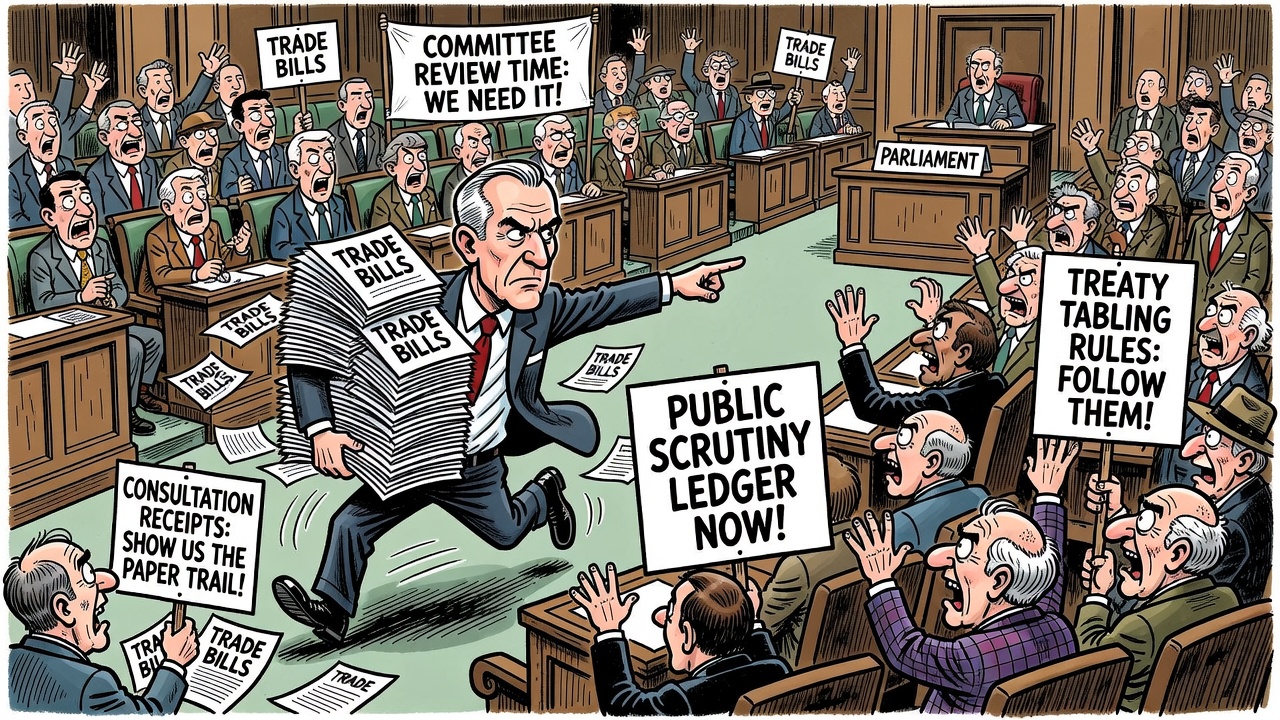
The Carney government says Canada needs faster trade diversification. Fair enough. Canada should not leave its economy hostage to one market. But when Ottawa changes the rules for how trade agreements move through Parliament, the answer cannot be: trust us, the scrutiny will happen later.
Global Affairs Canada’s current Policy on Tabling of Treaties now says that, for free trade agreements, the government may introduce implementing legislation on the same day the agreement is tabled in Parliament. The same policy says Ottawa must table a notice of intent and negotiating objectives at least 30 calendar days before negotiations begin, and that an economic impact assessment comes when implementation legislation is introduced.
That is the receipt Canadians can verify. The concern is what changed around it. Reporting summarized by South Asian Daily, citing The Hill Times, says the government eliminated the previous 21-sitting-day waiting period between tabling a trade agreement and introducing the implementation bill. The report also says the pre-negotiation notice period was reduced from 90 days to 30 days.
Those are not cosmetic edits. Trade agreements can affect workers, farmers, manufacturers, procurement rules, digital policy, immigration-linked labour markets and provincial jurisdiction. If the executive can table an agreement and a bill on the same day, MPs may still technically debate the bill — but the public loses the clean pause that lets committees, industries, provinces, unions, small businesses and ordinary taxpayers compare the text against the sales pitch.
Global Affairs’ defence is speed. The department says parliamentarians will still receive advance notice of negotiations, and that implementation bills will still face debate and committee study in the House and Senate. That is true as far as it goes. It is also not enough. A committee review after the government has already moved legislation is not the same as a public scrutiny period before the legislative train starts rolling.
Conservatives should not oppose faster trade for the sake of delay. Trade diversification can be good policy. The accountability test is whether speed is being used to solve a real bottleneck or to avoid awkward questions before deals are politically locked in. According to the same reporting, the department did not identify a specific agreement delayed badly enough to justify the procedural change.
So publish the parliamentary scrutiny ledger. Show the old rule and the new rule side by side. Release the ministerial rationale. List the negotiations and signed agreements expected to use the faster process. Publish consultation records, provincial concerns, sector impacts and the economic assessment timetable before MPs are asked to vote. If a deal is urgent, say why. If the only reason is convenience, Canadians deserve to know that too.
Carney can move quickly on trade without asking Parliament to inspect the cargo after the truck has already left the dock. Speed is not the enemy of accountability. Secrecy is.
- Global Affairs Canada: Policy on Tabling of Treaties in Parliament
- South Asian Daily: Federal government moves to fast-track trade bills, raising transparency concerns
- The Hill Times: ‘Much less transparency’: feds pave way to fast-track trade bills through Parliament
This article argues for procedural transparency around trade implementation. It does not argue against trade diversification or claim that implementation bills will avoid all debate.