Carney’s Immigration Productivity Test: Publish the Skills-and-Capacity Ledger
Restore the skills ledger before Ottawa raises intake again.
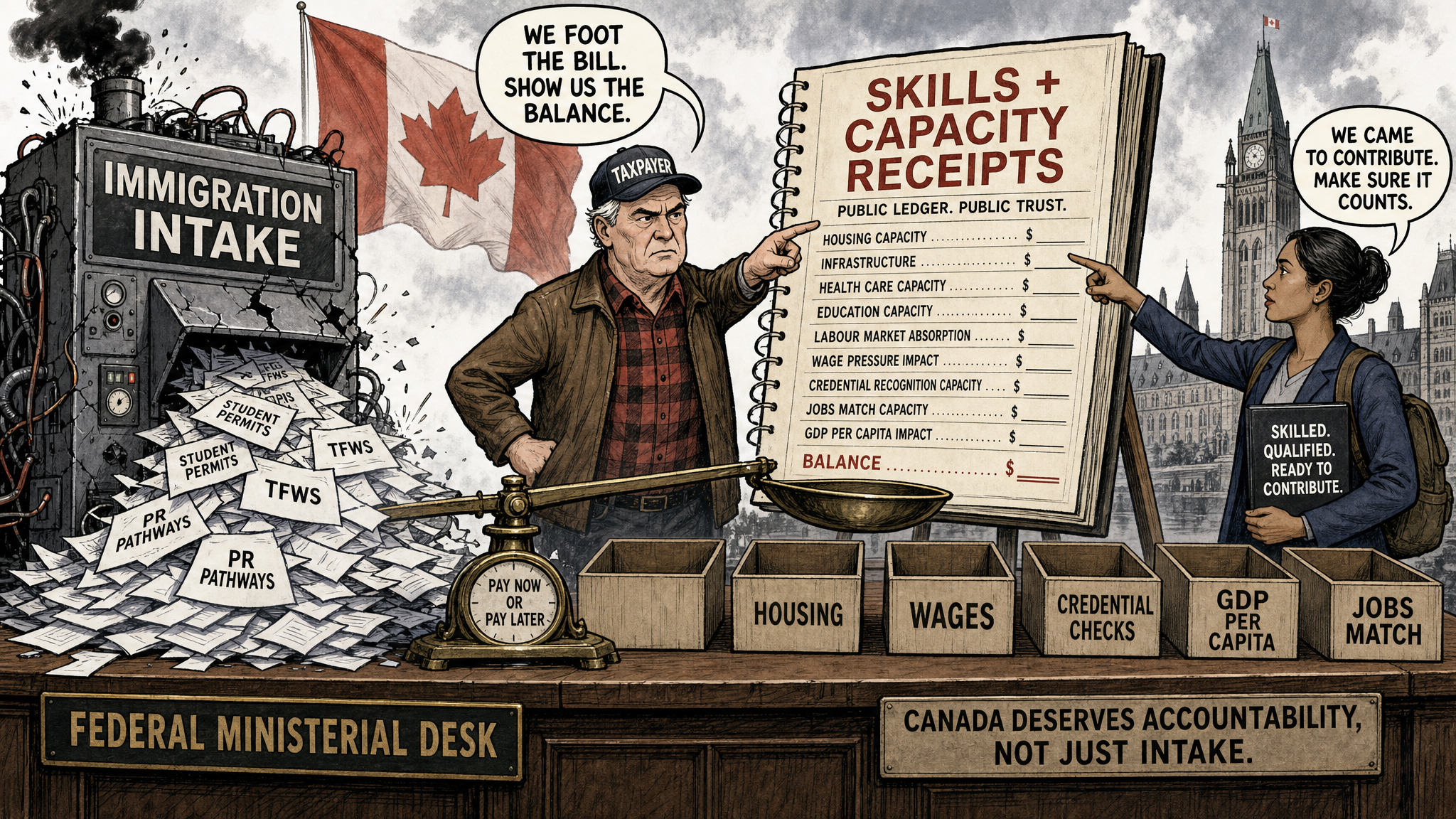
Canada’s immigration debate does not need more slogans. It needs receipts. A new C.D. Howe Institute productivity blueprint says the country’s living-standards problem is tied to weak productivity, poor skills matching and an immigration system that has drifted away from economic selection. That is not an argument against immigrants. It is an argument against Ottawa pretending intake targets can outrun housing, wages, services and credential integrity.
National Post reports that the blueprint urges a major overhaul of the Trudeau-era immigration system, including a return to skilled-applicant selection based more directly on economic contribution. The report says Canada’s former approach ranked applicants on education, work experience, language ability and demonstrated earning capacity, before Ottawa moved in 2023 toward targeted category-based draws such as selected occupations and French-language ability.
C.D. Howe’s own release gives the broader warning. From 2014 to 2024, Canada’s real GDP per capita grew just 3.5 percent, the weakest performance among nine peer countries, while the United States grew 20.2 percent. The institute identifies eight reform pillars, including human capital, tax competitiveness, regulation, trade infrastructure and government productivity. Immigration is not the whole productivity problem, but it is clearly part of the human-capital ledger.
The blueprint’s human-capital section is blunt. It says skilled immigration ran for two decades on a points system, and recommends restoring reliance on the Comprehensive Ranking System while adding proven predictors of success such as institution quality, field of study, language proficiency, a minimum points floor and pre-admission earnings. It also calls for direct assessment of foreign educational institutions so credentials used in applications are properly verified.
Ottawa should take that seriously before it asks Canadians to accept higher intake again. The same blueprint says Canada should raise standards in temporary admission streams, preserve high-skill pathways, reduce reliance on low-wage temporary labour, avoid ad hoc routes to permanent status, select more business immigrants for entrepreneurial capacity, and set immigration levels against a clear objective: raising GDP per capita.
That is the accountability test for Prime Minister Mark Carney. Publish the skills-and-capacity ledger. Show the points-score distribution for permanent residents. Show credential-verification failure rates. Show international-student admission standards and school-level outcomes. Show temporary-resident exits and compliance. Show PR approvals by earnings, skill match and region. Show housing starts versus population growth. Show youth and newcomer unemployment alongside low-wage temporary-worker approvals.
A serious country can welcome newcomers and still demand proof that the system works for them and for the citizens already paying for it. If Ottawa wants growth, it must prove that immigration policy is raising productivity, not merely inflating headline GDP while per-person living standards stall. The compassionate policy is the competent one: select honestly, verify credentials, match skills to jobs, and stop using population growth to hide a weak economy.
- National Post: Carney needs to completely overhaul the Trudeau-era immigration system, report says
- C.D. Howe Institute: C.D. Howe Institute releases recommendations to boost productivity
- C.D. Howe Institute: The Productivity Blueprint
- C.D. Howe Institute: Read the Blueprint: Human Capital recommendations
This article criticizes federal policy design and transparency. It does not criticize immigrants or claim that any individual applicant, student or worker is responsible for Ottawa’s system failures.