Carney’s Palestine Recognition Conditions Need a Failure Ledger
If recognition was sold as conditional, Canadians deserve to know what happens when a named condition slips.
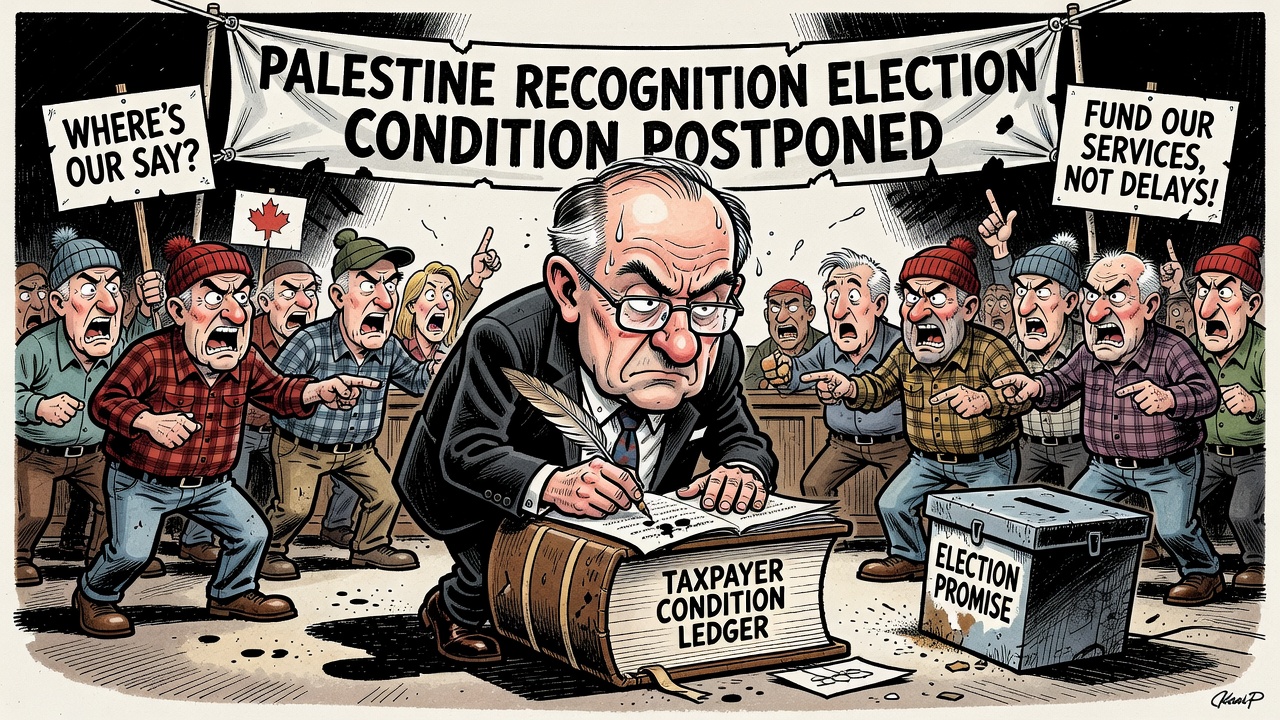
Prime Minister Mark Carney did not present Canada’s recognition of a Palestinian state as a blank cheque. In July 2025, his office said the move was predicated on Palestinian Authority commitments, including fundamental governance reform, demilitarization and general elections in 2026 in which Hamas could play no part.
On September 22, 2026, Carney repeated the point at a leader-level event on the two-state solution. Recognition, he said, was “not without preconditions.” The Palestinian Authority had to reform, demilitarize, hold general elections, and Hamas had to disarm and have no future governance role. He even welcomed the scheduling of Legislative Council elections for the fall.
Now the election condition has hit the wall. Reuters reported October 9 that Palestinian Vice-President Hussein al-Sheikh told France the November 28 legislative vote would be postponed, possibly until September 2027, because political, security and economic conditions had not materialized. France’s foreign ministry then publicly regretted the postponement and called on Palestinian authorities to reconsider and hold parliamentary and presidential elections without delay.
This is not an argument against caring about Palestinian civilians, supporting a durable two-state peace, or insisting that Israelis and Palestinians both deserve security. It is an argument against conditional foreign policy with no visible consequence mechanism. A government cannot ask Canadians to accept a high-stakes recognition decision on the strength of stated safeguards, then go quiet when one of those safeguards fails on contact with reality.
The conservative accountability standard is straightforward: conditions require receipts. Ottawa should publish the Abbas commitment letter or a redacted version of it, the election benchmark Canada relied on, the Hamas-exclusion verification plan, the demilitarization benchmarks, the governance-reform tracker, and the decision memo explaining what Canada would do if elections were delayed.
Canadians should also know whether any funding, diplomatic upgrading, technical election assistance or normalization step is now paused, reviewed or unchanged. If nothing changes, the government should say so plainly. If the answer is that recognition was effectively irreversible no matter what happened after the announcement, then the public was owed that honesty before recognition, not after the condition failed.
Rebel News is asking the sharper political question: was the condition ever real? Ottawa does not have to adopt Rebel’s tone to answer the underlying accountability problem. It only has to publish the ledger.
Foreign policy involves judgment. But judgment is not a substitute for democratic scrutiny, especially where Hamas, security guarantees and recognition of statehood are involved. If Carney’s word on preconditions is worth what Canadians were told it was worth, the government can show the response plan now.
- Prime Minister of Canada: Statement by Prime Minister Carney on Canada’s recognition of a Palestinian state
- Prime Minister of Canada: Remarks at a leader-level event on the two-state solution
- Reuters via Internazionale: Palestinians set to delay legislative elections due to worsening conditions
- France Diplomatie: Announcement of the postponement of Palestinian parliamentary and presidential elections
- Rebel News: Carney silent as Palestine election cancelled
This article argues for publication of Canada’s condition-and-consequence record; it does not claim that Canada has legally reversed recognition or that every cited source shares the same policy view.