SDTC’s $34M Adjournment Needs a Public Clawback Ledger
If Ottawa will not recover money from ineligible green-fund projects, taxpayers deserve more than an adjourned committee meeting.
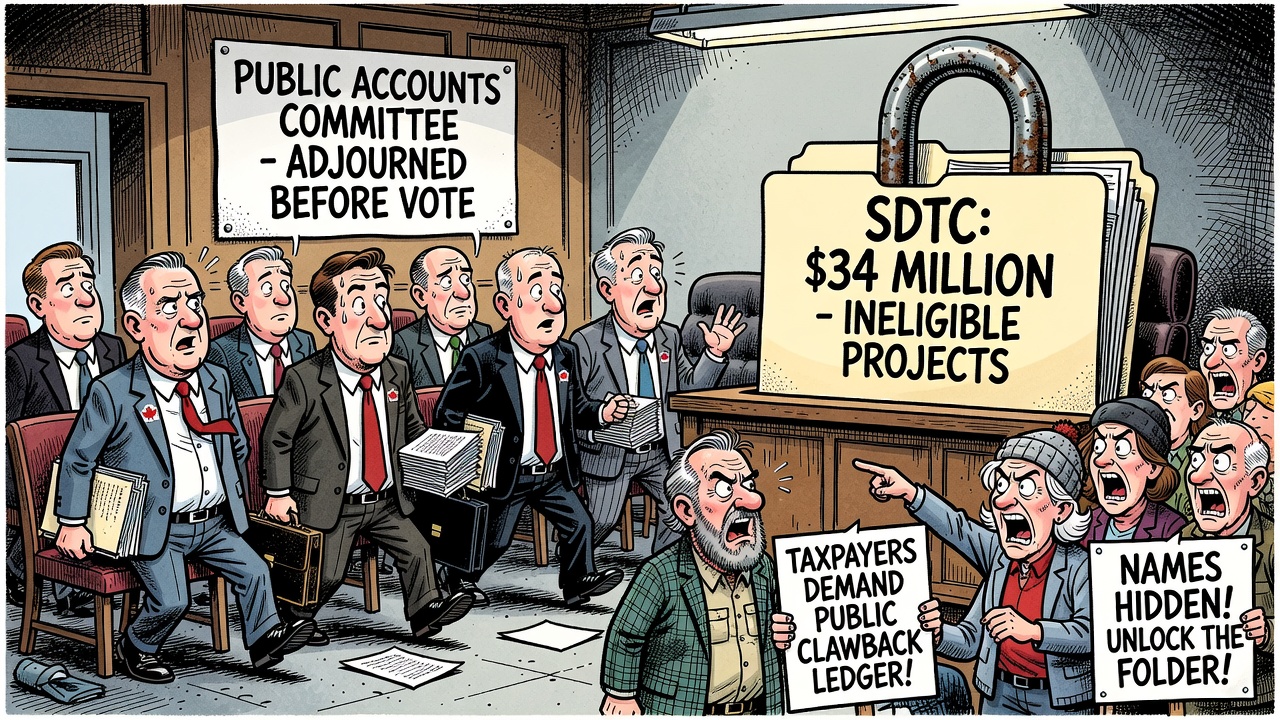
The Sustainable Development Technology Canada file did not disappear when Ottawa folded the scandal-plagued agency into new machinery. It returned last week in a simpler form: will the government even ask for $34 million back?
The Hub reported that the House public accounts committee adjourned on October 8 before voting on a Conservative motion saying recovery of $34 million paid to five ineligible SDTC projects was in the public interest. According to that report, Liberal MPs Jean Yip, Tom Osborne and Kristina Tesser Derksen voted to adjourn, while Conservative MPs Ted Falk, Jasraj Hallan and Michael Cooper, along with the Bloc member, voted against. The motion remained unresolved heading into the Thanksgiving recess.
That matters because the government’s answer to an Order Paper question, reported by Rebel News and Juno/The Counter Signal, said a review of 173 projects found five ineligible projects that had received about $34 million since 2017, plus another project with some ineligible costs. The board, after legal advice, decided not to pursue repayment, citing good-faith agreements and the view that recovery was unlikely to succeed or serve the public interest.
Maybe legal counsel is right. Maybe the companies did nothing wrong. Maybe the agreements were so poorly written that taxpayers have little practical recourse. But those possibilities are exactly why Canadians need the ledger, not another closed-door shrug. Who drafted the agreements? What clawback clauses existed? What legal analysis was relied on? Why are the five recipients unnamed? Were any connected to earlier conflict-of-interest findings? What did the minister sign off on, and when?
The Auditor General’s 2024 audit already found serious governance and stewardship failures at SDTC: $59 million awarded to 10 ineligible projects among the files reviewed, 90 cases where conflict-of-interest policies were not followed, and conflict-linked approval decisions representing nearly $76 million in funding. That is not a minor paperwork problem. It is the background against which every new “not in the public interest” claim should be tested.
Conservatives should be careful not to imply wrongdoing by unnamed recipients without evidence. Liberals should be equally careful not to use that uncertainty as a shield against disclosure. Taxpayers can be pursued aggressively for small debts, late filings and benefit overpayments. A federal green fund should not get softer standards because the paperwork is embarrassing.
Publish the adjournment ledger: the recorded vote, the motion status, the legal rationale summary, the board minutes, the ministerial correspondence, the recovery options, and the conflict screen for the five projects. If the $34 million truly cannot be recovered, prove it. If it can, recover it.
- The Hub: Committee adjourns before deciding on recovering $34 million agency payments
- Juno / The Counter Signal: Liberals shut down ‘green slush fund’ debate amid $34M dispute
- Rebel News: Green Slush Fund won’t seek return of $34 million paid to ineligible projects
- Auditor General of Canada: Significant lapses in governance and stewardship of public funds at SDTC
This article argues for disclosure and recovery analysis without alleging wrongdoing by unnamed recipients beyond the eligibility findings reported publicly.