CAF Ammunition in a Toronto Kidnapping Case Needs a Control Ledger
The issue is not pre-judging accused soldiers. It is whether Ottawa can account for military ammunition and armoury access when public safety is on the line.
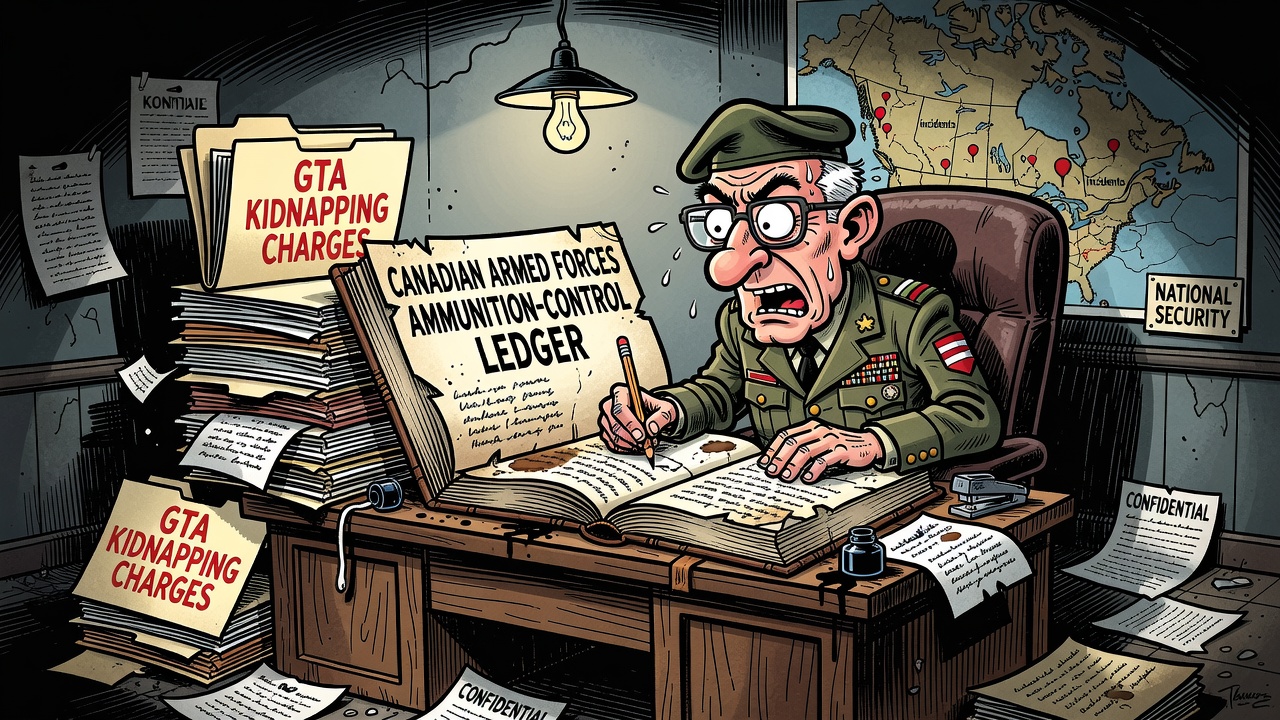
Three members of the same Toronto reserve artillery regiment are now reported to be facing serious criminal allegations connected to a July kidnapping-for-ransom investigation. None of the accused has been convicted, and the courts must decide the criminal case. But National Defence has a separate accountability problem that cannot wait for a verdict: Canadian Armed Forces ammunition was reportedly identified in the investigation.
National Post reporting, carried by The1News, says Jack David Miley, a 24-year-old master bombardier in the 7th Toronto Regiment, was charged after court documents linked the case to six types of CAF ammunition. The report says five types were tied to one accused — including .223 calibre rounds, blanks, 9 mm bullets, .270 ammunition and 12-gauge shells — while Miley was allegedly found with a 25 mm Bushmaster round. National Defence confirmed Miley was a current CAF member and said his access to equipment, facilities and bases was restricted after arrest.
Earlier Canadian Press reporting published by TorontoToday said two other members of the 7th Toronto Regiment, Sachintha Fernando and James Moreau, had been arrested in August and removed from military duties while an administrative review proceeded. The department said their access to CAF equipment, facilities and bases was also restricted.
That response may be necessary, but it is not enough. Restricting access after arrests is damage control. Canadians need to know what controls existed before the ammunition allegedly surfaced in a civilian kidnapping file.
The conservative accountability question is simple: who signed out the ammunition, when was it last reconciled, what was missing, and who was notified? If the answer is that nothing was missing, National Defence should explain how CAF-marked or CAF-owned ammunition ended up in the case record. If ammunition was missing, the department should publish the timeline from first discrepancy to police and military-police action.
This is not an attack on the Canadian Armed Forces. It is the opposite. Honest soldiers, reservists and armoury staff should not have their reputation damaged by vague assurances from Ottawa. A professional military deserves professional inventory control, especially for ammunition that can move from a government facility into criminal allegations.
Defence Minister David McGuinty and National Defence should publish a narrow ammunition and armoury access-control ledger: inventory-reconciliation dates, missing-ammunition notices, access-card restriction dates, administrative-review status, military-police referral dates, and any immediate audit changes ordered for reserve units. Names of uninvolved personnel can be protected. Operational details can be redacted. The existence of the controls should not be secret.
When Ottawa asks Canadians for billions in defence spending, it also owes proof that basic custody systems work. If the CAF cannot publicly account for ammunition after a case like this, the problem is not only criminal. It is managerial.
- National Post / Postmedia mirror: Third Toronto soldier charged in kidnapping probe that turned up Armed Forces ammunition
- TorontoToday / The Canadian Press: 2 Toronto-based Canadian Armed Forces members facing kidnapping, weapons charges
- Toronto CityNews: 2 Canadian Armed Forces members face organized crime, kidnapping charges
This article relies on reported court-document details and Department of National Defence statements carried by news outlets. It does not assert guilt by any accused person and argues for transparent military inventory and access-control receipts.