Bill C-39’s Committee Clock Needs Public Witness Receipts
A 243-page economic bill, a special committee and a mid-November clause-by-clause clock demand public witness, brief and amendment receipts.
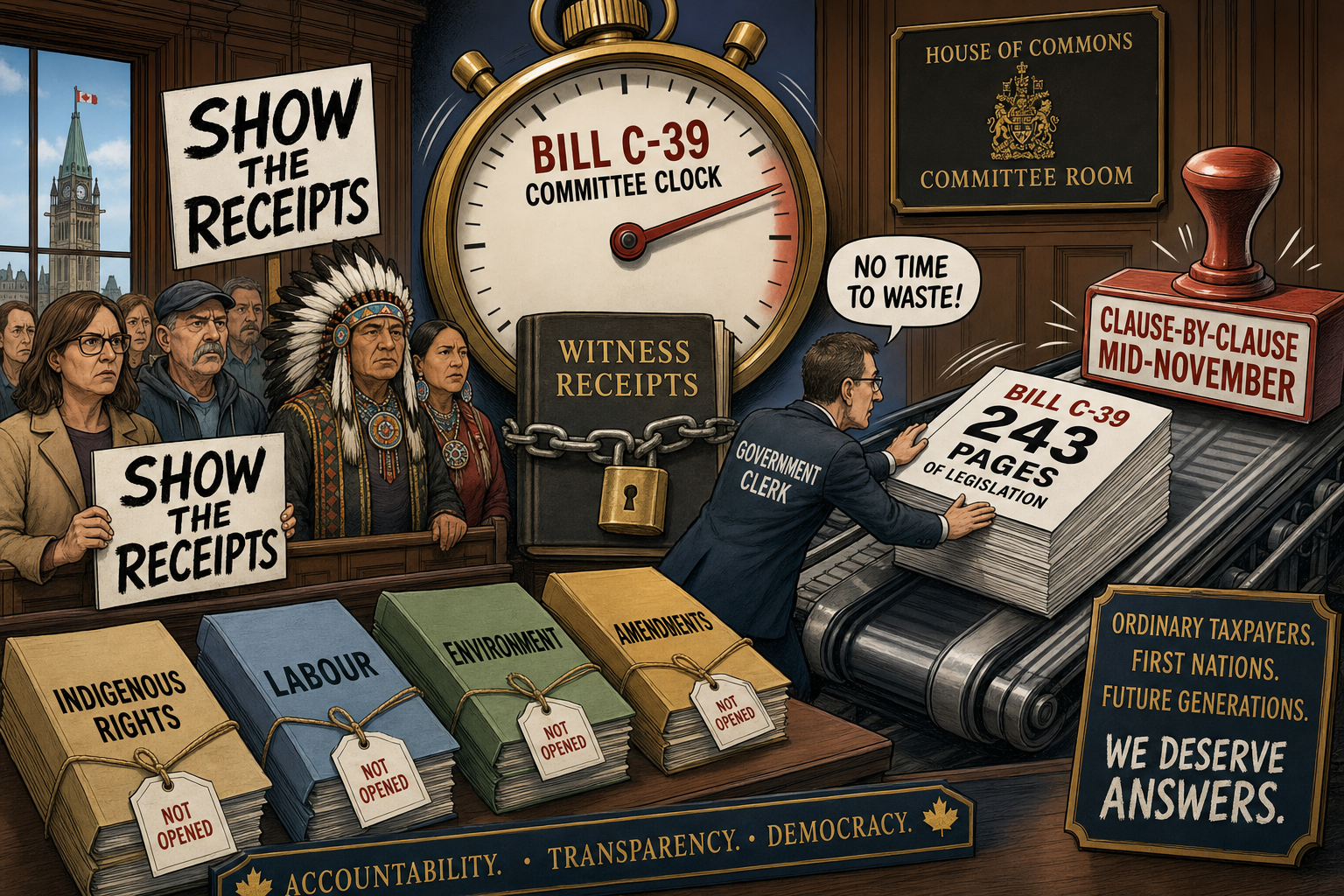
Bill C-39 is now a test of whether Ottawa can move quickly without asking Canadians to trust a closed process. The Canadian Press reported Friday that the special House committee created to study the Building Canada Strong Act agreed to limit the period for submissions and witness hearings, ask interested stakeholders for briefs by October 26, and begin clause-by-clause consideration in mid-November.
That matters because this is not a minor housekeeping bill. Parliament’s LEGISinfo record shows Bill C-39 passed second reading on October 8 and was referred to committee after a 296-26 vote. CP described the legislation as a 243-page bill that would extend the government’s “one project, one review, within one year” approach beyond major infrastructure projects to other projects across the country.
The government’s case is that Canada needs faster approvals, clearer rules and stronger confidence for builders. Its September release says Bill C-39 is intended to bring speed, certainty and predictability to infrastructure reviews while maintaining environmental standards and upholding Indigenous rights. Conservatives should not dismiss the goal of building things. Canada does need ports, mines, corridors, energy infrastructure and faster decisions.
But speed is not accountability. A special legislative committee may keep the bill tightly focused, but it also compresses the normal political oxygen around a complicated package touching project approvals, trade corridors, labour rules, environmental review and Indigenous consultation. If ministers want a faster track, the price should be more public receipts, not fewer.
The warning signs are already public. CP reported that First Nations organizations condemned the bill, arguing it would weaken environmental oversight and limit their ability to influence decisions affecting their territories. The Chiefs of Ontario, Assembly of First Nations Quebec-Labrador, Nishnawbe Aski Nation and British Columbia Assembly of First Nations said free, prior and informed consent cannot be squeezed into a predetermined federal project timeline. That is not a procedural footnote. It is a litigation-risk, reconciliation-risk and project-certainty issue.
Labour questions also deserve daylight. The government says the bill will modernize the federal labour framework and protect the right to strike while encouraging good-faith bargaining. Critics say committee time must be long enough to test those claims against the actual clauses. Again, the answer is not delay for delay’s sake. It is a public ledger.
Before clause-by-clause begins, the committee should publish the full witness list, rejected witness requests, all written briefs, Indigenous consultation records, labour-rights analysis, environmental-review safeguards, ministerial appearance dates, amendment tracker and any timeline instructions given by ministers or the PMO. If Ottawa’s reforms are sound, they can survive receipts.
Building faster is a serious national objective. Rushing a 243-page bill through a narrow public window is not. The committee clock is already running. Canadians deserve to see who was heard, who was shut out and what amendments were considered before MPs are asked to vote.
- Canadian Press via CKOM: Special House committee votes to push forward major projects bill
- Parliament of Canada LEGISinfo: Bill C-39, Building Canada Strong Act — progress
- Government of Canada: Government introduces legislation to transform how Canada builds
This article supports faster building where public rules are clear. It argues that compressed committee review of Bill C-39 requires stronger disclosure of witnesses, briefs, consultation records and amendments.