September’s Jobs Losses Need a Labour-Market Receipt Ledger
After a 68,000-job September decline, including 48,000 fewer youth jobs, Ottawa should publish labour-market capacity receipts before more announcements.
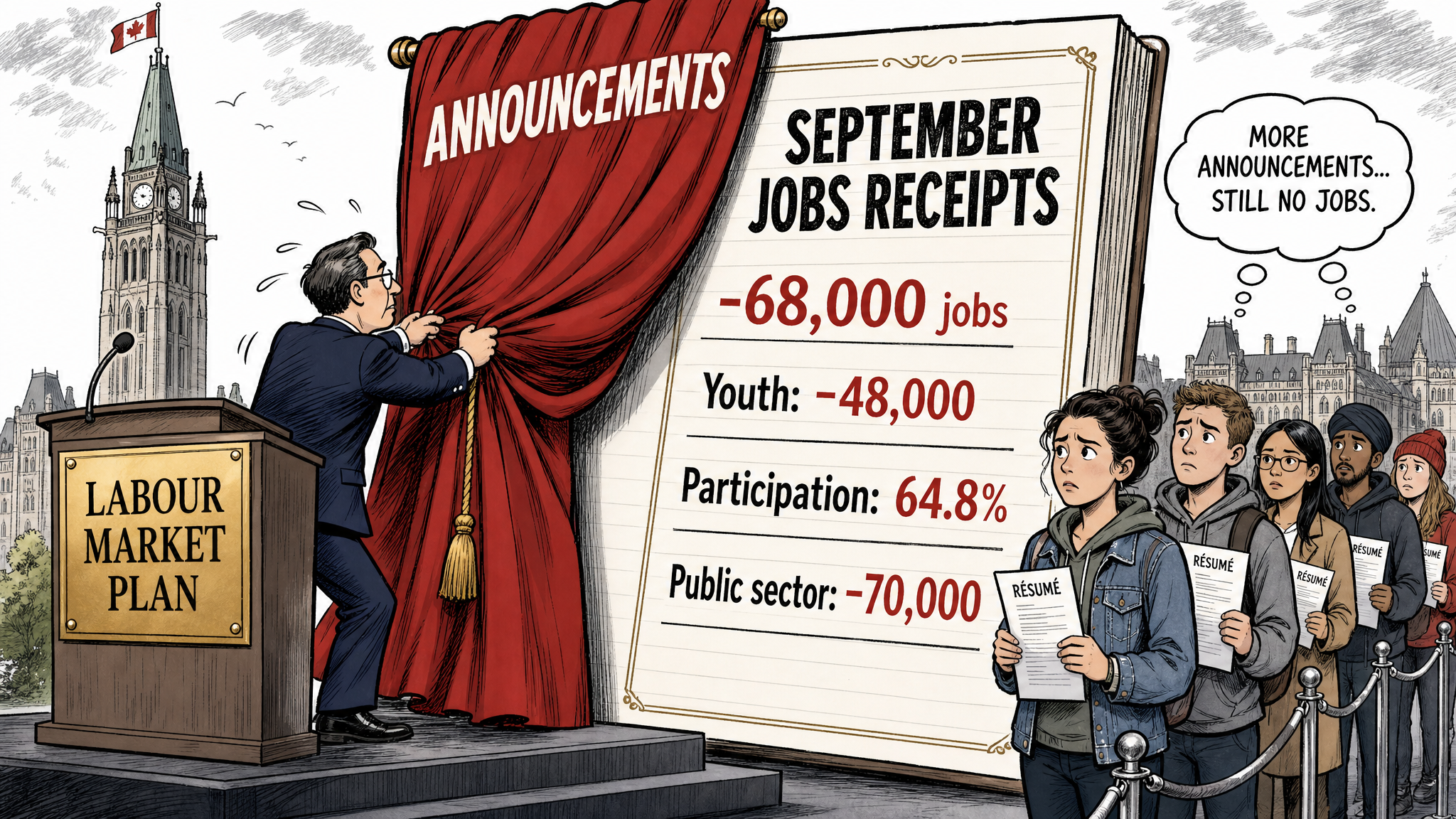
September’s jobs report is not a talking-point problem. It is a receipt problem. Statistics Canada reported on October 9 that employment fell by 68,000 in September, the employment rate dropped to 60.6%, and unemployment ticked up to 6.5%. That followed a 42,000-job decline in August. Two months do not make a recession by themselves, but they do make a serious accountability test for a government still selling big plans from Ottawa podiums.
The sharpest warning light is youth employment. Statistics Canada says workers aged 15 to 24 accounted for 48,000 of September’s decline. Youth employment fell for a second straight month, down 67,000 over August and September, while the youth unemployment rate sat little changed at 13.0% because the youth labour force also shrank. A government that talks endlessly about opportunity should not wave away a report showing young Canadians losing work and leaving the labour force.
The losses were not limited to one line in the table. Public-sector employment fell by 70,000 in September, the fourth consecutive monthly decline in that category. Education services lost 35,000 jobs, health care and social assistance lost 23,000, and manufacturing lost 13,000. Regionally, Statistics Canada reported declines in Quebec and British Columbia, while RBC Economics noted Ontario also posted a 20,000-job decline and Alberta added 23,000.
There is important context. RBC cautioned that monthly employment counts can be volatile, and that youth employment often faces seasonal pressure when school resumes. RBC also noted the unemployment rate remained below April’s 2026 peak. Fair enough. Conservatives should not pretend every monthly report proves a grand theory.
But accountability does not require exaggeration. It requires receipts. If the Carney government wants to keep announcing immigration targets, temporary-worker settings, industrial subsidies, public-service reshaping and “growth” strategies, it should publish a labour-market capacity ledger beside them.
That ledger should show youth job losses, job-finding rates, layoffs, vacancies, sector-by-sector demand, regional impacts, temporary foreign worker and LMIA approvals, international-student work pressures, re-employment outcomes and the government’s own assumptions for how many workers the economy can absorb. Statistics Canada reported the labour-force participation rate fell to 64.8%, the lowest level since December 1997 outside the pandemic period. That is exactly the kind of signal that should trigger more disclosure, not more slogans.
The point is not to blame one policy for one month of job losses. The point is to stop governing by press release while young Canadians carry the risk. Before Ottawa asks workers to trust another economic plan, it should put the September receipts on the table.
- Statistics Canada: Labour Force Survey, September 2026
- RBC Economics: Job losses concentrated among young Canadians in September
This article uses the official Labour Force Survey as the primary source and RBC Economics for economic context. It does not claim immigration, temporary work permits or any single policy caused September’s job losses; it argues Ottawa should publish capacity and labour-market receipts before making further claims.