The Impact Assessment Act Ruling Needs a Court-Compliance Ledger
Ottawa cannot promise faster project approvals while refusing to account for an approval law the courts say still crosses constitutional lines.
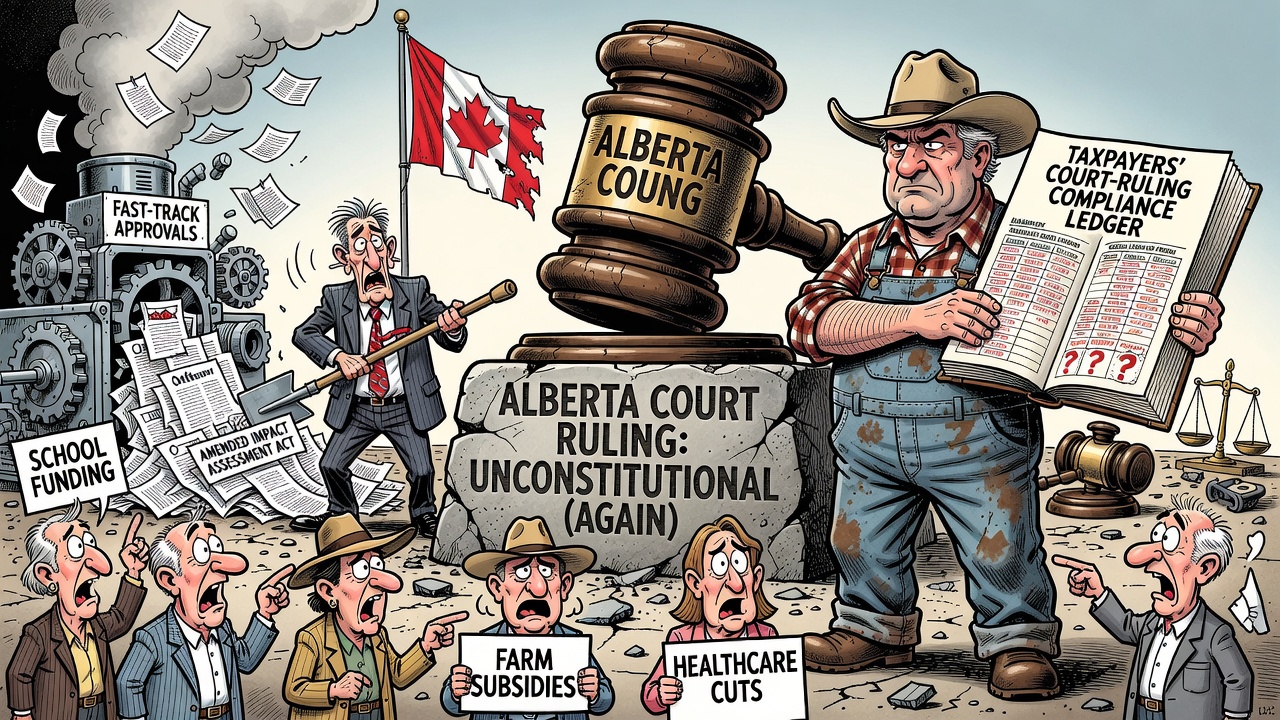
The Alberta Court of Appeal has handed Ottawa a simple accountability problem: if the federal government rewrote the Impact Assessment Act after the Supreme Court warned it about constitutional overreach, why did the amended law still fail in court?
On October 9, the court released Reference re Impact Assessment Act, as amended, 2026 ABCA 320. The majority acknowledged that Parliament made changes after the Supreme Court’s 2023 opinion, but concluded the designated-projects scheme still reaches beyond federal power. In plain English, the problem is not environmental review itself. The problem is Ottawa using federal hooks to regulate whole provincial projects based on concerns that are not truly federal.
That matters for workers, investors, provinces and taxpayers. Canada cannot build mines, pipelines, ports, power lines or trade corridors on a legal foundation that keeps collapsing. Every unconstitutional detour means delay, litigation, uncertainty and higher costs. It also gives ministers more room to blame provinces, markets or “process” for failures that began with Ottawa writing laws too broadly.
This is where the Carney government’s fast-build rhetoric meets the record. Ottawa is simultaneously advancing Bill C-39, the Building Canada Strong Act, with promises of faster approvals and national-interest projects. But faster approvals are not automatically better approvals if the underlying federal machinery still invites court challenges. A government serious about building would first show Canadians exactly which powers are safe, which powers are exposed, and which projects could be caught in the uncertainty.
The conservative accountability answer is not to abolish every review. It is to force discipline. Federal jurisdiction should be clear. Cabinet discretion should be bounded. Provincial projects should not be converted into federal projects through vague definitions. Indigenous consultation, environmental protection and investor certainty all suffer when Parliament writes a law that courts cannot square with the Constitution.
So publish the court-ruling compliance ledger before MPs are asked to hand cabinet more fast-track tools. List every Impact Assessment Act section affected by the Alberta decision. Identify which departments warned cabinet during drafting. Say whether Ottawa will appeal. Name the projects potentially exposed to delay. Release the legal risk analysis in redacted form if necessary. Explain how Bill C-39 will avoid repeating the same mistake.
If the Liberals believe their amended law is defensible, disclosure should strengthen their case. If they already knew the fix was vulnerable, Canadians deserve to know before another approval regime is sold as a nation-building breakthrough.
- Alberta Court of Appeal: Reference re Impact Assessment Act, as amended, 2026 ABCA 320
- Alberta Court of Appeal: Full judgment PDF
- Global News / The Canadian Press: Alberta court says amended federal impact law unconstitutional
- Parliament of Canada LEGISinfo: Bill C-39, Building Canada Strong Act, progress
- iPolitics: Evening parliamentary context on the ruling and Bill C-39
This article argues for constitutional compliance, public-risk disclosure and accountable project approvals. It does not replace the court judgment or legal advice.