Carney’s $2B Heat-Pump Rebate Needs a Brookfield Conflict Ledger
A $2 billion rebate program is exactly where Ottawa should publish the conflict screens, vendor safeguards and consumer-protection receipts before cheques start flowing.
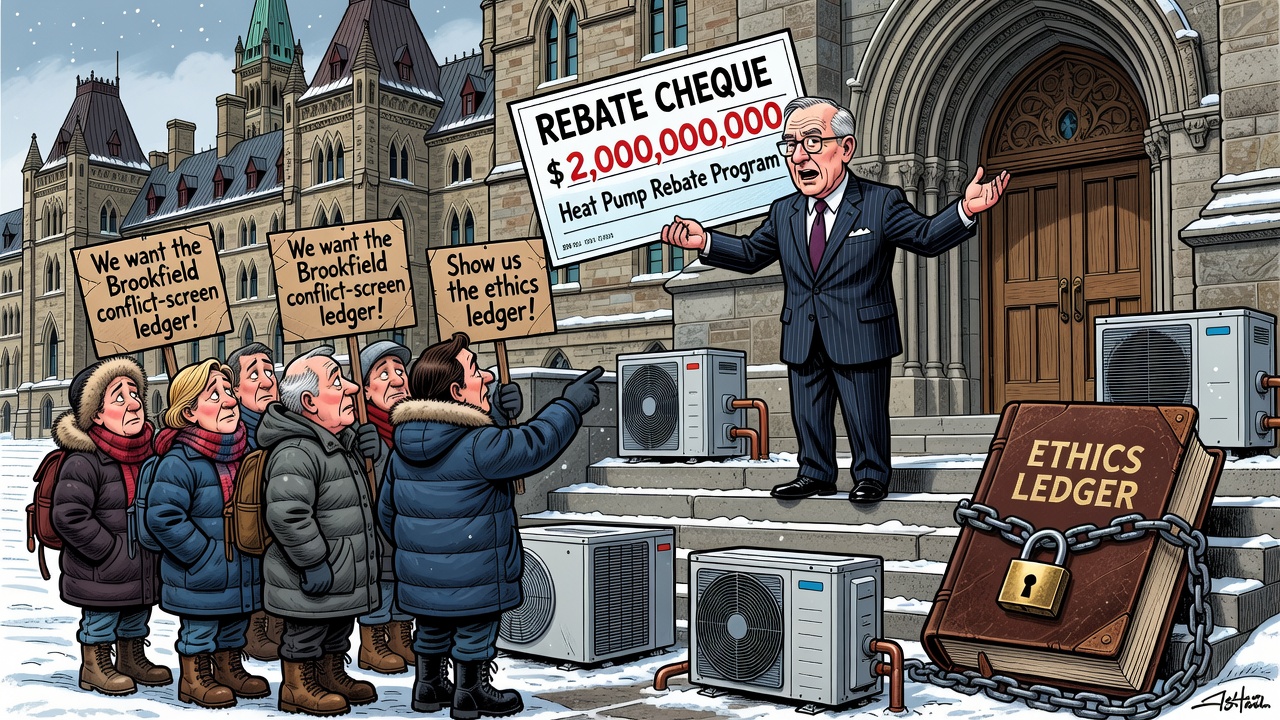
Carney’s new heat-pump plan may be pitched as affordability policy. For taxpayers, the first question is simpler: who is eligible to collect from the public stream, and who in Ottawa has been screened out of decisions that could benefit connected firms?
On October 8, the Prime Minister’s Office announced a $2 billion federal investment to deliver one million home retrofits across Canada. The package includes a new National Heat Pump Rebate for up to 820,000 households, with rebates of up to $10,000 for eligible below-median-income households and $2,000 for other eligible households. Ottawa also says CMHC and the Canada Infrastructure Bank will support retrofits for 280,000 apartment and multi-unit homes over eight years.
Those numbers are large enough to move a market. Every contractor, equipment seller, financing provider and property owner now has an incentive to position itself around federal rules. That is why the same-day political allegation matters — carefully. Global News posted a Question Period clip titled “Conservatives allege Carney is profiting off $2B investment in heat pumps,” in which Conservative MP John Brassard alleged a conflict involving Brookfield-linked companies, including firms active in HVAC and home-services markets. That allegation is not proof of misconduct. It is a reason to demand documentation.
The public record makes the conflict-screen question legitimate. Brookfield Infrastructure announced in 2018 that it had completed a C$4.3 billion acquisition of Enercare. The release described Enercare as a major home and commercial services and energy-solutions company providing water heaters, furnaces, air conditioners, HVAC rental products, plumbing services, protection plans and related services. Enercare’s own materials have identified it as a portfolio company of a Brookfield-managed fund.
That does not mean Enercare, Brookfield, Trane, or any other market participant has done anything wrong. It means a prime minister with a known Brookfield past should not ask Canadians to rely on trust when public money is being pushed into a sector where Brookfield-linked assets have operated.
A conservative accountability standard is not anti-rebate or anti-heat pump. It is anti-blind cheque. If Ottawa believes the program lowers bills, it should welcome a clean ledger: the ethics screens applied to the prime minister and senior staff; the list of covered Brookfield-linked entities; any recusals; procurement and vendor rules; anti-upselling safeguards; installer eligibility standards; financing disclosures; complaint tracking; audit sampling; and a public report showing whether rebates reduce net household costs rather than inflate sticker prices.
There is also a housing angle. The multi-unit retrofit stream runs through CMHC and the Canada Infrastructure Bank, precisely the kind of institutional channel where large owners and sophisticated financing firms can navigate paperwork better than ordinary households. If the government wants this sold as affordability, it should publish who receives financing, what rents or utility savings tenants actually see, and how Ottawa prevents public subsidy from becoming private asset enhancement.
Carney promised one million retrofits. Fine. Now publish the conflict ledger before the money moves.
- Prime Minister of Canada: Prime Minister Carney announces landmark investment to retrofit one million homes
- Global News video: Conservatives allege Carney is profiting off $2B investment in heat pumps
- GlobeNewswire / Brookfield Infrastructure: Brookfield Infrastructure completes C$4.3 billion acquisition of Enercare Inc.
- Enercare: Enercare 2021 ESG Report
This article treats the Conservative claim as an allegation and argues for disclosure. It does not allege that Carney, Brookfield, Enercare or any other company broke ethics, lobbying or procurement rules.