ECCC Revolving-Door Case Needs a Cuts-and-Access Ledger
If Ottawa cuts public expertise and former insiders then lobby the same department, Canadians deserve cooling-off, meeting and funding receipts.
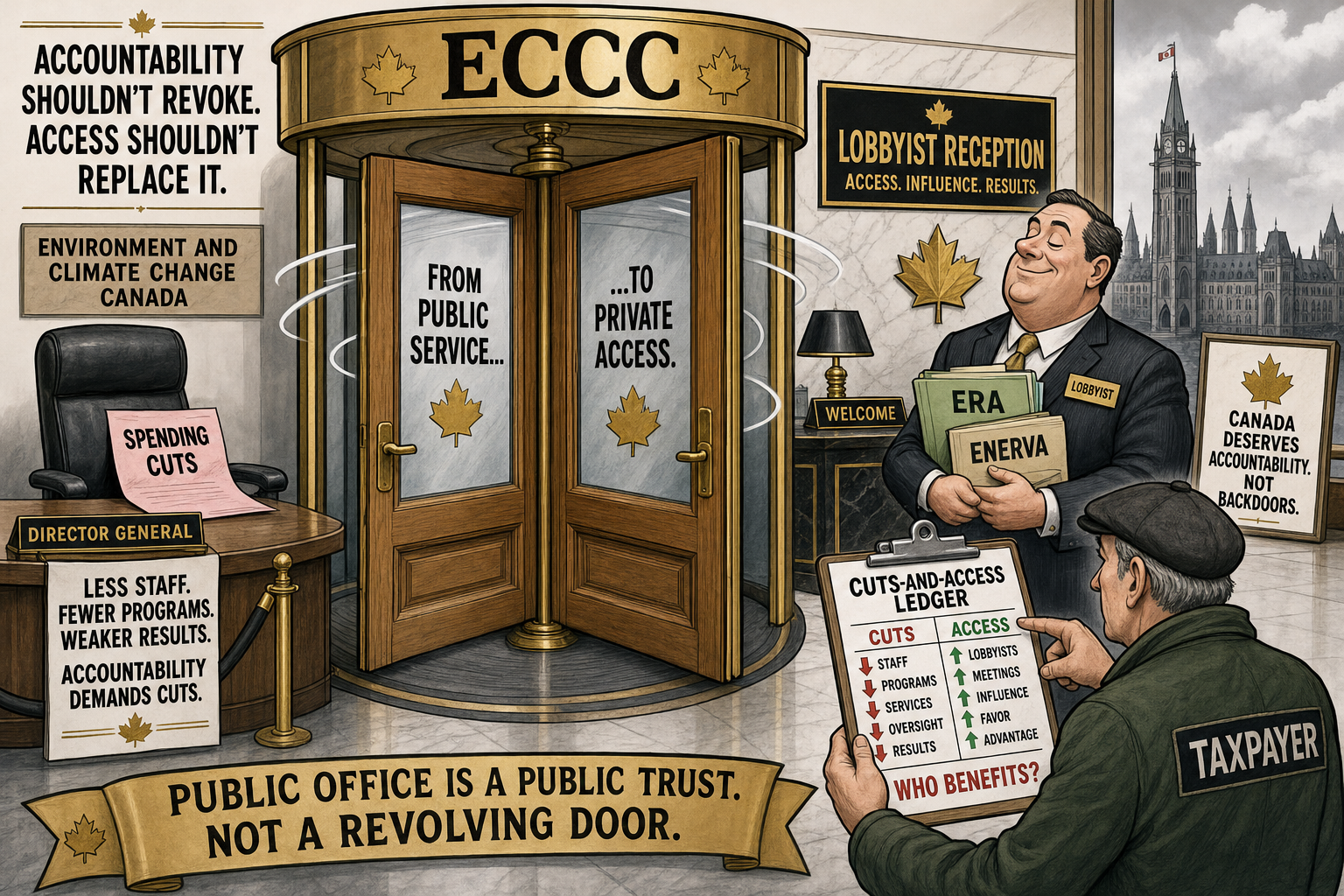
Carney’s spending review is being sold as discipline. The test is whether it saves taxpayers money — or simply moves federal know-how from the public payroll into the paid-access economy.
The Investigative Journalism Foundation reported this week that Jesse Fleming, a former senior official at Environment and Climate Change Canada, began lobbying his former department after his job was eliminated under the Carney government’s cuts. IJF reported that Fleming registered in August 2026 to lobby for Emissions Reduction Alberta and in September 2026 for Enerva Energy Solutions, both with ECCC officials among the targets. The same report says Fleming had spent more than two decades in government and was most recently director general of the programs directorate in ECCC’s climate change branch.
That does not prove wrongdoing. It does prove why the public needs receipts. When a senior official leaves a climate-program role and soon appears on lobbying registrations aimed at the same department, Canadians are entitled to know whether cooling-off rules were reviewed, what files are off limits, who signed the ethics screens, and whether any meetings or funding requests touch the former official’s old responsibilities.
The stakes are larger than one registration. Finance Canada’s comprehensive expenditure review briefing says Budget 2025 identified $9 billion in savings in 2026-27, $10 billion in 2027-28 and $13 billion in 2028-29, with $60 billion over five years when combined with other savings and revenues. Treasury Board’s committee materials described the review as an estimated 16,000 full-time-equivalent reduction by 2028-29, with an expected public-service decline of about 40,000 positions, or 10%; as of April 1, 2026, departments had announced 17,792 CER-related position reductions.
Those are not abstract spreadsheet lines. They are people, programs, institutional memory and access points. If Ottawa cuts senior capacity inside government, then organizations hire former insiders to navigate the remaining system, taxpayers may end up paying twice: once for the severance and disruption, and again through a lobbying market that monetizes knowledge the public sector used to hold internally.
A conservative accountability standard is straightforward. Cutting government should reduce costs, simplify rules and protect taxpayers. It should not create a boutique access pipeline where former officials can sell familiarity with departments still administering grants, regulations and climate programs.
Publish the ECCC cuts-and-access ledger: eliminated senior roles, severance and transition costs, cooling-off determinations, lobbying registrations, meeting logs, program or grant asks, recusals, conflict screens and any communications between former officials and their old branches. If every rule was followed, the ledger will clear the air. If the cuts created a revolving-door premium, Parliament should know before the next round of savings is booked.
- Investigative Journalism Foundation: Former senior public servant says he turned to lobbying after losing job to Carney’s spending cuts
- Government of Canada / Finance Canada: Standing Committee on Government Operations and Estimates — Comprehensive Expenditure Review briefing materials
- Government of Canada / Treasury Board Secretariat: Secretary of the Treasury Board appearance on the Comprehensive Expenditure Review
This article argues for public disclosure of cooling-off, access and spending-cut records. It does not allege that any named individual or organization broke lobbying or ethics rules.