MAID Reversal Needs a Vulnerable-Canadians Safeguards Ledger
Ottawa finally admits mental-illness-only MAID is not ready. Now it must prove advance requests will not outrun safeguards.
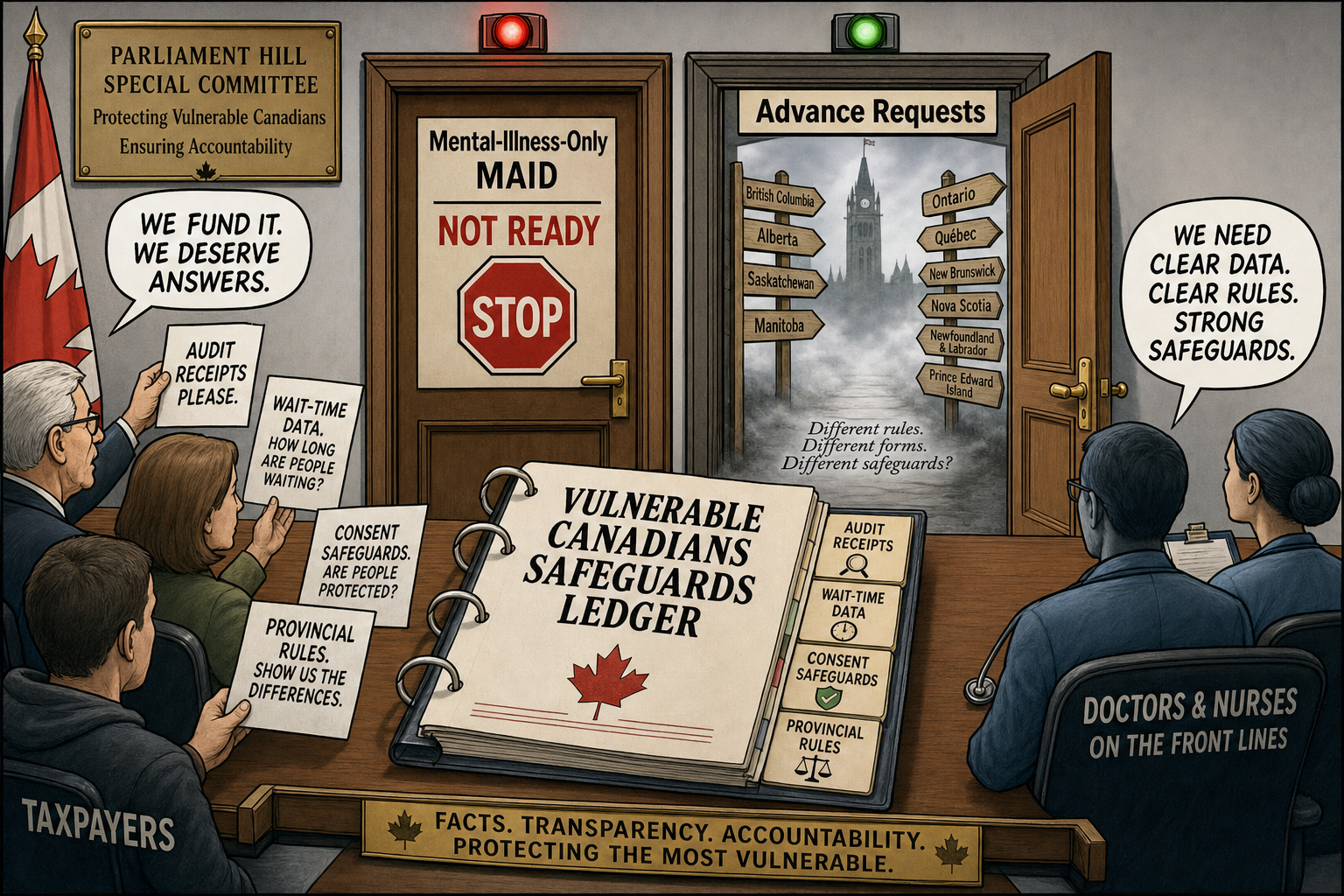
The Liberal government made the right call on one of the most serious files in federal law: it now says people whose sole medical condition is mental illness should remain excluded from medical assistance in dying indefinitely. That is not a partisan concession. It is an admission that the country has not solved the basic safeguard question.
The current exclusion was scheduled to expire on March 17, 2027. Health Canada’s public guidance still says a person whose only medical condition is a mental illness is not eligible until that date. Justice Canada’s own transition material put the stakes plainly: without further legislation, mental-illness-only MAID would become lawful on March 17, 2027.
Justice Minister Sean Fraser’s explanation is the accountability headline. He cited the lack of medical consensus on when mental illness can be considered irremediable and concerns about access to mental-health care. In ordinary language: Ottawa cannot responsibly offer a state-facilitated death pathway where the system cannot first prove timely access to treatment, supports, second opinions and durable recovery options.
Conservatives should say clearly: pausing this expansion is necessary. But necessary is not sufficient. The same plan would change the Criminal Code so health professionals could provide MAID based on an advance request from someone diagnosed with a serious illness who later loses capacity to consent. Provinces would decide whether and how to offer it because they run health-care delivery.
That creates the next Liberal accountability test. If Ottawa is ready to decriminalize advance requests while leaving delivery to provinces, Parliament needs a public safeguards ledger before the vote. Canadians should see the provincial readiness map, the capacity-assessment standard, the witness and renewal rules, the refusal-or-resistance protocol, the complaint pathway, the audit schedule and the data that will show whether vulnerable people are protected in practice, not just in press releases.
The government should also table the mental-health wait-time record that led it to reverse course. If access gaps are serious enough to bar mental-illness-only MAID indefinitely, those gaps should be measured, reported and fixed. Otherwise, Ottawa is admitting the danger without showing the repair plan.
This file involves autonomy, suffering, disability rights, clinical judgment, family trust and public confidence in medicine. It deserves better than slogans from either side. The conservative accountability standard is straightforward: protect vulnerable Canadians first, publish the evidence, and do not move into advance requests until every province can show who verifies consent, who audits the decision and who answers when safeguards fail.
Credit the reversal. Demand the receipts.
- Associated Press: Canada to indefinitely bar assisted dying for people whose sole condition is mental illness — October 7, 2026
- Global News: Canada to bar MAID for mental illness alone — October 7, 2026
- Health Canada: Medical assistance in dying overview
- Justice Canada: Minister of Justice transition note: MAID policy issues
- Department of Justice Canada: Media availability on Canada’s MAID laws — October 7, 2026
This article supports scrutiny of federal and provincial safeguards and does not provide medical or legal advice. Anyone in immediate crisis should call local emergency services or a crisis line.