The $29M Foreign-Influence Registry Failure Needs a Privacy-Breach Ledger
A transparency registry that hides its own failure is not transparency. It is a test of whether Ottawa can produce receipts.
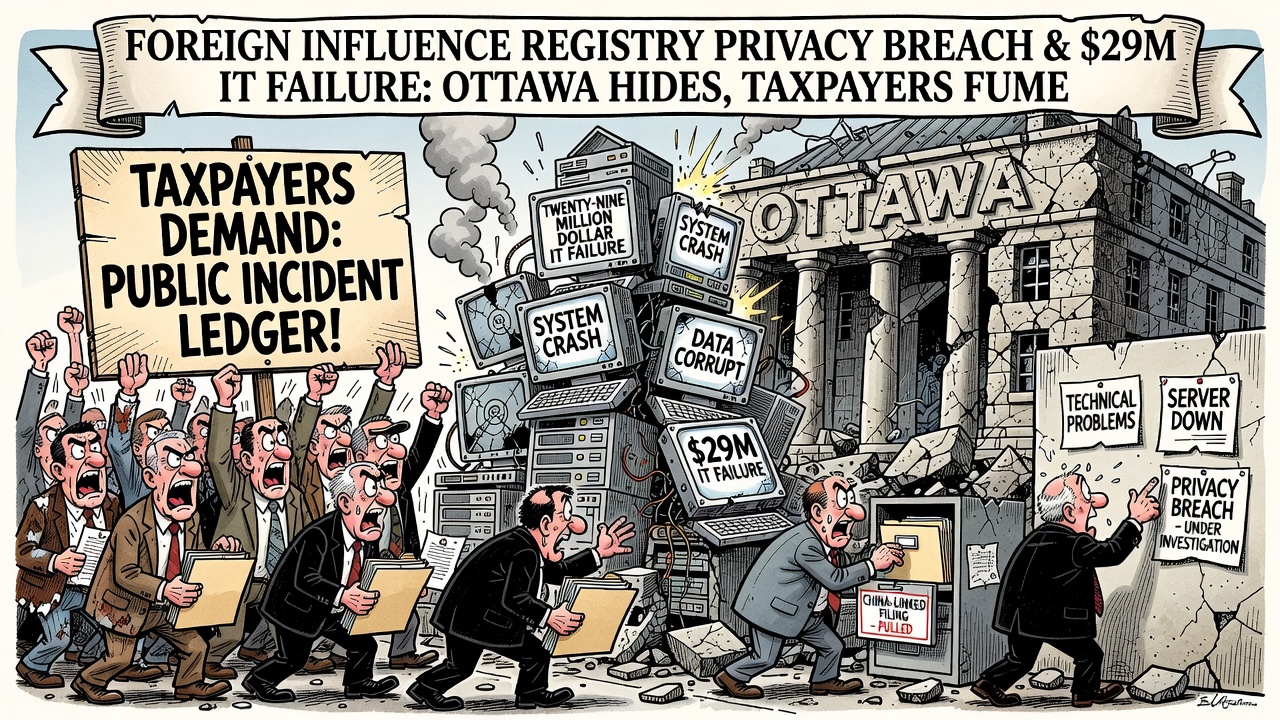
Canada created a foreign-influence transparency registry because sunlight was supposed to be the answer to covert pressure, intimidation and foreign-state lobbying. Now the registry itself is becoming a secrecy story.
The Bureau reported Wednesday night that Foreign Influence Transparency Commissioner Anton Boegman told the House procedure and House affairs committee that an early registry filing involving a principal from the People’s Republic of China was pulled because it displayed information that should not have been public. Conservative MP Michael Cooper pressed him on the removed filing, earlier technical explanations from the commissioner’s office, a separate privacy breach involving China expert Charles Burton, and the cost of the registry’s information-technology system.
The pulled filing reportedly came from The Canada Files Media and named CGTN Français, the French-language service of China Global Television Network, as the foreign principal. According to The Bureau, the filing disappeared from the public registry on September 15. When asked earlier, the commissioner’s office reportedly attributed the problem to technical issues transferring data from submission forms to the public database. At committee, Boegman said incorrect information appeared because of technical limits in the current system, and said the filing would be republished when possible.
That answer is not good enough. If a registry meant to expose foreign influence accidentally exposed information it should not have published, Canadians deserve to know what category of information was exposed, who was notified, whether the Privacy Commissioner was engaged, and what audit trail shows the problem has been fixed. Nobody needs operational secrets or personal data dumped online. They need the incident report.
The IT angle makes the story worse. Cooper cited a Public Safety estimate of $29.41 million for the registry system. Boegman described the launch system as a “minimum viable product” built on existing systems and reliant on manual processes. That may explain some rough edges at launch. It does not excuse a national-security transparency tool that reportedly has only two public entries while officials expected a far larger universe of registrants.
The Bureau says Boegman disclosed about 30 submissions by the October 3 deadline for pre-existing arrangements, while a Public Safety Canada analysis had estimated 2,422 individuals and businesses would need to register. If those numbers are right, the public cannot tell whether the registry is deterring non-compliance, sitting on a backlog, or failing to identify targets in the first place.
The conservative accountability standard here is straightforward: protect genuinely sensitive data, but publish the management receipts. Ottawa should release a redacted privacy-breach ledger, the removed-field list, the contractor and cost ledger for the IT build, the daily backlog count, the restoration timeline for the pulled China-linked filing, and the enforcement plan for registrants who missed the deadline.
A foreign-influence registry cannot ask Canadians to trust a black box. The whole point was to replace whispers with records. If the Liberal government wants credibility on China, national security and public spending, this is where it proves the registry can survive its own first test.
- The Bureau: Foreign-Influence Watchdog Claims China-Linked Media Registry Filing Was Pulled Over a Privacy Breach — October 7, 2026
- House of Commons: Committee work listing, including PROC study update on implementation of the Foreign Influence Transparency Registry — October 6, 2026
- House of Commons PROC: Meeting 40 notice, Update on the Implementation of the Foreign Influence Transparency Registry — October 6, 2026
This article does not allege that any named registrant committed wrongdoing. It asks for redacted public management records about a federal transparency system, privacy handling, costs and enforcement.