The Social Housing Ledger Ottawa Still Can’t Produce
Ottawa announces billions for housing, but the watchdog says Canada still lacks reliable data on the basic stock of social housing.
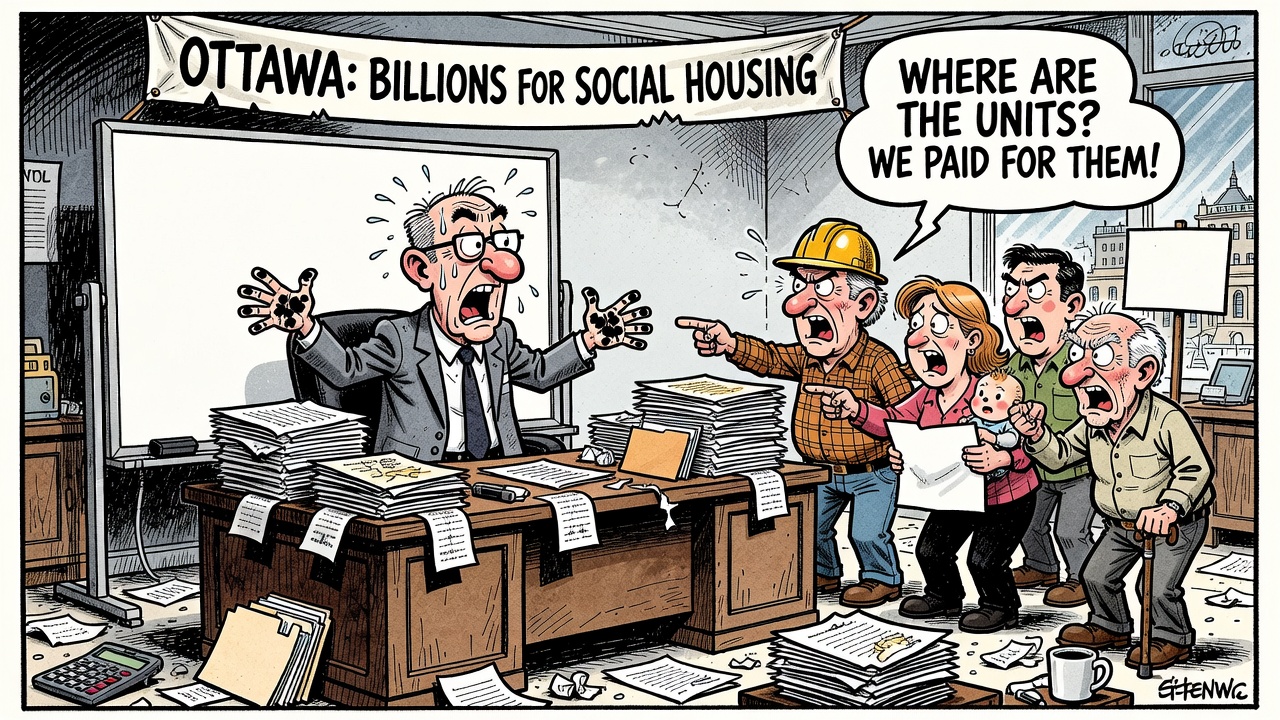
The Liberal housing file has become a parade of announcements: strategies, funds, accelerators, repairs, acquisitions and glossy targets. But a basic accountability question remains embarrassingly unresolved: how many social-housing units does Canada actually have, how many have been gained or lost, and where is the public ledger?
The Parliamentary Budget Officer’s warning is blunt. Canada lacks reliable data to understand the size and evolution of its social-housing stock. The best available estimate is roughly 600,000 to 700,000 units, a stock that has been relatively stable over the last 30 years. The PBO also notes that much of that stock was built before 1994, while federal support continued through long-term operating agreements in later decades.
That matters because Ottawa is spending and committing enormous sums under the National Housing Strategy. CMHC’s 2025 annual report says $49.45 billion had been committed through NHS programs to support the creation, repair or acquisition of 348,240 housing units. That is not a small line item. It is a generational housing bill. Taxpayers deserve to know whether the country is getting a net increase in deeply affordable homes or merely funding a churn of repairs, replacements, expiring agreements and renamed programs.
Statistics Canada’s own data challenge points in the same direction. Social and affordable housing accounts for about 5% of Canada’s overall housing stock, which makes it difficult to capture through ordinary housing surveys. In 2024, Statistics Canada reported 690,500 households living in social and affordable housing and 301,000 households with at least one member on a waitlist. More than half of those waitlisted households had been waiting two years or longer.
So the accountability gap is not academic. If families are waiting years, if the stock is small, and if federal dollars are being announced in the tens of billions, Canadians need a hard inventory instead of another slogan. A serious government would publish a unit-by-unit ledger: built, repaired, acquired, protected, demolished, converted to market rent, subject to expiring operating agreements, and net change by province, municipality, year and program.
Conservatives should not let Ottawa hide behind “investments” when the outcome is homes. Spending can rise while the stock barely moves. Commitments can sound historic while waiting lists grow. Repairs can be necessary while still failing to add capacity. The test is not whether a minister can announce a fund; it is whether a family can get a stable home and whether taxpayers can trace the dollars to durable units.
Until the Liberals can produce that ledger, their social-housing record is a black box. In a housing crisis, that is not good enough. Publish the stock, publish the net change, publish the expiring-agreement risk, and let Canadians judge the results.
- Parliamentary Budget Officer: The Evolution of Canada’s Social Housing Stock
- Statistics Canada: Requests for information — Housing
- Statistics Canada: Housing affordability in Canada, 2024
- CMHC: 2025 Annual Report
- Housing, Infrastructure and Communities Canada: National Housing Strategy progress reporting
This article criticizes federal housing accountability and reporting. It does not argue against social housing; it argues that public spending should be matched to a transparent net-stock ledger.