The Islamophobia-Definition Trip Needs a Travel-Value Ledger
The issue is not whether Ottawa should oppose anti-Muslim hate. It is whether taxpayers can see the receipts when a policy office spends thousands on international definition work.
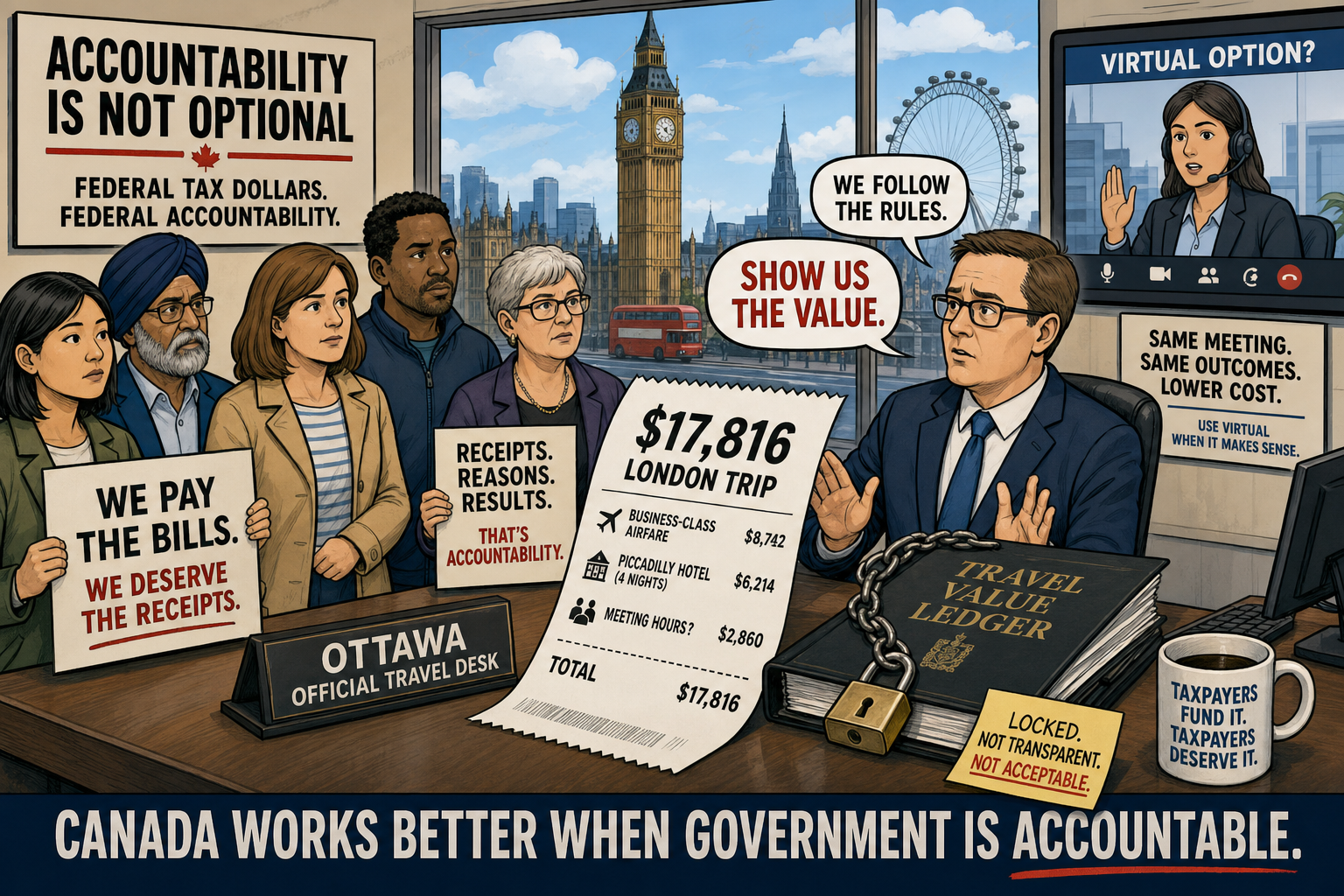
A reported $17,816 taxpayer-funded London trip by Canada’s former Special Representative on Combatting Islamophobia deserves a plain public ledger. Blacklock’s reported October 5 that Amira Elghawaby billed taxpayers nearly $18,000 for a business-class trip to England to “define Islamophobia,” including a $2,947 stay at a four-star hotel in Piccadilly. Rebel News, citing Blacklock’s access-to-information reporting, put the total at $17,816 and reported $10,522 in business-class airfare.
This should not be reduced to a fight over whether anti-Muslim hatred exists. It does. The federal government created the office after community calls following deadly attacks on Canadian Muslims, and Ottawa’s own annual report says the office advised government, encouraged public education and engaged stakeholders. Elghawaby resigned in February 2026, with Canadian Heritage thanking her for service as the first Special Representative. None of that removes the taxpayer question.
According to Rebel’s summary of the records, the four-day London visit was to address a private British working group developing a definition of Islamophobia and anti-Muslim hatred. The records reportedly described discussions about terminology, the relationship between Islamophobia and racism, and how definitions influence government policy. They did not specify how many hours of the four-day visit were spent meeting with the five-member working group.
That missing detail is the whole story. Definitions used by government can affect workplace rules, grants, public-sector training, policing advice, speech debates and institutional policy. If Canadian taxpayers funded in-person participation abroad, they deserve to know what was gained that could not have been achieved by secure video conference, written submission or a lower-cost itinerary.
The travel rules make the value-for-money question sharper, not weaker. Treasury Board says the National Joint Council Travel Directive governs reimbursement of reasonable expenses for government business. The directive says travel mode should be selected based on cost, duration, convenience, safety and practicality; for international travel, it also says economy is the standard, while business class is authorized where continuous air travel exceeds nine hours. If business class was permitted, publish the approval record. If personal attendance was required, publish the reason.
The Carney government should release the travel-value ledger: the invitation, approval memo, fare comparison, hotel justification, itinerary, meeting hours, attendee list, briefing notes, trip report, deliverables, follow-up emails and any Canadian policy output that used the trip. It should also disclose whether virtual participation was assessed and rejected.
No community is protected by hiding receipts. A serious anti-hate policy can withstand ordinary financial scrutiny. If Ottawa wants Canadians to trust sensitive policy-definition work, it should prove the trip bought measurable public value, not just an expensive seat at a private table in London.
- Blacklock’s Reporter: Bill $18K For Piccadilly Junket
- Rebel News: Elghawaby billed taxpayers $17,816 for London trip to discuss defining Islamophobia
- Government of Canada: Office of the Special Representative on Combatting Islamophobia annual report, 2024–2025
- Government of Canada: Statements on Ms. Elghawaby’s resignation
- Treasury Board / National Joint Council: Travel on government business and Travel Directive — international transportation
This article condemns anti-Muslim hate while demanding transparent, measurable value for taxpayer-funded travel tied to government policy-definition work.