The EV Rebate Fairness Ledger Ottawa Should Publish
A subsidy sold as affordability policy should not become a publicly funded discount for households already able to buy electric vehicles.
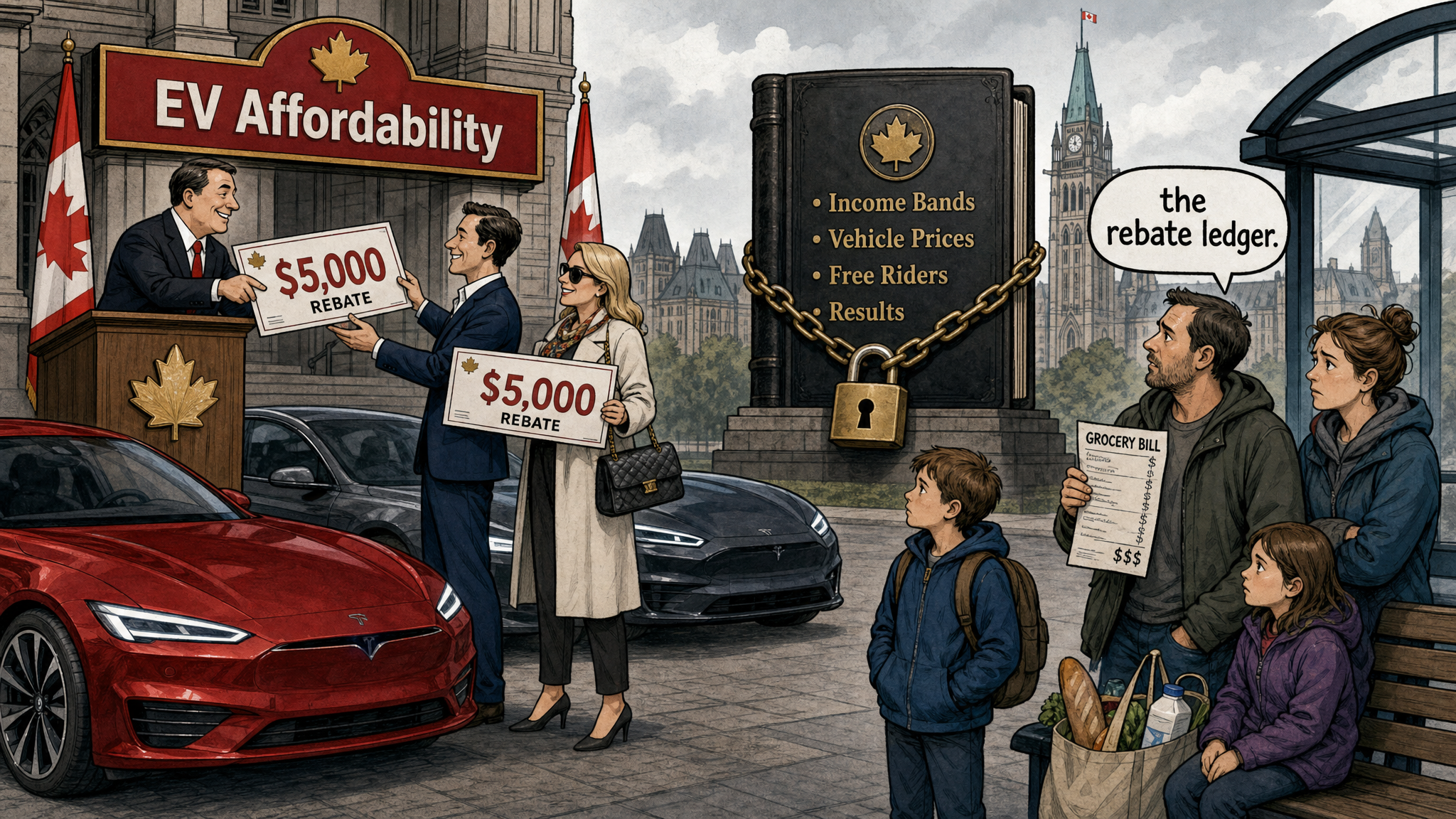
Ottawa’s electric-vehicle rebate story has a fairness problem. Blacklock’s reported October 5 that Transport Canada’s electric-car rebate program paid millions to affluent drivers, while only 5% of buyers using the rebate made under $50,000 a year. That headline is not just a partisan talking point. Transport Canada’s own evaluation points to the same basic imbalance.
The original Incentives for Zero-Emission Vehicles program was introduced in 2019 and offered up to $5,000 at the point of sale for eligible battery-electric, plug-in hybrid and fuel-cell vehicles. It was paused on January 12, 2025 because funds were depleted, then officially sunset on March 31, 2025. The program was meant to boost EV adoption, and Transport Canada says it contributed to uptake. But public money should be judged by who received it, what it changed, and whether the same result could have been achieved for less.
On that test, the income data should alarm taxpayers. Transport Canada says the 2024 internal recipient survey found most individual respondents who received the incentive and voluntarily completed the survey had household income over $100,000. Only 5% reported income under $50,000. For comparison, the same evaluation cites 2021 census data showing 27% of Canadian households below $50,000 and 40% above $100,000.
The evaluation also flags “free ridership”: people who received a subsidy but would have bought the product anyway. In the 2024 survey, 22.9% of individual recipients and 22.5% of organization recipients said they would have bought a zero-emission vehicle even without the incentive. That is not a rounding error. It is a warning that a broad rebate can spend scarce dollars subsidizing decisions already made.
Transport Canada’s own lesson learned is careful but clear: future ZEV incentives should consider more targeted approaches, including income testing, to improve uptake among lower-income individuals, promote affordability and reduce free ridership. That is exactly the conservative accountability point. If the goal is climate theatre, write cheques and count announcements. If the goal is measurable public value, target the dollars and publish the receipts.
The issue is live again because Canada.ca now lists a 2026 Electric Vehicle Affordability Program offering up to $5,000, declining thereafter, for eligible light-duty EVs with a final transaction value of $50,000 or less for vehicles made in free-trade countries, with no limit for Canadian-made EVs. Before Ottawa repeats the same mistakes under a new affordability label, Canadians deserve a full rebate ledger.
Publish the income bands. Publish the vehicle prices. Publish the manufacturer and country-of-assembly breakdown. Publish how many buyers stacked provincial subsidies, how many businesses claimed multiple incentives, and how many recipients said they would have bought anyway. If public money is buying emissions reductions, show the cost per tonne. If it is buying discounts for comfortable households, stop pretending it is affordability policy.
- Blacklock’s Reporter: Most Didn’t Need The $5,000
- Transport Canada: Evaluation of the iZEV and iMHZEV Programs
- Government of Canada: Electric vehicles — incentives
This article criticizes rebate design and transparency. It does not argue against electric vehicles; it argues that taxpayer subsidies should be targeted, measurable and publicly auditable.