Do Not Put Street-Crisis Footage on the Criminal-Code Track
A Liberal-sponsored petition is not a law. But its proposed remedy should set off every free-expression alarm in Ottawa.
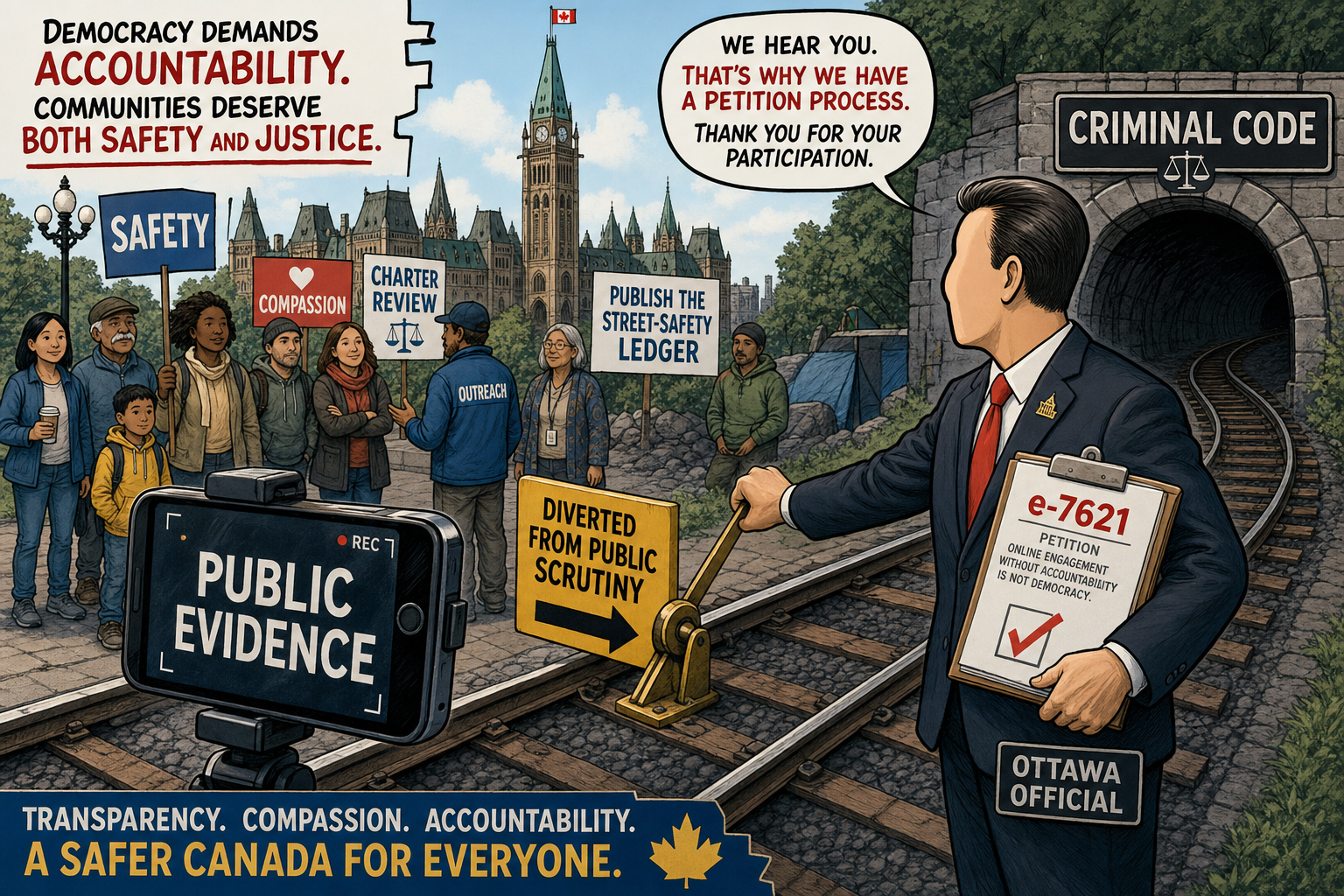
Petition e-7621 is real, and the distinction matters. The House of Commons record says the Justice petition opened for signature on September 10, 2026 and remains open until January 8, 2027. It identifies Liberal MP Arielle Kayabaga of London West as the member attached to the petition record, and the official page showed 690 validated signatures when reviewed today.
What the petition asks for is not small. It calls on the Government of Canada to create a new Criminal Code provision making it an offence to knowingly record, in public, a person the recorder knows is experiencing a “prescribed circumstance of significant vulnerability” for the purpose of publishing or distributing that recording to the public. The listed circumstances include homelessness, a mental-health crisis, significant impairment from alcohol or drugs, and other prescribed vulnerability.
Start with compassion. People in crisis are not props. No decent country should celebrate humiliation videos, exploitation, doxxing or predatory content aimed at people who are homeless, impaired, ill or fleeing violence. The petition’s stated concern for dignity and safety deserves to be read fairly.
But compassion cannot become concealment. Public recording is also how Canadians document assaults, disorder, unsafe transit, encampment conditions, police response, service failures, public spending failures and the visible consequences of housing and addiction policy. A broadly framed criminal offence could chill residents, journalists, victims, business owners and outreach workers before Parliament has even published the housing, treatment, policing, bail and shelter-capacity ledger.
That is the conservative accountability problem: Ottawa should fix the street crisis, not criminalize evidence of it. If the Liberal answer to visible disorder is a Criminal Code proposal aimed at cameras before a measurable public-safety plan, Canadians are entitled to ask whose comfort is being protected — vulnerable people’s dignity, or political leaders’ reputations.
There is also a legal-process problem. This is not a bill, not an enacted offence and not a current filming ban. Source checks have correctly warned against overstating it. But a petition can still reveal policy appetite, and this one raises obvious Charter, journalism, public-interest, consent, evidence-preservation, incidental-capture and victims’ rights questions.
Before any minister, caucus or department advances this idea, publish the ledger: the Charter analysis, privacy rationale, exemptions for journalism and public interest, safeguards for victims documenting crime, treatment and shelter capacity metrics, crime and disorder data, and evidence that existing harassment, voyeurism, privacy and civil remedies are inadequate. Protect dignity, yes. Hide failure, no.
Canada needs fewer politicians trying to manage optics and more officials willing to be judged by outcomes. If Ottawa wants to help vulnerable people, it should make streets safer, treatment more available and shelters more accountable. The camera is not the crisis. The crisis is the policy failure the camera keeps revealing.
- House of Commons e-petitions: Petition e-7621 — Protection for vulnerable individuals’ privacy
- Canadian Petition Tracker: e-7621 signature tracking
- Rebel News commentary: Hamilton resident attacked as Liberal MP petition draws criticism
- Western Standard: Liberal MP sponsors petition to criminalize filming homeless people, addicts in public
- Pureblood Canadians source check: Filming homelessness: a real petition, not a new Canadian law
This article treats e-7621 as a petition requesting government action, not as enacted law. It criticizes the proposed policy direction while recognizing the legitimate dignity and safety concerns raised for vulnerable people.