Buy Canadian Means Publish the Contract-Control Ledger
A slogan is not a procurement policy. If Ottawa says it is buying Canadian, Canadians deserve to see who ultimately controls the companies getting paid.
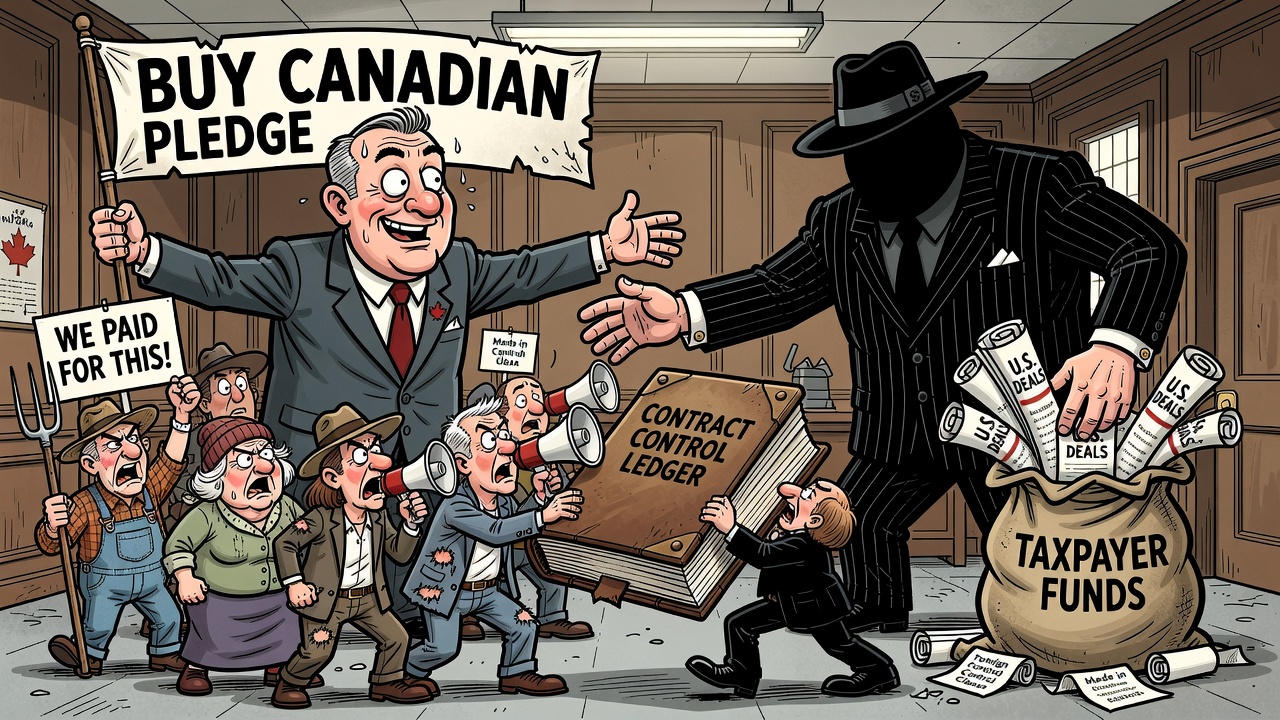
Prime Minister Mark Carney’s “Buy Canadian” pitch sounds simple: use federal purchasing power to strengthen Canadian workers, Canadian firms and Canadian supply chains. That is a defensible goal. The problem is that Ottawa’s contract ledger appears far less simple than the slogan.
The Toronto Star reported on October 5, 2026, that since Carney’s pledge, roughly $7.8 billion in federal contracts have gone to American-controlled corporations. The largest listed recipient in the Star’s analysis was IBM Canada, at more than $1.5 billion, followed by major U.S.-controlled names including Microsoft, L3Harris, General Dynamics Land Systems and Amazon.
That does not prove every contract was improper. Some work may be specialized. Some defence and technology purchases may have limited domestic alternatives. Some Canadian subsidiaries employ Canadian workers, pay Canadian taxes and perform work here. But none of that excuses a government from showing its math. If a Canadian-branded subsidiary is ultimately controlled elsewhere, taxpayers should know what was Canadian about the award: labour, intellectual property, assembly, subcontractors, data hosting, sustainment, ownership or merely the letterhead.
This is where conservative accountability matters. A “Buy Canadian” standard should not become a communications shield for the same old procurement culture: opaque exemptions, giant incumbents, bundled contracts and after-the-fact explanations. Ottawa’s own proactive-disclosure portal publishes contracts over $10,000 and amendments over $10,000, but it is not enough to dump rows of supplier names and values while leaving beneficial ownership, Canadian-content scoring and waiver reasons scattered or invisible.
The Carney government should publish one plain table for every post-pledge award to a foreign-controlled firm. It should list the contract ID, department, value, amendments, ultimate parent company, country of control, Canadian-content score, subcontractors, security classification where releasable, sole-source or competitive status, exemption rationale and the name of the official who signed off. If national security requires redactions, publish the reason and the aggregate totals.
There is also a fairness issue. Smaller Canadian firms cannot compete with global giants if Ottawa’s rules reward scale first and explain “Canadian” later. If the Liberals want credit for economic nationalism, they must accept the discipline that comes with it: transparent criteria before the contract, not patriotic branding after the award.
Buying Canadian should mean more than buying from a Canadian mailing address. It should mean a measurable Canadian benefit that survives public scrutiny. Until Carney publishes the contract-control ledger, Canadians should treat the pledge as unproven.
- Toronto Star: PM Mark Carney pledged to “Buy Canadian.” Since then, $7.8 billion in contracts went to American corporations
- Government of Canada: Search Government Contracts over $10,000
This article criticizes procurement transparency and federal political messaging. It does not allege that every listed contract was unlawful or unnecessary.